NELA EGGENBERGER ON SOPHIE THUN
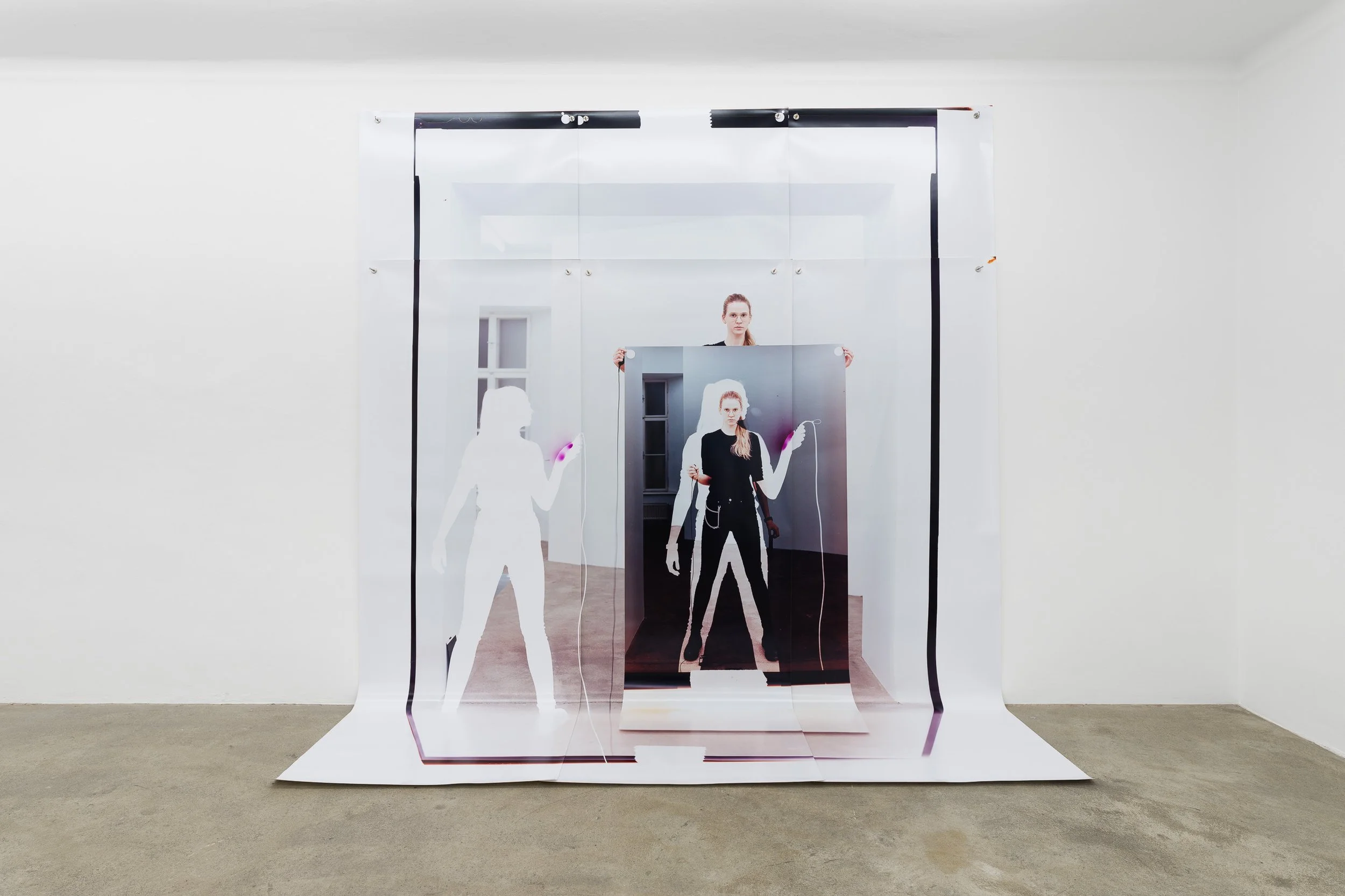
Sophie Thun, While Holding (passage closed) (Y110,8M17,4D+59F8m18,142CA3T69,2b100|249), 2018. Analogue colour photography, photogram, metal and magnets. From Sophie Thun, Double Release, exhibition view, SOPHIE TAPPEINER, 2018. Courtesy the artist & SOPHIE TAPPEINER. Copyright Maximilian Anelli-Monti.
Afterimage by Nela Eggenberger:
We are overloaded with images—especially as editors—seeing hundreds, if not thousands of pictures every week. Accepting the invitation to slow down in this endless stream of photographs the question is: which ones really stay in our minds?
This specific self-portrait by Sophie Thun has been haunting me for a while, in a positive manner. It’s documented in the artist’s gallery in Vienna, and is multilayered in many ways. Above all, it’s clearly constructed: What we’re looking at is an installation, consisting of six different photographic prints. The prints depict two photograms of the artist’s own body, shown as white shapes fixed on the light-sensitive surfaces themselves. In doing so the artist creates an aura (see center) while these figures are also referencing the layers of (production) time. The fact that the artist is presenting a print of her own image further multiplies of her own body (and layers of image-making).
The work captures an emancipatory act—she’s very much the author here, owning her own portrait. The cable release in her hand emphasizes that she is the one creating this image. It’s an interplay between subject and object, because in photography—and in the fine arts more generally—women are often positioned as the object, exposed to the male gaze. Thun cleverly evades this by presenting blank photograms of herself. Here, a woman clearly flips that power dynamic, showing us her empowerment. Her wide stance, direct gaze and the powerful fist further reinforces this. The fact that the artist is depicted life-size makes her feel incredibly present.
I love how the artist plays with the photographic image in all its facets, thus challenging our perception of seeing in multiple ways.
Afterimage is an ekphrastic series about that one image you see when you close your eyes, the one still lingering in your mind. We invite artists and writers to reflect on an image they can't shake. This column has been a part of Objektiv since our very first issue, originally titled Sinnbilde in Norwegian. As the sea of images continues to swell, the series explores which visuals linger and take root in today's endless stream—much like a song that plays on repeat in your head. Whether it's an image glimpsed on a billboard, a portrait in a newspaper, a family photo from an album or an Instagram reel, we're interested in those fleeting moments that stay with you and refuse to let go.