MATTHEW RANA ON ROBERT HEINECKEN

From Robert Heinecken's series Are You Rea (1964-68)
Afterimage by Matthew Rana:
Seduction belongs to artifice. It's a play of surfaces and transformation, disappearance and gestural veils. In other words, seduction is fleeting and mysterious, it takes what's visible and licks it with falsity. On a different register, pornography might be pure allegory: forced over-signification verging on the baroque. With its graphic disclosures, pornography points to an external logic, an invisible power that determines what can be seen. More simply put, it leaves nothing to the imagination.
Unlike his more libidinally charged works that actually make use of pornographic imagery, Robert Heinecken's series Are You Rea (1964-68) seems to negotiate the tension between these two poles. In the 25 photograms, magazine pages featuring advertisements for products such as cosmetics, cigarettes, lingerie and spaghetti, are juxtaposed with images of police violence, protests and photo essays on reproductive rights. Layering image on top of image, recto and verso are flattened, so to speak, onto a single surface. The compositions are chancy and ironic; everything is inverted and continuity and scale are confused Often full of sex appeal, the images in Are You Rea also indicate a loss of coherence, a figuration that is ghostly and at times grotesque. But despite all their violence, fragmentation and internal dissonance, they seem less about critique or defamiliarization than they do correspondences. Because if archives create the illusion of totality by making gestures of equivalence between things archived (i.e., between an ordered multiplicity of things, indexed and gathered together to be read as a single entity), Heinecken's series is archival in that it suggests a deep and dark unity.
I think this might be part of why his work still looks so fresh to me, especially the photograms. It's their insistence on materiality and distribution. What I find across the multiple surfaces, in the patterned utterances and the vulgar repetitions, is not the reality that's hidden behind appearances. Rather, it's the spatialization of circulatory and temporal relationships, of reading and discourse. If speech takes place at the intersection of material and social forces, then this is how the archive surfaces – a shifting assemblage of contradictory and inconclusive statements – iterative, synthetic, hardcore.
LAARA MATSEN ON HARRISON SCHMITT
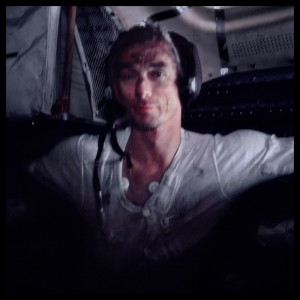
Commander Eugene Cernan After Three Days of Lunar Exploration. Photographed by Harrison Schmitt, Apollo 17, December 7-19, 1972, Michael Light, Full Moon. Transparency NASA © 1999 Michael Light
Afterimage by Laara Matsen:
Taken by fellow astronaut Jack Schmitt as a sort of snapshot, and part of NASA’s extensive and wonderful archive of space imagery, this photograph is of Gene Cernan, Commander of Apollo 17, the last man to walk on the moon. I came upon it years ago, hanging on the wall at the Museum of Natural History in New York, and it resonates with me still. A man at work, covered in moon dust, exhausted and seemingly content, the image speaks to me of the quieter side of grand adventure. Exploration of the unknown is a romantic and exciting notion by nature, and one that led me to photography (among other endeavors) in the first place, but I am especially taken and moved by the less romantic aspects of exploration: the grit of the moon dust. This is a photograph taken after a significant event has occurred, post-climactic. I am often compelled by images of such after-moments, the almost forgotten underbelly of the “main attraction”. While the factual situation documented is anything but common (gunpowder-scented moon dirt clinging to skin, walking in space, probing into mysterious and dangerous territory), there is also something immensely accessible and intimate in this photograph. The simplicity of the moment is at once direct, calm, mundane and ephemeral.