ISA GENZKEN

A spread from Isa Genzken’s Mach Dich Hubsch!
Afterimage by Jenny Kinge:
It was with great anticipation that I walked up the stairs of the Martin-Gropius-Bau, the solemn building on the former border between East and West Berlin that hosted Isa Genzken’s exhibition Make Yourself Pretty! As I wandered through the comprehensive collection of the German artist’s sculptures and installations, with their wide-reaching cultural references, I was taken by surprise by a re-encounter with a long-forgotten idol of mine.
The photo of Leonardo DiCaprio, with his slick hairstyle and cute smile, bound up with sticky tape and juxtaposed with bold colours and elements containing the word DUDE, was part of a rich collage unfolding over the many pages of Genzken’s diaristic book Mach Dich Hubsch!
My crush on Leo had manifested itself through the posters, diaries and magazines I bought in the late 1990s, all furnished with his smiling face. My re-encounter with the young movie star stirred up many memories. When facing the image through the glass vitrine, I felt as if I’d been caught red-handed: the work reminded me how I had wholeheartedly worshipped this dandy as a young girl. I didn’t reflect upon the consumerist aspect of this ‘love affair’ at the time. The material culture crept up from behind, as it still does – my identity is unintentionally affected by my acquisition of things.
I left Martin-Gropius-Bau with a new crush that day – not on Leo, but on the eye-opening work I’d just seen.
FRIDA ORUPABO
Afterimage by Ruby Paloma:
I first saw Frida Orupabo’s work last year in Arthur Jafa’s exhibition A Series of Utterly Improbable, Yet Extraordinary Renditions at the Julia Stoschek Collection in Berlin. I have carried Frida’s Untitled (2018) with me since. I have been searching for a means to contribute to the nearly invisible topic of race in the visual art discourse in Norway and Frida’s work struck me at the exact right moment.
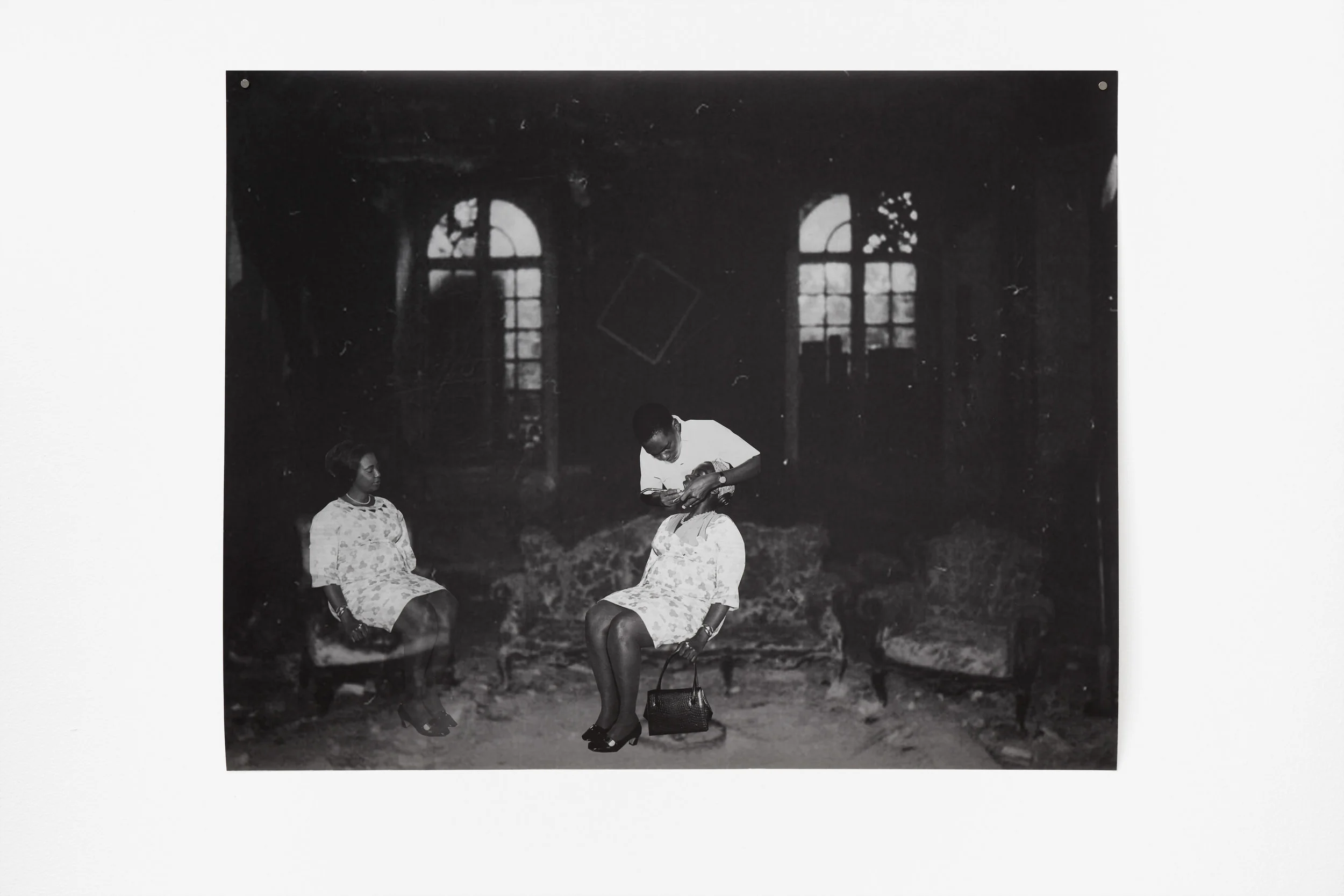
Frida Orupabo, Untitled, 2018, digital C-print, 89 x 105 cm, Courtesy of Galerie Nordenhake and the artist.
I don’t care for Instagram so I was relatively late to discover the work of @nemiepeba. I had no idea Frida was Norwegian, and that she lives about 300 metres away from me in Oslo. She is half Nigerian, like myself. I was stunned. Not because another Norwegian-Nigerian woman with a cultural agenda lived nearby, but because one of this country’s most significant contributors to Blackness in visual culture had been right under my nose for some time. I had never heard anyone talk about Frida, never seen her work included in a show nor seen her at an opening. It seemed that Frida’s almost unbelievable path to international fame had gone unnoticed to most in the Oslo art scene; Arthur Jafa’s crucial advocacy for Blackness, and use of Instagram, was in other words decisive for her breakthrough.
The role that a digital platform has played in disseminating Frida’s work (and her discovery) can be argued to be a democratisation of hierarchies in the art world, but it seems less relevant to me as @nemiepeba had little effect on the local audience, even more so because I first saw Frida’s work as enlarged collages; collage being the only thing I am certain about in the search for an expression for Blackness in Norway. Formally emerging from the philosophy of Dada artists and their distrust of rationalism and the order of civilisation, collage seems naturally suited to re-build social structures, comment on racial hierarchies, politics and culture, and display the complexity and nuances of a dispersed identity.
Frida’s digital collage of two black women and a black male dentist in a manor house combines WTO vintage photographs from Uganda (c.1970s) with Nona Limmen’s “Photogenic 18th century mansion captured on Polaroid”. For years, Frida has created an archive of images found online and used it as the basis for her digital and physical collages. She is interested in how we see things: race, sexuality, gender, family relations and motherhood, and by combining images that are not meant to be together, she challenges how we understand and talk about the arrangement of things. In Untitled it is unclear which bodies and actions belong where and when. Do black bodies (not) belong in (abandoned) mansions? Does the work of a black dentist belong there? The women are similarly dressed with identical shoes and bracelets and their dresses have the same pattern. How many times have I not been mistaken for someone with the same skin colour as myself?
The art of Frida Orupabo, both on and off Instagram, is of tremendous importance in promulgating Blackness in Norway. The lack of visible focus on the topic makes it seem like no one is working on it, making it harder to locate each other and start the discourse that will help build an identity around being brown or black in Norway today. Luckily, the Norwegian art institutions have now noticed her, and she is opening her first solo exhibition in Norway at Kunstnerens Hus on 1 March 2019.
PATRIK RASTENBERGER

Patrik Rastenberger, from the series Küme Mogñen – a healthy mind in a healthy land, 2018
Afterimage by Anna-Kaisa Rastenberger:
Two photos of destruction occupy my mind. They show no corpses, blood, gestures of desperation, or homes in ruins. Instead, the destruction takes the visual form of a landscape, with the reference imprinted in a surface pattern or abstraction across time. This photographic method could be even termed ‘aftermath photography’: the photos abstract from the traumatic historical events taken as subject matter. In both cases, the photographer has arrived on the site years or decades after the conflict.
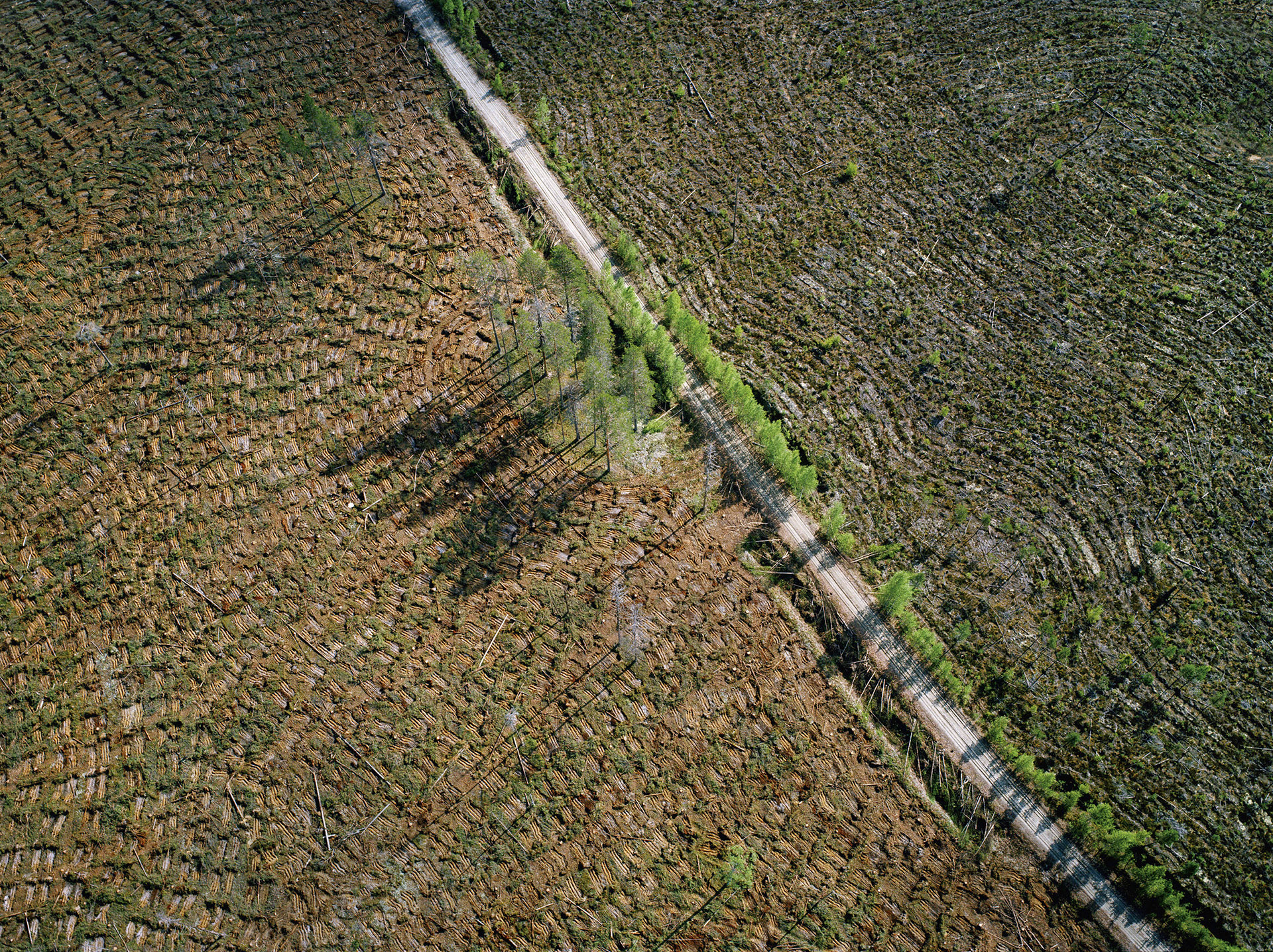
Ritva Kovalainen & Sanni Seppo, Sateenkaarenpää (The end of the rainbow), 2007/2019
In the photo by Patrik Rastenberger eucalyptus trees are planted where a natural forest once stood. Eucalyptus forests grow rapidly, and the wood is ready for harvest every 10–15 years. That makes them attractive in places such as Chile, where this photo was taken. Here, eucalyptus is an invasive species supplanting natural forests. The leaves that fall from eucalyptus trees are acidic, killing the species-rich undergrowth as they decompose. Also, they need vast amounts of water, so the area grows drier and habitats change. Such overexploitation of resources and cultivation of nonnative species at the expense of variety are among the greatest factors in erosion of biodiversity. Biodiversity involves genetic development of the species tapestry over time, into rich and resilient ecosystems, and it is often measured in the species count: 1 in this photo.
The second image was captured by photographers Sanni Seppo and Ritva Kovalainen, long-time forest activists in Finland: Photography is their main weapon against state forest policies that entail a shift from natural forests’ diversity to managed ‘fields of wood’. Their long-term projects have investigated clearcutting of natural forests and its effects at ecosystem level, in how both biodiversity and human lives suffer. Such images portray another face of climate change and habitat destruction/fragmentation: we zoom out to sterile manmade lines, stark patterns in biodiversity’s decline.
Both photos represent forests, but they do far more when read in the context of reduction of biodiversity. They are two ways of answering the question I pose of how to visualise lost diversity and richness, now replaced with a diversity-poor monotone. How can we show the absence of thousands upon thousands of species, which once inhabited these forests and composed a rich ecosystem? The invisible massacre in our environment.
The battle over knowledge and its control and distribution has become a defining development of our time. However, the question about photography is an old one: how photos visualise something that cannot be seen and, further, how we read in them something that is absent.
STEIN RØNNING

Stein Rønning, ROUTHE II, 2014. Lightjet on paper, 86 x 63 cm. Courtesy the artist and Galleri Riis.
Afterimage by Kåre Bulie:
Why am I so enthusiastic about Stein Rønning’s photographs of boxes that I just never forget them? Since 2008, I’ve followed, with a growing fascination, the development of these images moving from one exhibition to another – in Arendal, in Oslo, in Kristiansand, and once again in the Norwegian capital. I’ve also written about them on several occasions. When Objektiv asked me to contribute to the "On my mind”-column, Rønning’s “object photographs”, which the artist himself has called them, were the first pictures that came to my mind, even if it’s been a while since I’ve seen them outside of the internet.
For those who don’t know them, these works might seem dry, almost evasive in their ascetic elegance. For whoever gives them time and attention, there is much to discover and reflect further upon.
The creation process is complicated: The artist, originally known as a sculptor, and who still exhibits physical sculptures in addition to the photographs, first makes the boxes. He then places them together in continually changing combinations and photographs them. The photographs Rønning presents are also processed digitally – the same box can, for example, be seen in several places in one and the same photograph. Under changing titles, throughout more than a decade, the artist has worked with what is fundamentally the same project. There is nonetheless variation: in colouring, scale, composition, and the creation of space. Some of the photographs give associations to painting and consequently open for reflections on a third medium.
I think my enthusiasm for these images has to do with how they bring together so much of what interests and excites me. First of all, there is something arch-modernistic about the universe of forms in Rønning’s works, which mobilizes my fascination for the entire history of modernism. Secondly, the box project is an example of an art that is exciting to look at and interesting to think about at the same time – visually striking and intellectually stimulating in equal measures. This is not at all an obvious combination in this day and age. Third of all, these motifs have something markedly architectonic about them, which agrees especially well with someone who has always had parallel interests in visual art and architecture. The Rønning photographs steer the thoughts both to the adults’ Manhattan and to children’s building blocks. Like many of his modernist colleagues, in his art, Stein Rønning points at the potentially great significance of the small difference – and at the richness that reduction and concentration can lead to.
TOM SANDBERG
I am driving his car.
Somewhere, in the midst of those dark Scandinavian woods,
I pull over to the side of the road and make a complete stop.
In the rear view mirror I see him on the shoulder, camera in hand.
I am driving his car.
Somewhere, in the midst of those dark Scandinavian woods,
I pull over to the side of the road and make a complete stop.
In the rear view mirror I see him on the shoulder, camera in hand.
Before I have had the chance to rummage through the glove compartment for another song, he is back, and we speed off.
We speed off through the pines, leaving the sunset behind.
Afterimage by Morten Andenæs:

I am driving his car.
Somewhere, in the midst of those dark Scandinavian woods,
I pull over to the side of the road and make a complete stop.
In the rear view mirror I see him on the shoulder, camera in hand.
Before I have had the chance to rummage through the glove compartment for another song, he is back, and we speed off.
We speed off through the pines, leaving the sunset behind.
meet me in the morning*
My foot presses down. We accelerate.
A small country road. 90. 110. 130.
I want to let go. To simply let go of the wheel.
See what happens.
they say the darkest hour, is right before the dawn / they say the darkest hour, is right before the dawn*
An incline. In the distance, a clearing.
Anticipation.
My hand releases its grip on the wheel and rests heavily on my thigh. The leg is forced down. Car speeds up.
At the top of the hill we come out through the pines onto a straight stretch of open road.
A gash through the landscape.
The volume is turned up.
We come out onto a stretch of open road and I let go.
I let go of the wheel and close my eyes. I close my eyes as the man on the radio bellows out the last lines of the song.
look at the sun, sinking like a ship / look at the sun, sinking like a ship*
A black and white photograph.
Black and white in name only.
An endless array of grey dots really renders a house set amidst trees.
Well. House implies home, and a home welcomes us. This is no home. A dwelling at best.
Shelter in any case.
A scene seen from a distance, from the shoulder of the road perhaps.
The black house I'm describing from memory emits no light, reflects nothing.
No hope there, no refuge.
No mirror to bask in.
We are pulled in. Pulled in by the force of gravity, by the gravity of the situation at hand.
Lures, and promises never to be fulfilled.
The house is a black hole toying with our expectations of what might be revealed in that ever expanding field of darkness.
A black hole threatening to engulf everything in its vicinity.
Just like his puddles.
Just like him
We step back.
Without this, and without that we are taken aback.
He takes his leave, leaving it up to us.
A here, there and then, where he once was.
Just an image.*
Untitled, dimensions vary.
A house, or shelter in any case.
He knows. That is, he knew.
In front of this picture, or the memory of this picture, I too know.
I know something.
A certainty beyond words.
Beyond or before them..
Morten Andenæs is an artist and writer. He worked as an assistant to Tom Sandberg from 2005 to 2006 and is co-curating the TOM SANDBERG: VIBRANT WORLD exhibition at Henie Onstad. This text was written for the launch of Objektiv #11, which accompanied the Tom Sandberg exhibition Diptych at Kunstnernes Hus in 2015.
* (1,2 and 3): Bob Dylan, 'meet me in the morning',
* (4): Jean Luc Godard.
ROBERT HEINECKEN

From Robert Heinecken's series Are You Rea (1964-68)
Afterimage by Matthew Rana:
Seduction belongs to artifice. It's a play of surfaces and transformation, disappearance and gestural veils. In other words, seduction is fleeting and mysterious, it takes what's visible and licks it with falsity. On a different register, pornography might be pure allegory: forced over-signification verging on the baroque. With its graphic disclosures, pornography points to an external logic, an invisible power that determines what can be seen. More simply put, it leaves nothing to the imagination.
Unlike his more libidinally charged works that actually make use of pornographic imagery, Robert Heinecken's series Are You Rea (1964-68) seems to negotiate the tension between these two poles. In the 25 photograms, magazine pages featuring advertisements for products such as cosmetics, cigarettes, lingerie and spaghetti, are juxtaposed with images of police violence, protests and photo essays on reproductive rights. Layering image on top of image, recto and verso are flattened, so to speak, onto a single surface. The compositions are chancy and ironic; everything is inverted and continuity and scale are confused Often full of sex appeal, the images in Are You Rea also indicate a loss of coherence, a figuration that is ghostly and at times grotesque. But despite all their violence, fragmentation and internal dissonance, they seem less about critique or defamiliarization than they do correspondences. Because if archives create the illusion of totality by making gestures of equivalence between things archived (i.e., between an ordered multiplicity of things, indexed and gathered together to be read as a single entity), Heinecken's series is archival in that it suggests a deep and dark unity.
I think this might be part of why his work still looks so fresh to me, especially the photograms. It's their insistence on materiality and distribution. What I find across the multiple surfaces, in the patterned utterances and the vulgar repetitions, is not the reality that's hidden behind appearances. Rather, it's the spatialization of circulatory and temporal relationships, of reading and discourse. If speech takes place at the intersection of material and social forces, then this is how the archive surfaces – a shifting assemblage of contradictory and inconclusive statements – iterative, synthetic, hardcore.
HARRISON SCHMITT
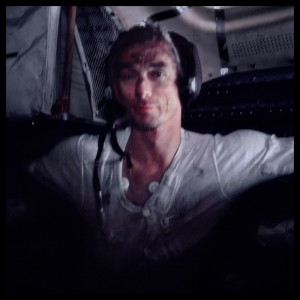
Commander Eugene Cernan After Three Days of Lunar Exploration. Photographed by Harrison Schmitt, Apollo 17, December 7-19, 1972, Michael Light, Full Moon. Transparency NASA © 1999 Michael Light
Afterimage by Laara Matsen:
Taken by fellow astronaut Jack Schmitt as a sort of snapshot, and part of NASA’s extensive and wonderful archive of space imagery, this photograph is of Gene Cernan, Commander of Apollo 17, the last man to walk on the moon. I came upon it years ago, hanging on the wall at the Museum of Natural History in New York, and it resonates with me still. A man at work, covered in moon dust, exhausted and seemingly content, the image speaks to me of the quieter side of grand adventure. Exploration of the unknown is a romantic and exciting notion by nature, and one that led me to photography (among other endeavors) in the first place, but I am especially taken and moved by the less romantic aspects of exploration: the grit of the moon dust. This is a photograph taken after a significant event has occurred, post-climactic. I am often compelled by images of such after-moments, the almost forgotten underbelly of the “main attraction”. While the factual situation documented is anything but common (gunpowder-scented moon dirt clinging to skin, walking in space, probing into mysterious and dangerous territory), there is also something immensely accessible and intimate in this photograph. The simplicity of the moment is at once direct, calm, mundane and ephemeral.