SHAHRZAD MALEKIAN
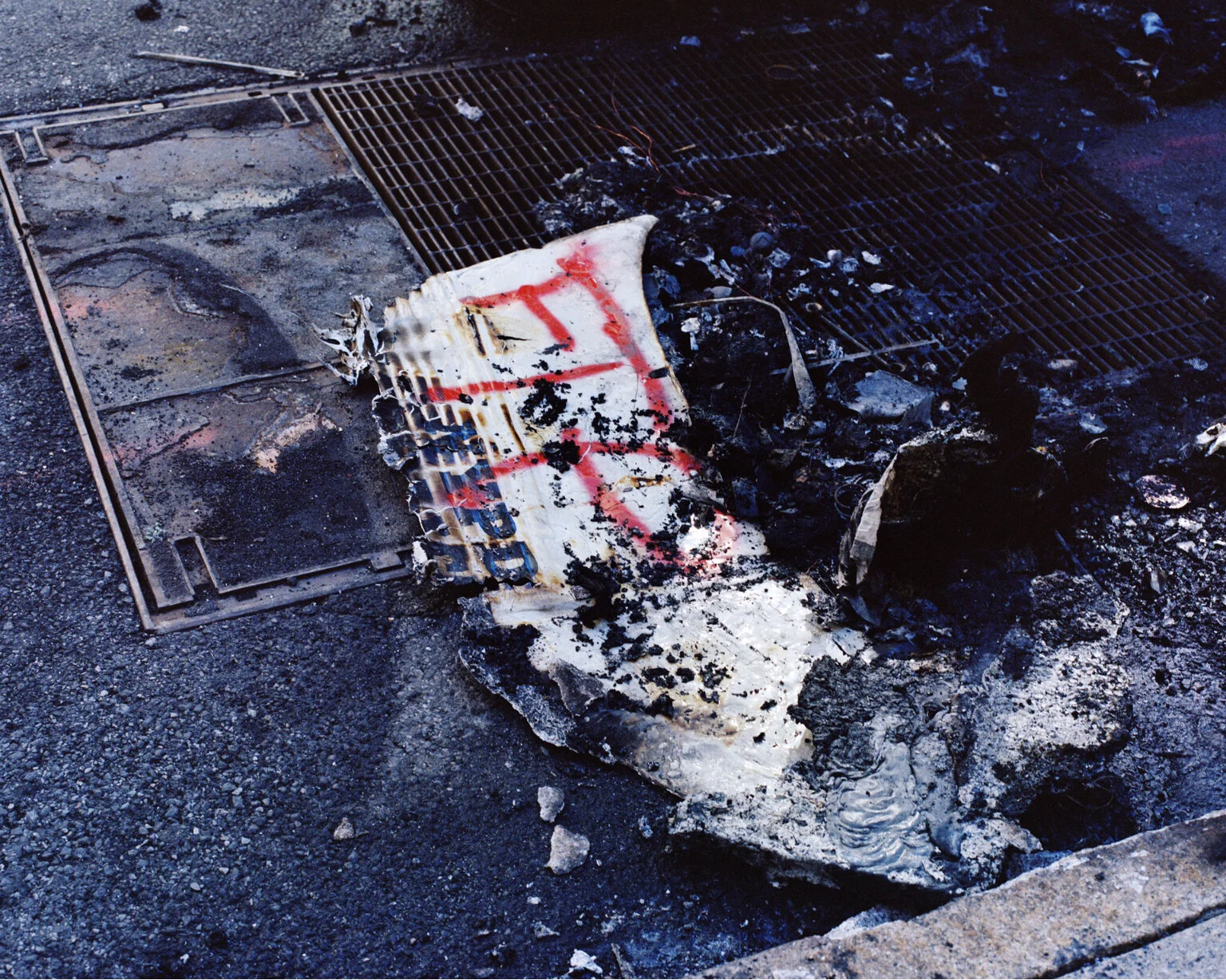
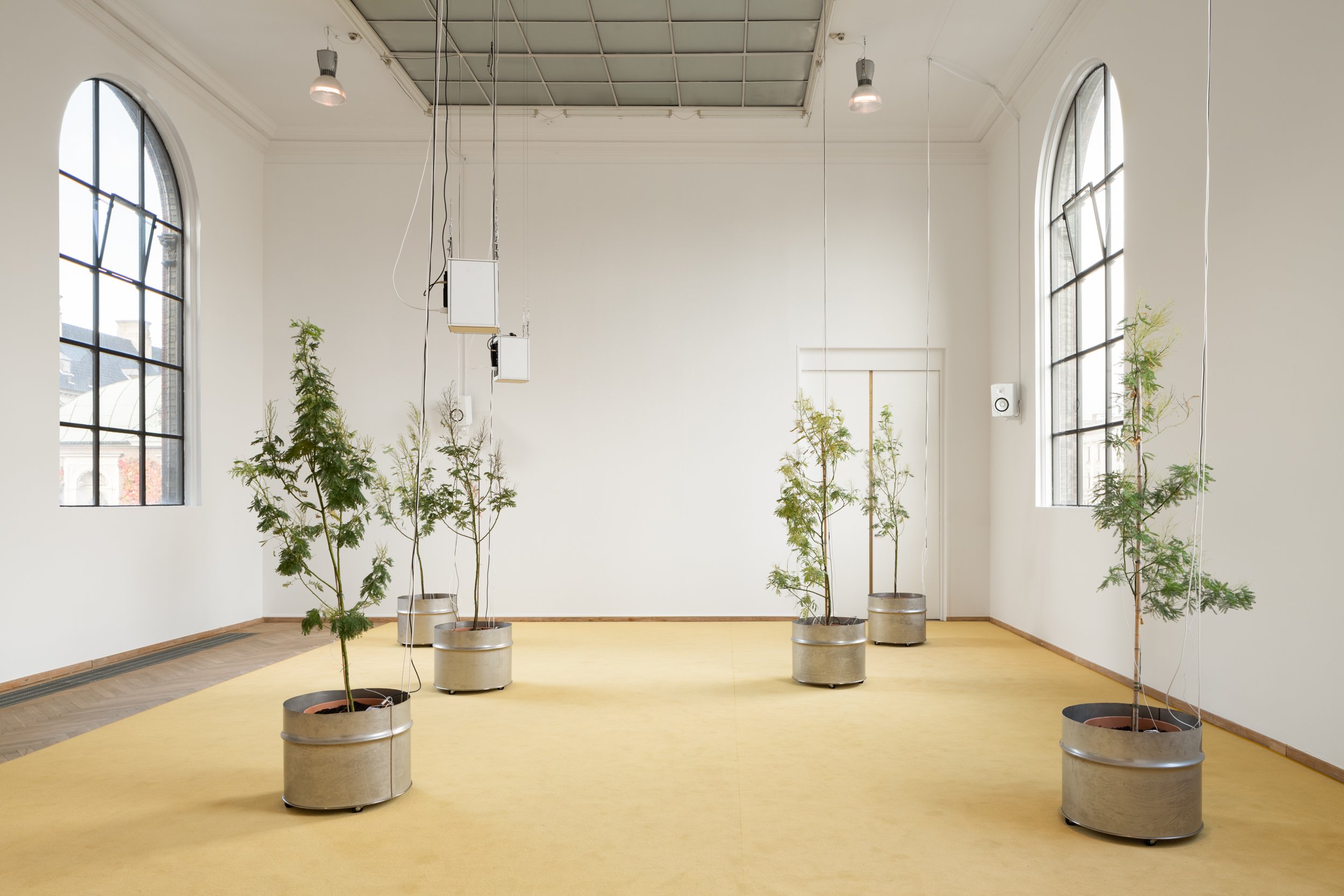
This is my pop-up sculpture and installation in public spaces. It operates at the intersection of the natural and the human-made. Plants, moss and fungi become entangled with the body of the sculpture and creating a continuously evolving and living sculptural form. For me, this is a perfect symbol for the current situation which is happening around the world, and my contribution to this series. I want to remind the audience of the urgency of rethinking our relationship with non-human forms of living.

MOHAMED BOUROUISSA
Afterimage by Nina Strand:
The couple in the café next to me are either on their first date or their last. It’s difficult to know if they’re shy or bored with each other. They’ve been discussing a friend. I’m hoping he’ll never hear their opinions on how sadly he leads his life. I’m on time and happy for the entertainment these two bring while I wait. My friend arrives late. I still suggest we have a glass wine before we go in, it’s been so long. But he’s in a rush and so I quickly gather my things. He doesn’t look me in the eye.
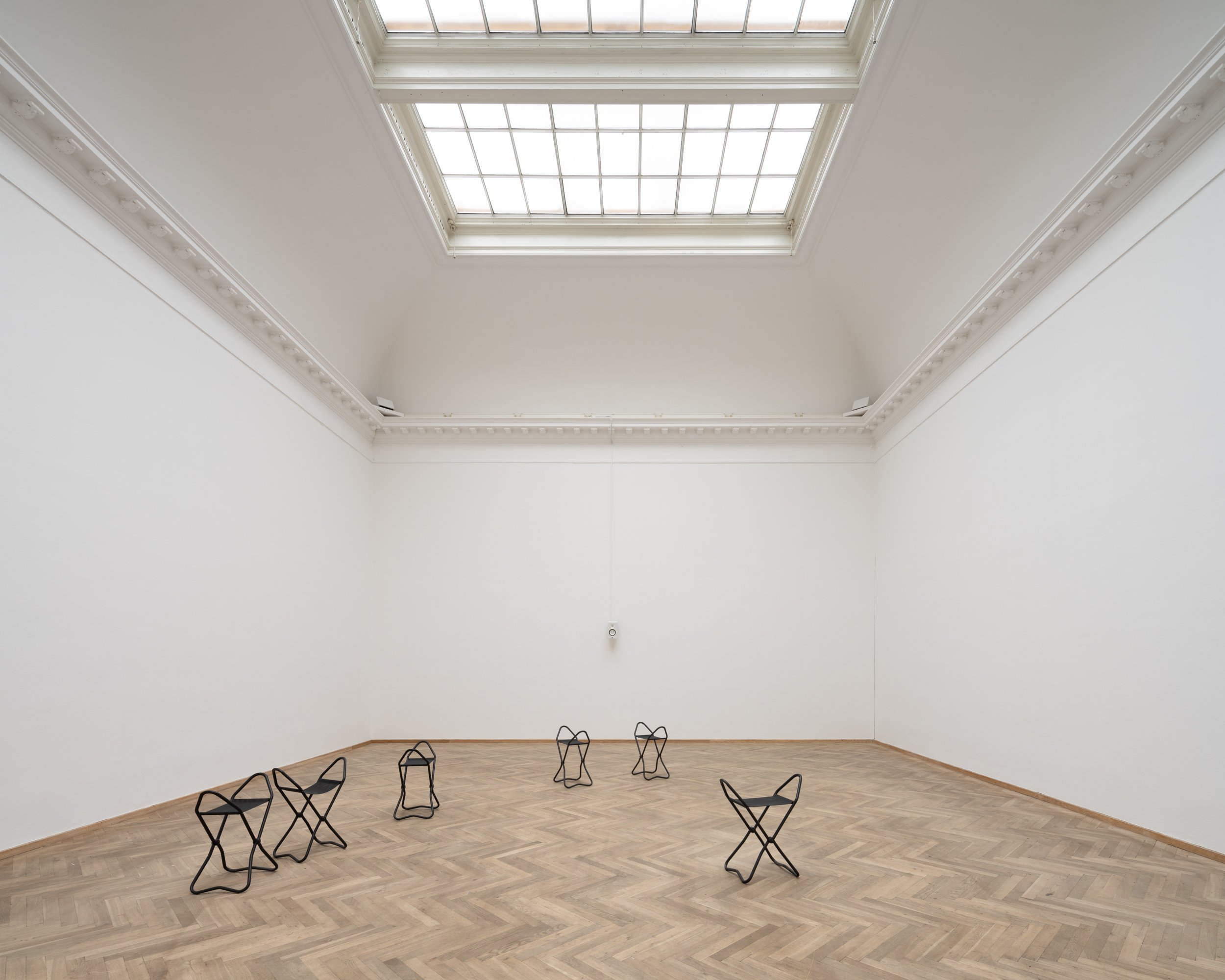
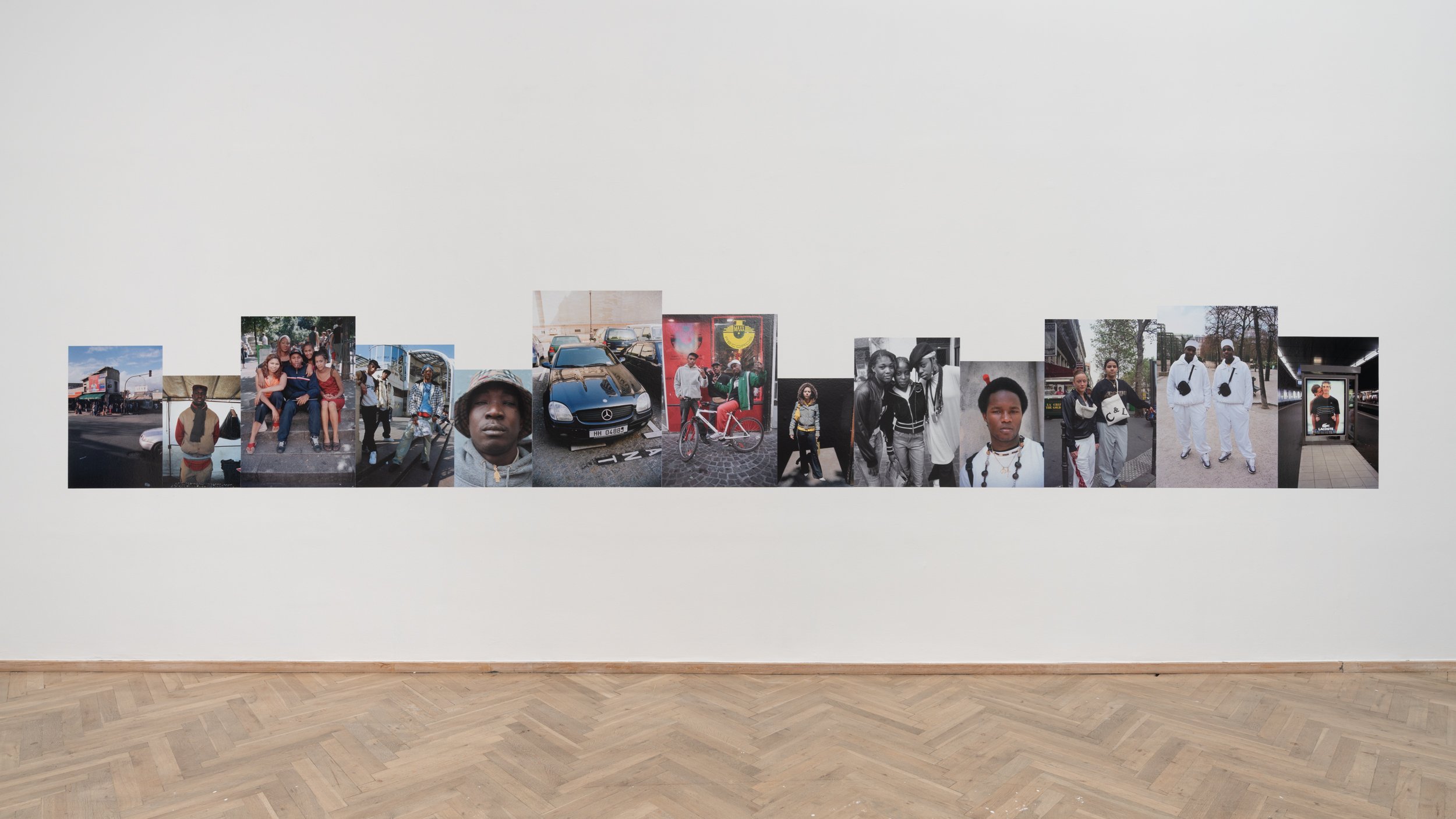
We begin in a sky-lit room that contains only some speakers and small chairs to sit on. Everything is white. Everywhere is sound. Many voices are shouting the word ‘hara’, used by young people as a warning if the police get too close. I wonder if there’s a warning word I can shout to myself about a friend acting weirdly. The thing is, I didn’t really have time for this exhibition visit. This was his idea. ‘All I do is try to keep it together’, I say to him, or to his hair; his back is turned to me. He looks at the wall text – explaining how the artist uses his work to call attention to young people from ethnic-minority backgrounds – and says one should always compare.
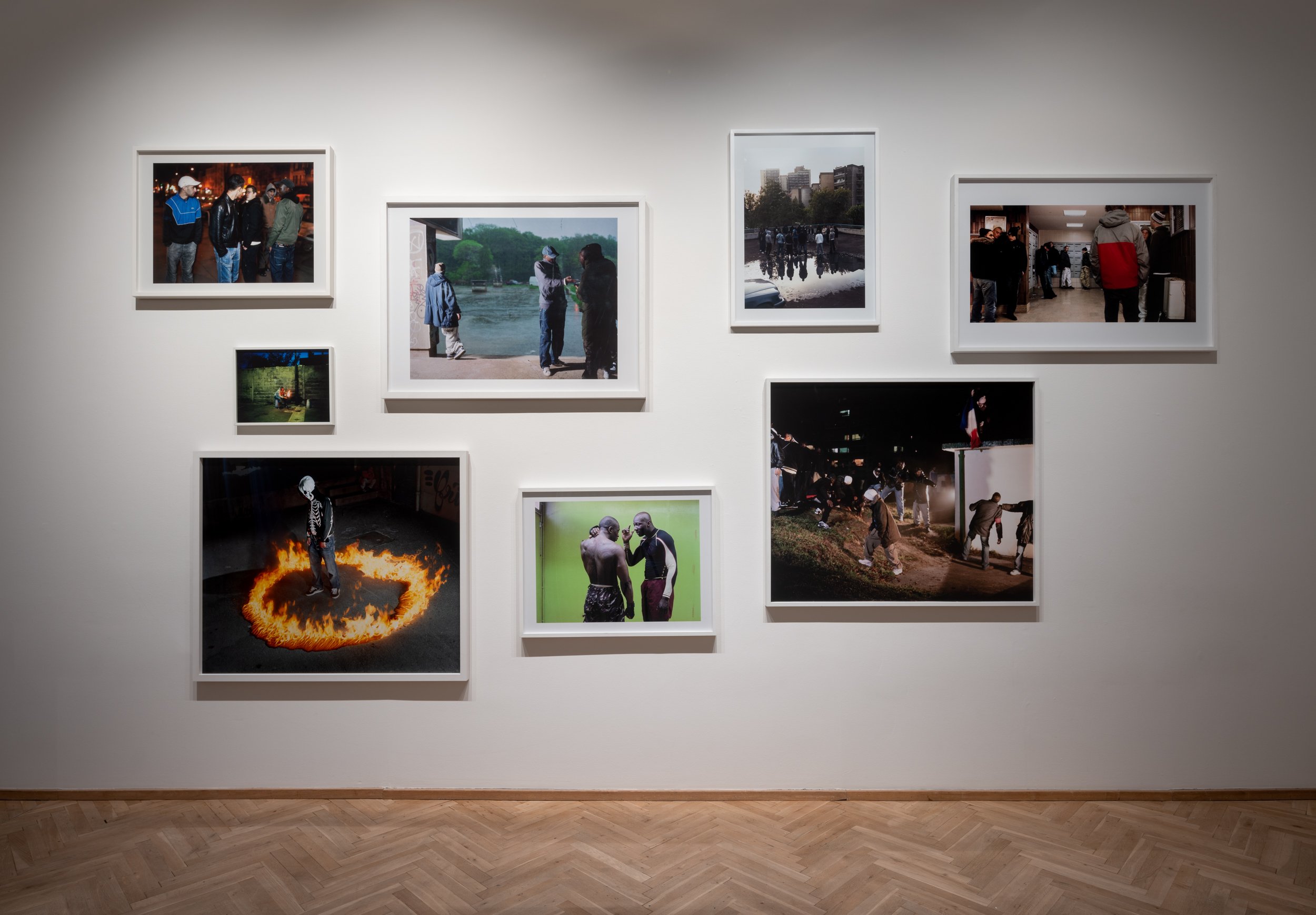
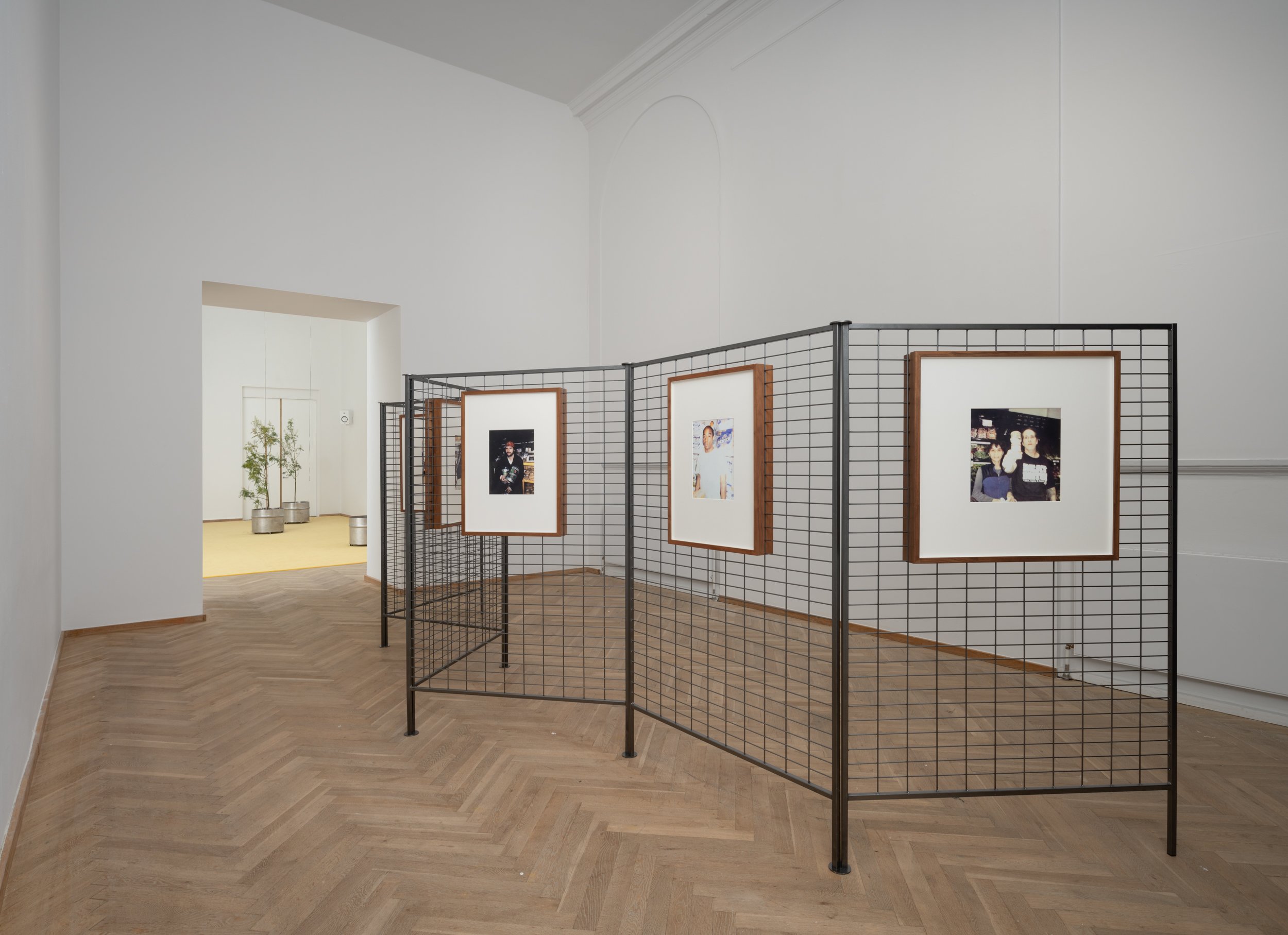
We move further into the exhibition, passing a labyrinthine structure of fences with images of refugees on them. The complicated installation makes perfect sense to me in this tense situation. In the next room, we spend time in front of large photographs hung on only one wall. I am moved by the presence and focus the images acquire when exhibited like this. He says he couldn’t disagree more.
We’ve nothing left to talk about. When we pass a sort of garden planted with very thin trees, they seem embarrassed to be there with us. A man is vacuuming around them, something we’d normally laugh about, but my friend still doesn’t meet my eye. I look at his cap, which is on backwards. Who does he think he’s fooling? It does nothing for his receding hairline.
Does one break up with friends? I wonder if I said something stupid last time we met. This is probably my fault. It usually is. He walks quickly through the final room, which is plastered with too many unframed photographs – too many people’s stories we’ll never hear – and makes his way down the stairs. We usually write a wish and hang it on the Wish Tree placed there, but he doesn’t stop.
If I go back to my studio now, I’ll stew for the rest of the afternoon. I write a wish for his health and hang it on the tree, and go back to the café, hoping the couple is still there.
I can still hear the shouting of ‘hara’ for days afterwards.
Mohamed Bourouissa: HARa!!!!!!hAaaRAAAAA!!!!!hHAaA!!! Kunsthal Charlottenborg 09 Okt 2021 – 20 Feb 2022. Courtesy the artist, Kamel Mennour and Blum & Poe. Installation photos by David Stjernholm.
HIROSHI SUGIMOTO

Hiroshi Sugimoto, Opticks 008, 2018, courtesy of the artist and Marian Goodman Gallery
Afterimage by Nina Strand:
In a currently closed Paris I saw Hiroshi Sugimoto’s new exhibition at Marian Goodman Gallery, and I spent a long time looking at this beautiful blue work. It was a welcome escape from our lockdown situation.
Sugimoto’s subject matter include lifelike displays in museums of natural history, old American drive-in theaters as well as vast seascapes — as he has investigated time and memory throughout his practice. For him, photography functions as a system for saving memories, it is a time machine.
His current exhibition Theory of Colours at Marian Goodman consists of his new series Opticks. The title of this series is a reference to Sir Isaac Newton’s treatise Opticks, published in 1704. Opticks is according to Sugimoto essentially a series shot using a Polaroid camera, capturing the light that Newton refracted using a prism.
This new body of work is just as meditative as his seascapes. He has previously stated that photography is like a found object. That photographer never makes an actual subject; they just steal the image from the world. But not every photographer has the expertise in finding these ‘found objects’ as Sugimoto.
Known for his precise techniques, long exposures and perfectly composed large format photographs — the philosophical and conceptual aspects of his ouvre is just as important. His photographs reveal the time passing, and the mediums unique ability to render a trace of it.
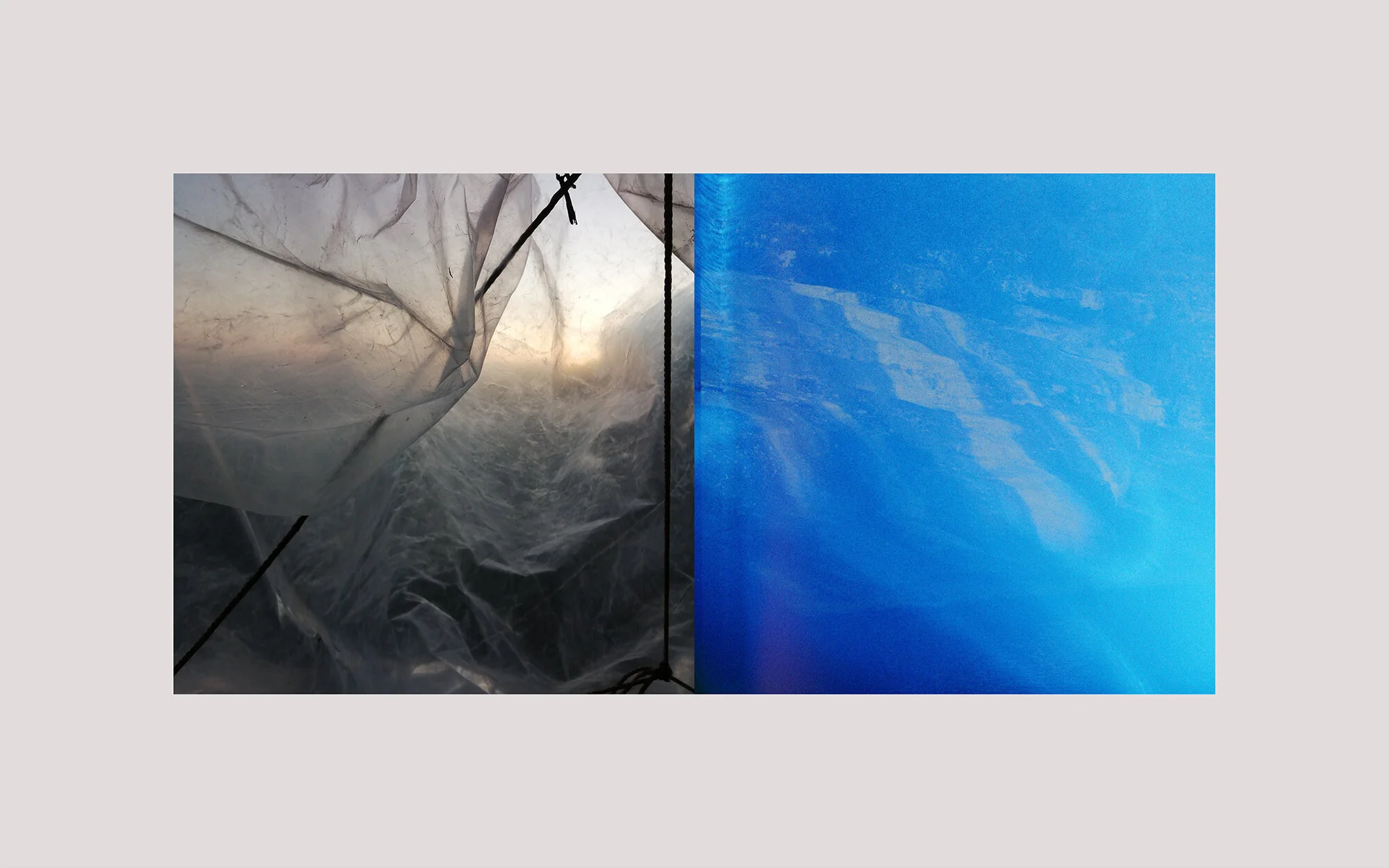
ESSI KAUSALAINEN
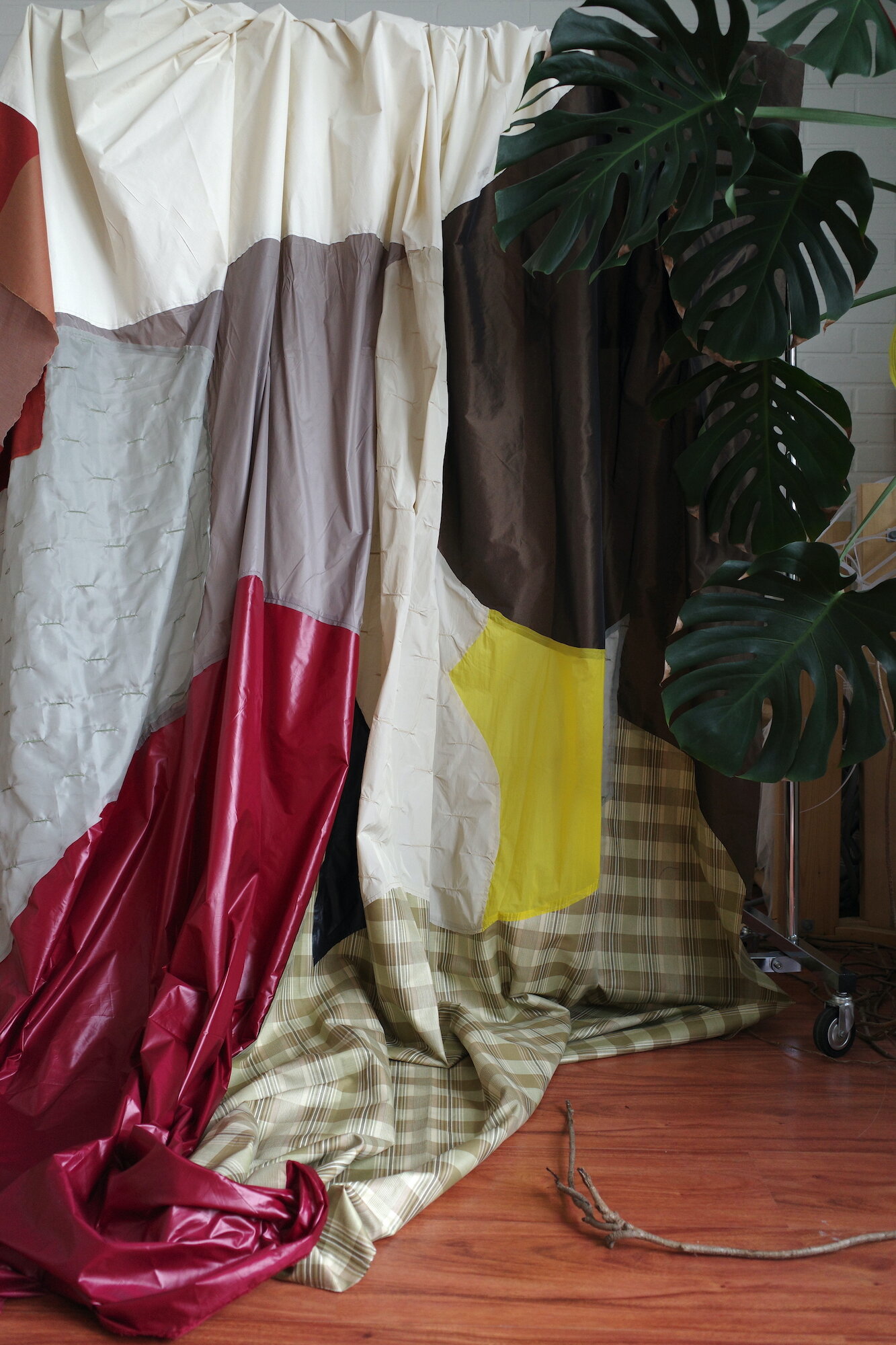
Dear L,
While writing this, the early spring light filters through a thick layer of clouds and bounces from the snow covered roofs. The light is so even there are nearly no shadows visible. Somehow this makes sense with my sense of time, which has gone out of joint. The days are short and long with no apparent logic. They are thick, sticky and viscous, and my attempts to organize them into segments of activity and rest seem to be ridiculed. All the borders grow soft and blurry.
I am filling this uneven time by walking in circles in the suddenly quiet seaside city, orbiting like a moon of an unknown planet. Everything is floating. My body, the time, the language. In my solitude I am knitting new words to tell you how it all resonates in me: the sense of pressure within the bone, the electricity behind the eyes, the opening of the skin in my back that allows the room, the world, to flow through.
In these peculiar settings, I have started to sew. Connecting pieces of fabrics into shapes, into platforms for unknown future events. Most of them are so small and light one can carry them in a pocket. Yet, they are all big enough for two people to stand on, if their bodies are arranged close to each others. I hope one of these days I could orbit to you and hand one over.
With love, E
(This text has not been edited by Objektiv as it is a personal letter.)
NICOLE EISENMAN, VANESSA BAIRD & LINN PEDERSEN

Nicole Eisenman, Destiny Riding Her Bike, 2020. Photo Thomas Widerberg. Astrup Fearnley Collection.
Afterimage by Nina Strand:
There's no place like home
On a painting, a drawing and a photograph.

Linn Pedersen, Kiddo, 2021.
The large painting Destiny Riding Her Bike by Nicole Eisenman has been on my mind since I saw it at the Astrup Fearnley Museum In Oslo a couple of weeks ago. A woman soars off her bike having crashed into a ladder set up against a tree, toppling a man who is trying to save the small cat that intently watches the chance meeting between the two humans. In the March issue of New Yorker, Eisenman explains the image in the article ‘Every Nicole Eisenman Picture Tells a Story’ by Ian Parker. ‘It’s a romantic painting of two people meeting. One is falling off a ladder, and the other is riding a bicycle into the ladder—and popping off the top of the bicycle. She’s flying through the air. And they kind of have their eyes locked on each other. I think it’s very romantic—a Douglas Sirk film still.’ Eisenman explains that the picture is connected to her recent relationship with the art critic and writer Sarah Nicole Prickett, and that the image became ‘this disaster happening, and a kind of romance inside this disaster’. In these days of isolation, I long to meet new people like this, romance or no romance.
Eisenman has mentioned her admiration for the Norwegian artist Karl Ove Knausgaard, to whose project My Struggle Vanessa Baird’s work has been compared. Baird has just published her new book There's no place like home with autobiographical drawings of living with her kids and her mother. Some drawings are accompanied by notes written by her mother about her different needs, reflections and thoughts. When I once interviewed Baird, she told me she called her drawings for short essays, hoping people could get something out of seeing her work. ‘My everyday life is like everyone else's, it's about recognition.’ This book with her mother certainly seems to depict a struggle, to paraphrase Knausgaard. In one drawing, Baird is sweeping a never-ending dirty floor, with several kids around her, while in a corner her frail mother is lying in a bed. On the top she has written: ‘Stuck in genes and affection.’
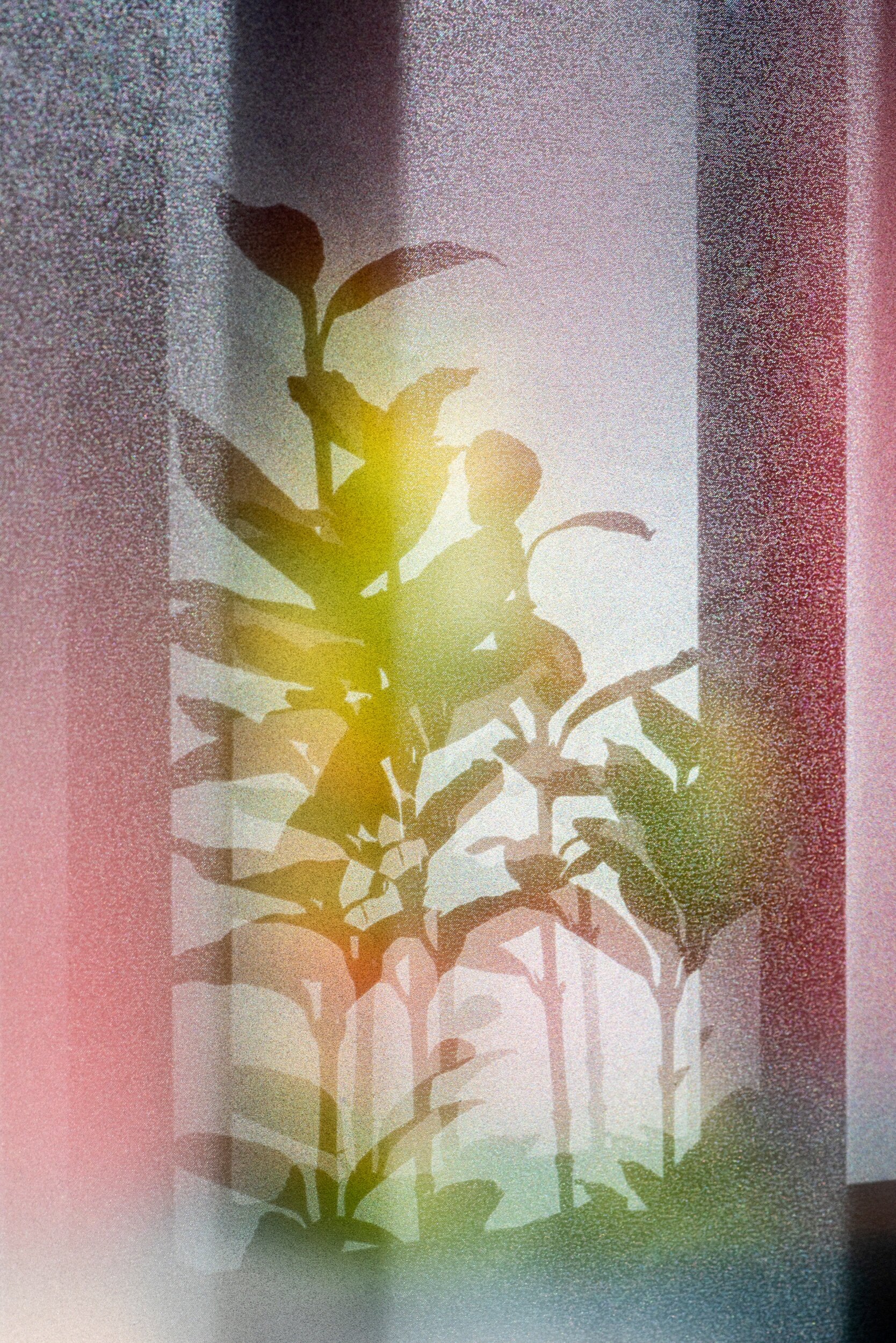
Another mother and daughter relationship is evoked in the photograph Kiddo by Linn Pedersen, included in her recently opened exhibition Omland at Golsa in Oslo. The image is the imprint left in the snow after her youngest daughter outside their house in Lofoten. It was dark outside, Pedersen tells me, and she was carrying groceries from the car as she walked past this impression her daughter had made in the snow. It reminded Pedersen of a cherub from a Raphael painting mixed with the Michelin man, an astronaut, and craters in the lunar surface. Many of the images in the exhibition are from the north of Norway, where she has moved back with her family after many years in the South. Omland in Norwegian means land surrounding an area, and the exhibition is a kind of rediscovery of her old surroundings, very clearly suggested in two images next to each other, one depicting a mountain and the other a mountain of souvenirs, old business cards, passport photos, notes.
A chance meeting, a daughter taking care of her mother and children, and an imprint of a young child in the snow. All three artists were working with a fulcrum in their own life and family situations, and during these weeks of a new lockdown in Oslo it became for me a triptych almost emblematic of the situation. We just have to make the best of it. And it helps to make or see art.
PATRICIA CAROLINA
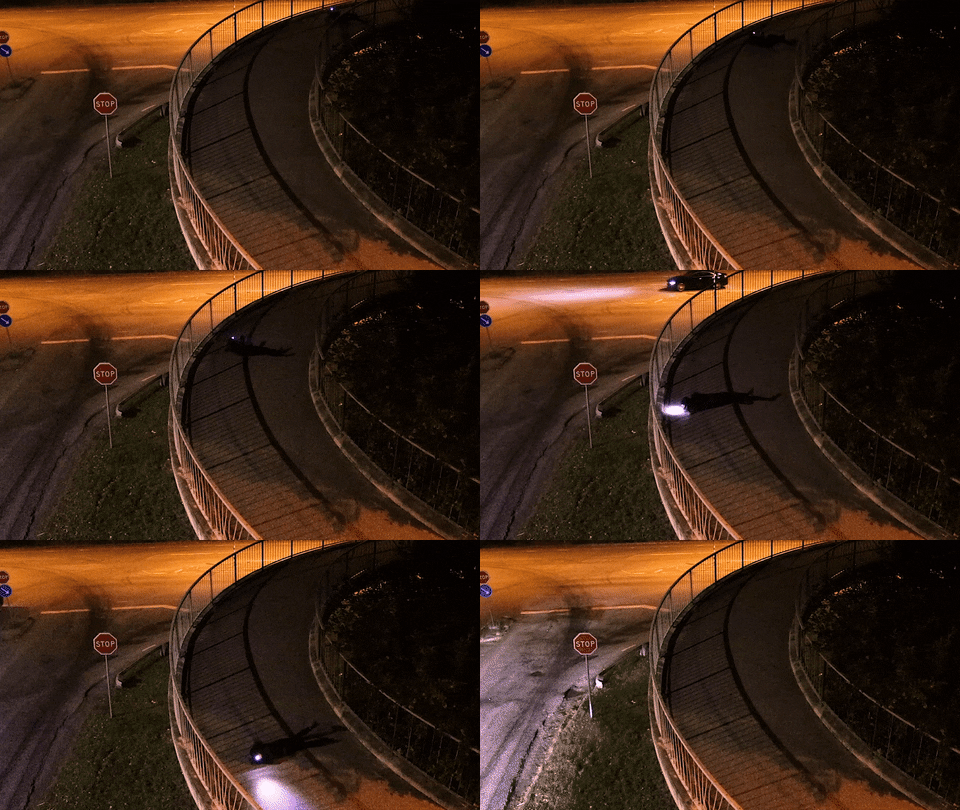
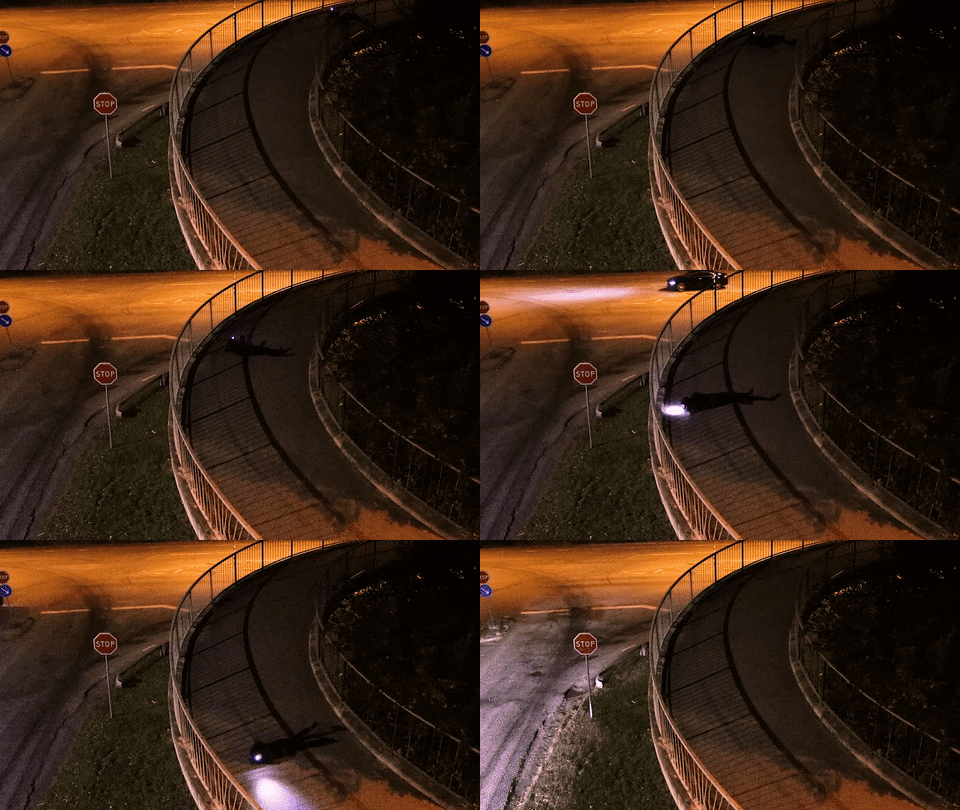
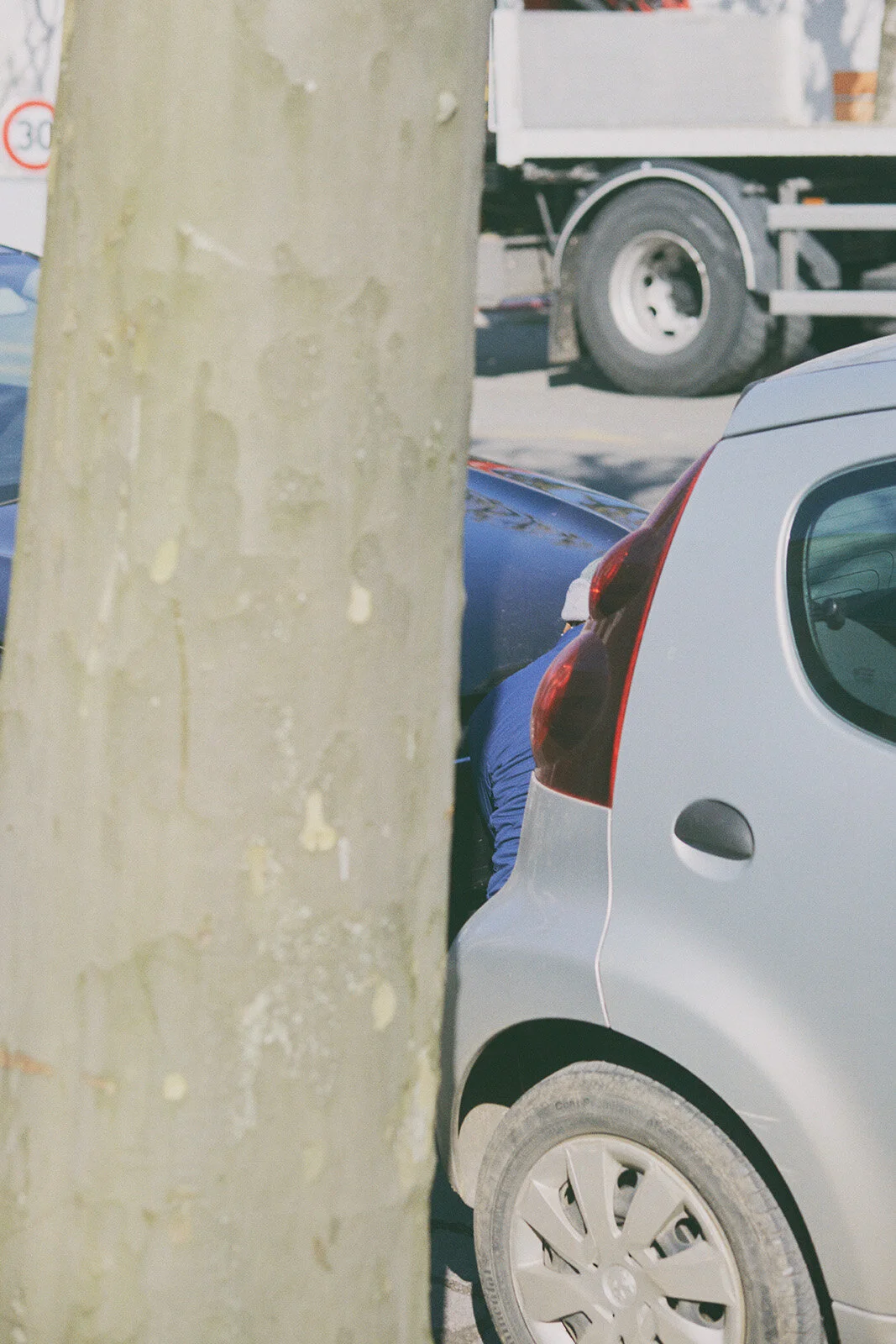
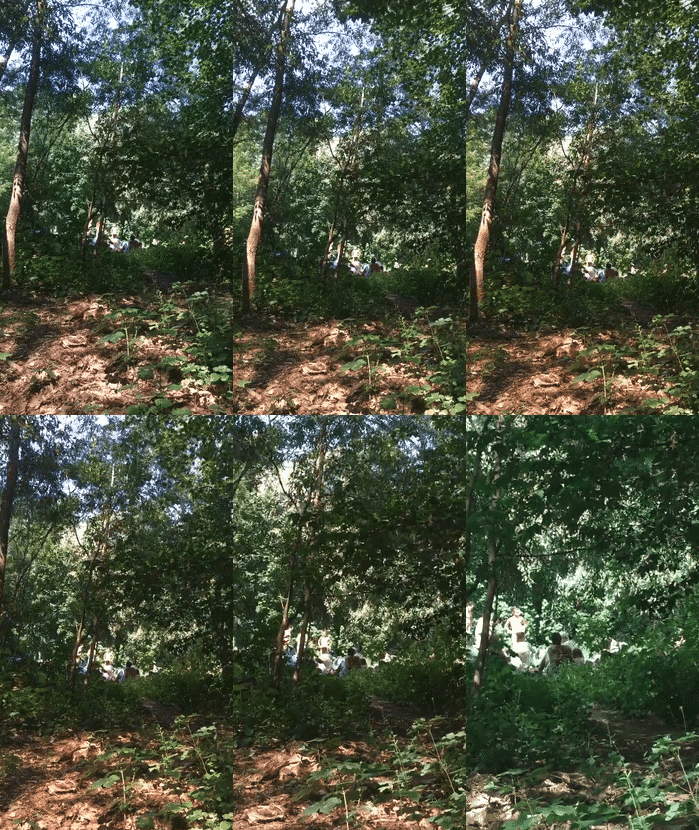
In my practice as an artist, these short clips function as letters in an upgrowing alphabet.

INDER SALIM

Inder Salim, We All Are Women’s Issues, 2003. Courtesy of the artist.
Afterimage by Nina Strand:
In the recently opened exhibition Actions of Art & Solidarity at Kunstnernes Hus (The Artists’ House) in Oslo, there is one image that embodies the title perfectly: We All Are Women’s Issues by Indian performance artist and poet Inder Salim. The photograph is from a performance by Salim in Bangalore, India, in 2003. Salim made himself into a walking billboard to protest against violence against women, using the double meaning of “issue” to show how everyone should take a stand against gender-based violence, and also that all humans come from women. As he writes in an email to me: ‘It was indeed a day-long walk on the roads in Bangalore City in 2003. There was no video possibility in those days, but I got some clicks by friends who accompanied me.’
At that time, he and his colleagues put up around 500 posters in Bangalore, and later on buses and walls in Delhi where Salim currently lives. The poster was also used by the women’s police department in Bengaluru, and by Vimochana, a NGO working for women's issues. Salim used the image as his business card for a long time, and it was also printed on a banner of about four and a half metres. ‘The situation in India, the unfortunate treatment of women’, Salim writes, ‘particularly in rural areas, is very disturbing’.
For the past 30 years, Salim has worked tirelessly within the genre of art as activism, using video and photography as well as other channels to make us look again at the world in which we live. His work deals with bodies, sexuality and gender & queer politics. Last fall Ishara Art Foundation invited to the exhibition Every Solied Page where Salim made a series of eleven different performances under the name Every Page Soiled, to be enjoyed here. As he explains his work: ‘Performance art is not body-centric, but revolves around material and subjectivities of all kinds in our respective presents.’
The exhibition’s press text claims that: ‘solidarity has re-entered the global zeitgeist with resounding force in the last decade. It has driven new thinking focused on countering systemic failures and outright abuses related to climate, economy, surveillance, health, gender and race amongst other issues.’ And it continues: ‘Actions of Art and Solidarity considers the central role that artists play within this historical shift in the new millennium, drawing parallels to synergic cases of the twentieth century.’ Looking at Salim’s career, solidarity has always been present in his performances: ‘Doing posters from my own pocket money was my passion in early days. Nowadays, I put up flags from my terrace with text to highlight different topics in our current situation.’
The latest, from five days ago, has a very simple message: ‘I love you.’
VILDE SALHUS RØED

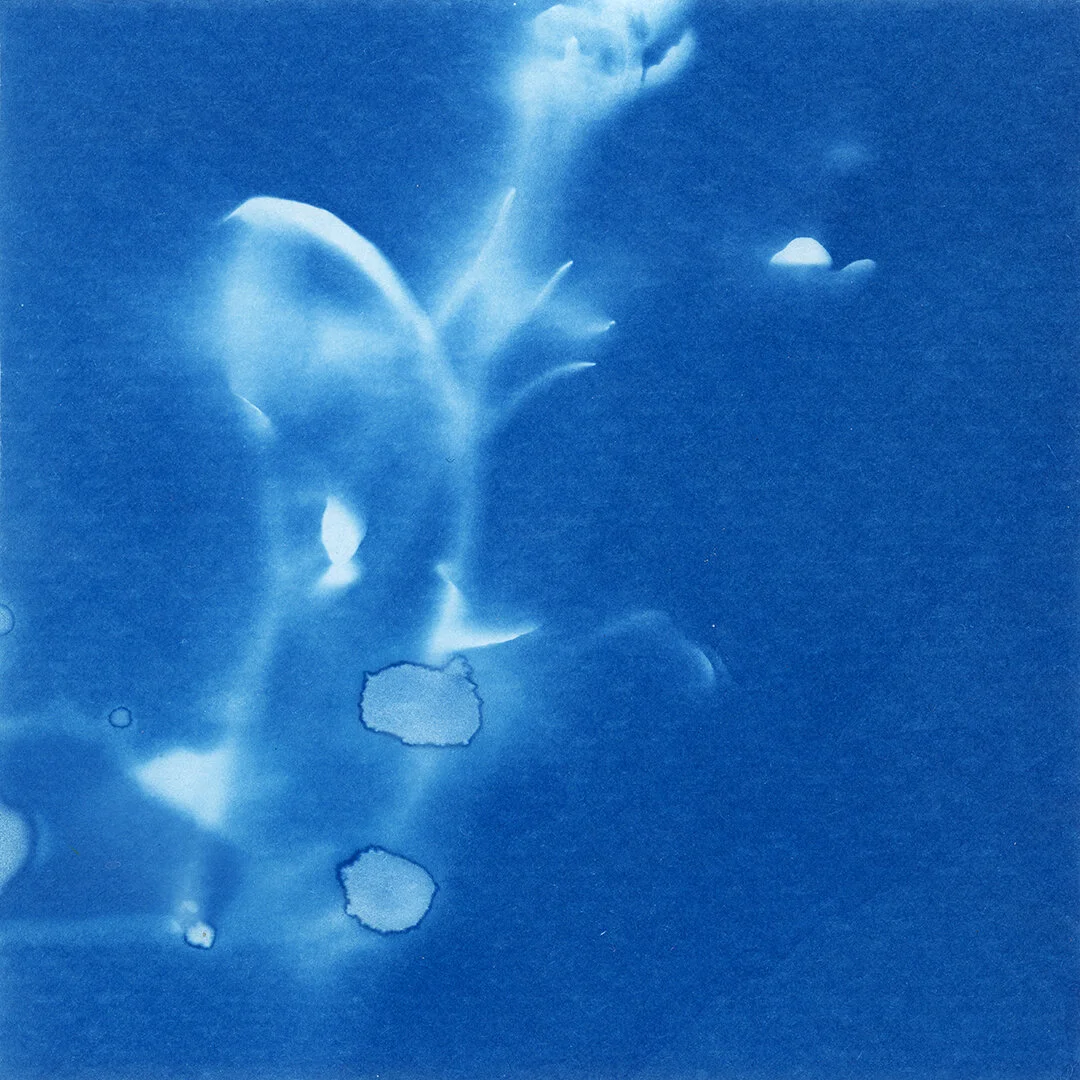
The Same Sun
Sun prints from hikes in mountains not far away, but closer to the sun, together with Una 4 1/2 years old, in the early spring of 2020, when time and days began to flow.
INGRID EGGEN

Installation photo by Ingrid Eggen of her Tranquilshiver #2, 2020.
Afterimage by Nina Strand:
This weekend, Ingrid Eggen opened the show CLAIM YOUR SUPERIOR BONE together with Admir Batlak at the small artist-run gallery Noplace. Her three new photographs made me recall a recent FaceTime conversation with a dear friend and colleague who had just attended a vernissage and needed a debrief. She said everyone there had been acting weirdly, and wondered if it was anything to do with her. We analysed the situation for a while, before concluding that it was simply an extreme COVID-influenced version of Norwegian’s general uncomfortableness. (In our opinion, being uncomfortable is the norm for Norwegians.) This made us laugh, since in normal times, exhibition openings are often quite awkward, but in this self-isolating time, they become even more so.
Eggen’s work is concerned with the body and its involuntary actions, the ones we deem irrational. As she once explained in an interview with me, these actions are on a par with affect theory: they turn us away from the rational and towards the notion that something more basic informs our actions, such as muscles, reflexes and instinct. For this new work, she had made three frameless photographs on polytex paper of hands twisted into each other, hung directly on the wall. As she says about the work, this is an attempt at advancement within an anatomical form. Both hands in each image belongs to the same person, but act as if they are from two different persons, with one holding the other back.
The title, Tranquilshiver, along with the unease they convey, reflecting the way we feel at this point in time, made me smile. A tranquil shiver: does that even exist?
CLAIM YOUR SUPERIOR BONE. Admir Batlak & Ingrid Eggen. 21.11.20 – 20.12.20.

ANDREA GRUNDT JOHNS
This text contains translated extracts from my master thesis written in March 2020. It is based on many years of research on photography, sight and perception. Have we lost the ability to see due to the enormous amount of visual material filling our daily lives? Are we being blinded by too much information? How can we, if need be, learn to see again? And what does seeing actually mean?
The original text was finished at the same time as large parts of the world were suddenly shut down, moved over to digital space, and thinking about touch became a pressing matter.

Le visible et l'invisible
I have walked 7,244,629 steps since I moved to Bergen 775 days ago. That is, approximately 9,348 steps per day. On a normal day, when I walk to the studio and back, I walk around 6,500 steps. Many governments now recommend an average of 10,000 steps per day. Several days this spring, my step count is down to only a few hundred steps a day.
___
There is an imbalance in our sensory system.
Vision separates us from the world, whereas the other senses unite us with it.
___
There are mirrors on the Moon to measure the distance between us and it. The mirrors were placed there during the voyages of Apollo 11, 14 and 15.
Light hits a surface, and a reflection is created. The surface's microscopic topography dictates all reflections. The surface catches the light and throws it back at us – either as the near perfect reflection in a mirror, or as the soft light on our living-room wall when the afternoon sun hits its rough surface. The smoother the microscopic topography, the more lifelike the reflection.

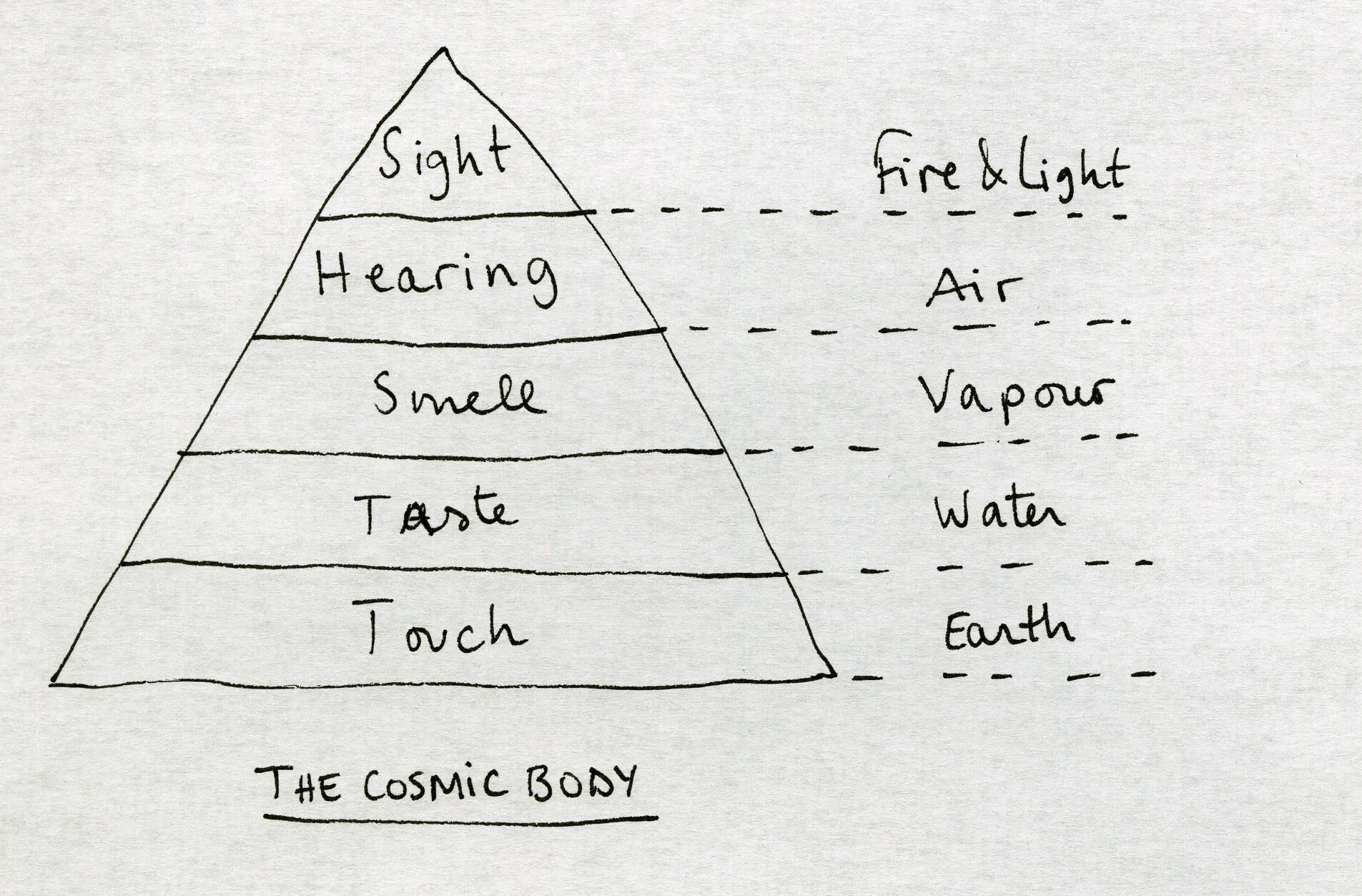
According to art historian Hans Belting, the ancient Greeks never really managed to decide if what they saw in the mirror was reality or trickery. This confusion is partly explained through their understanding of sight. Through the Emission Theory, Plato explains that we see because of light emitted from our eyes, that we see the objects in front of us only when the light from our eyes hits the object. The ancient Greeks’ idea of the Cosmic Body placed sight at the top of the sense hierarchy. Sight is light is fire is enlightenment. At the bottom is touch, and earth. Touch, treacherous, dangerous, confusing and seducing. Thus sight became the most important sense in the western world.
According to the Arab scientist Ibn Al-Haytham and his studies on optics from around 1,000 ad, there is an important difference between visibility, an optic phenomenon, and visuality, a psychological phenomenon. It is only through prefrontal mental synthesis that we are able to see, that we are able to understand and translate the light that hits our eyes. Memory and contemplation become essential in the process of seeing. Thus only details are needed to be able to understand the larger picture. We see because we have already seen.
A reflection is created when reflected upon.
Some months ago, I talked to a friend of mine who is currently working on developing eyes for robots. Their goal is to make robots that can see and recognise what is placed in front of them. A step closer to replacing humans with machines. The idea is fairly simple. The robot will get two ‘eyes’ – one working as a projector, emitting light, hitting the surfaces in front of it, the other as a camera recording and registering the shape of the object in front of it and the distance to it. They have already made great progress in their research.
___
We look, register and name. John Cage once said that we stop seeing when we start to name and categorise. ‘You look at a conifer [for instance] … and because it all looks basically alike [like other trees], you say it's a tree – and when you say that you cease to look. But only if you move from understanding to actual experience can you really begin to see.’ Seeing can lead to blindness.
___
There is something about being allowed to touch.
Last July in Japan I removed my shoes whenever I entered a space. Off with the shoes, on with slippers, or socks or barefoot. I feel an over thousand years old dark and smoothly polished wooden floor under my feet. It is burning hot in the sun, cooling, soothing in the shadows. After a long day in hard, dusty sandals, I step into the softest whitest plushest slippers and into a stark white art installation. Suddenly, I am inside the wooden floor, inside the installation. Suddenly I feel my surroundings. After a month of taking off my shoes I start to notice a certain change in perception, a certain change in the way I experience my surroundings. I have started to see with my feet. It occurs to me how much information I lose by wearing shoes. What if we wore gloves on our hands all the time?
Seeing with other senses can make us see again.
After thousands of thumbs being stuck into a hole in a column in Hagia Sofia in Istanbul and then twisted around 360 degrees for hundreds of years, the sweating-column, weeping-column, or wishing-column now has a clear scar on its side. The hole is as deep as a middle-sized thumb, and its contours are golden from the stroke of hands.
In a park in Oslo, the tightly clasped fist of a young bronze boy has become golden from the repeated touches from visitors. In the museum next door, the visually impaired could up until recently touch a few selected sculptures with signs in Braille.
At the Kiasma museum in Helsinki, all visitors are invited to press their hands against a cold, now dirty and greasy, marble plate at the entrance. Slowly we create a concave surface. Some time after my last visit to Kiasma, I read by chance in the foreword of The Eyes of the Skin by Juhani Pallasmaa, that the museum's name is a Finnish version of ‘chiasm’, a word the architect found in a chapter in Merleau-Ponty's Le Visible et l'invisible. The visible and the invisible.
There is something about being allowed to feel.
Some time before I move to Bergen I decide that I will walk wherever I go. Walking becomes my sole mode of transportation. I walk everywhere.
___
Our skin is our largest organ. Covering everything, making us feel with our whole body, the skin covers our tongue, our ears, our eyes. Touch is both external and internal. Touch is when we feel the humidity or the heat outside. Touch is when we feel pain or pleasure inside our bodies. Touch is when different body parts relate to each other without us thinking about it. Touch is the movement of our body. Touch is the only sense we cannot loose.
Lately, the word ‘haptic’ has emerged when talking about our sense of touch. The haptic refers to a combination of sight and touch, allowing us to understand and feel texture without touching. But to do this we have to touch first, to create a library of haptic memories.
Once, I experienced the lack of touch over a longer period. I had just moved away from home for the first time, and had almost no physical contact with others for half a year. It felt as if my body was imploding. Silently, slowly, sucking, sinking into itself. I was amazed and baffled. I remembered the horror stories from my childhood about orphanages where children grew up with serious disorders due to the lack of touch.
___
We break the surface. We see with our hands and feel with our eyes. They lead our fingers quickly over the touch-screens. We cannot feel our way anymore. How do you feel an app?
CLAUDE CAHUN
Afterimage by Nina Strand:
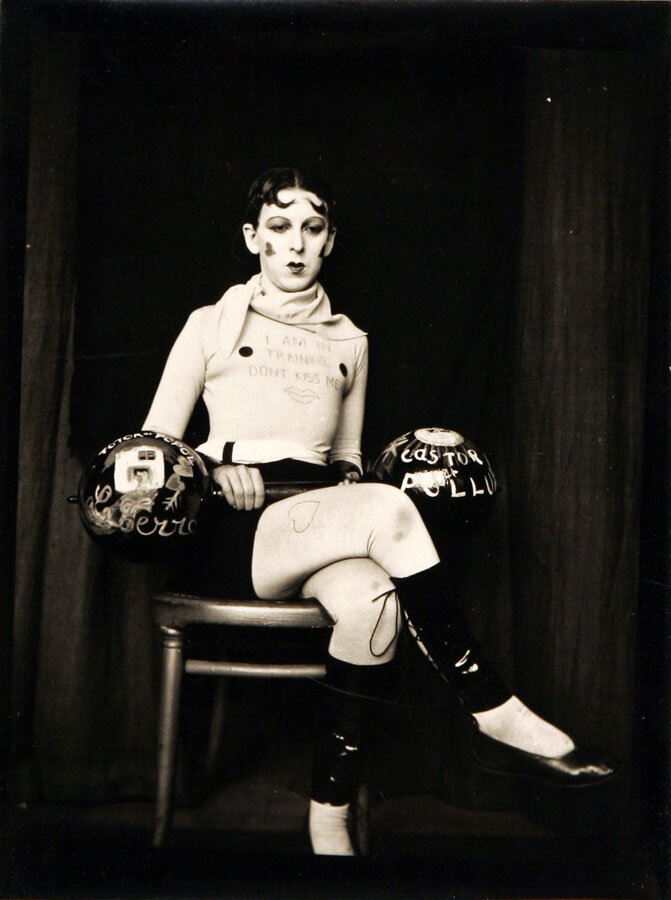
This is the last week of Fantastic Women – Surreal World at Louisiana Museum of Modern Art, Humlebæk, where the work of Claude Cahun, among 34 others, is displayed. Cahun was a pioneer of photography that worked with gender fluidity and identity, and in this sense we owe her a lot. In one self portrait, Cahun is dressed as a weight lifter with the text: ‘I am in training, don’t kiss me’ on her jersey, and a small heart on each cheek, as well as one drawn on her knee. Her quote on gender accompanies the work: ‘Masculine? Feminine? It depends on the situation.’
It’s almost too much of a coincidence that this show is on at this time in this small Scandinavian country, since it’s been an interesting fall for Denmark. Three years after the MeToo Movement swept over at least the western part of the world, Denmark has finally begun its own investigation into people in powerful positions. A quote by the famed writer Suzanne Brøgger is circulating on social media. She said to the Danish newspaper Børsen that she has no patience with people who complain about MeToo. She doesn’t listen to those inexperienced people who say that women are to blame for their own abuse because they could just say no thank you, dress differently or simply stop putting themselves in dangerous situations. She is at an age where she trusts her own experience, and yet the politician Pia Kjærsgaard is only two years younger, but is one of those who have opposed the movement in Denmark, saying that women must accept advances, and diminishing harassment to simple, innocent flirting. Kjærsgaard claims never to have experienced unwanted attention or sexual advances, and yet she doesn’t hesitate to dictate what other women should put up with. Has she really never been touched by a man without her permission? Luckily, this time she’s outnumbered by many famous men and women, who are standing together, keeping up the momentum of the movement. It all began when the 30-year old TV host Sofie Linde delivered a powerful opening monologue at the TV Zulu Awards, watched by mainly young people, which was the perfect audience to finally hear someone say that enough is enough.
The movement spread quickly from the media world to the art world, giving this exhibition at Louisiana extra importance. If you didn’t catch it, there’s consolation in the fact that this week the great retrospective of the work of Anna Ancher opened at the National Gallery in Denmark. Not a moment too soon.
PROTESTIMAGE
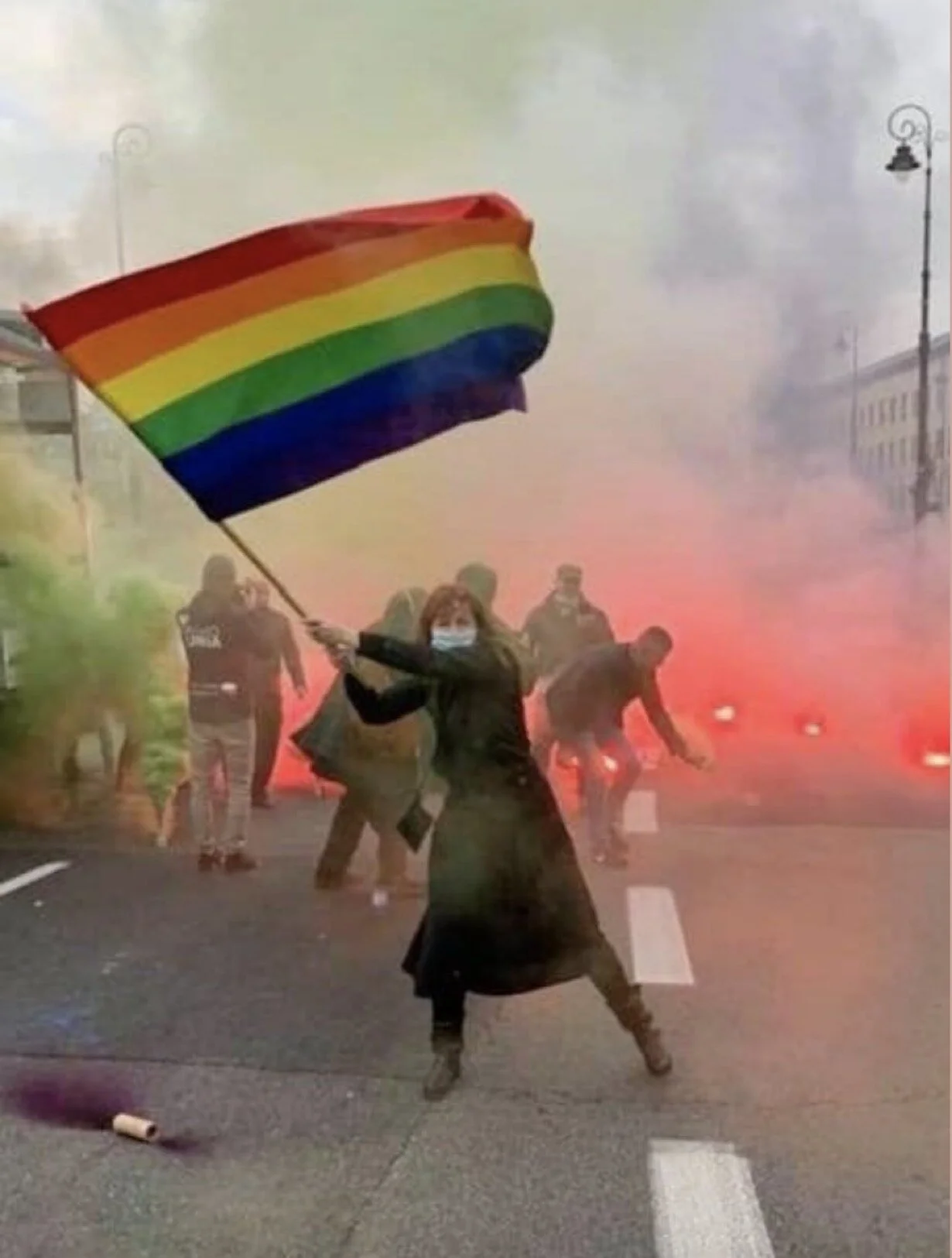
Found via Feminist News on Facebook. Photographer unknown.
Afterimage by Nina Strand:
There’s an image from the recent protests in Poland that I can’t stop thinking about. A woman stands in the middle of a street, in the midst of a demo, wearing a mask and waving a Pride flag in all the smoke and chaos. She seems angry, which is understandable and relatable. Why shouldn’t Polish women be able to decide what happens in their own wombs? It’s 2020 and I can’t believe that we’re here again, with the election of Amy Coney Barrett to the Supreme Court putting the American right to abortion in danger, and so the image from Poland hits me. I’m with her in this protest. I’m with her on the issue of choice. It’s vital to me that every single woman gets to decide what to do with her own body. And it’s terrifying how this choice is still being threatened. It reminds me of the image that went viral some years ago, from another protest, of a woman in her sixties holding the sign: ‘I Can't Believe I Still Have To Protest This Fucking Shit.’ She’d obviously done this before. We know that we, and our daughters, stand on the shoulders of our mothers, their grandmothers, who fought for the right to choose. And yet here we are again.
In 2017, I co-curated an exhibition called Subjektiv at Malmö Konsthall showing the work of Josephine Pryde among others, whose series It’s Not My Body shows MRI scans of a foetus in the womb montaged onto colour landscape shots. Pryde hadn’t been intending to take part in any ‘urgent response’-type exhibitions at that specific political juncture, but what caught her attention was another chance to NOT say how it feels to be a pregnant individual. She was interested in describing a shared material state, and included these pieces in the exhibition because she thinks human reproduction is extraordinary and that the history of women as property, as the designated site of reproduction, still haunts our popular mythologies and cultural exchanges. How these ghosts return, how they duplicate themselves and occupy imaginations, is a matter of intense relevance to her, and also to us four years later in these very trying times. So all these thoughts and feelings arise in my mind when looking at the Polish woman waving her flag in Warsaw. I do hope that we won’t have to see images like this in the years to come.