NINA STRAND ON SZILVESZTER MAKÓ
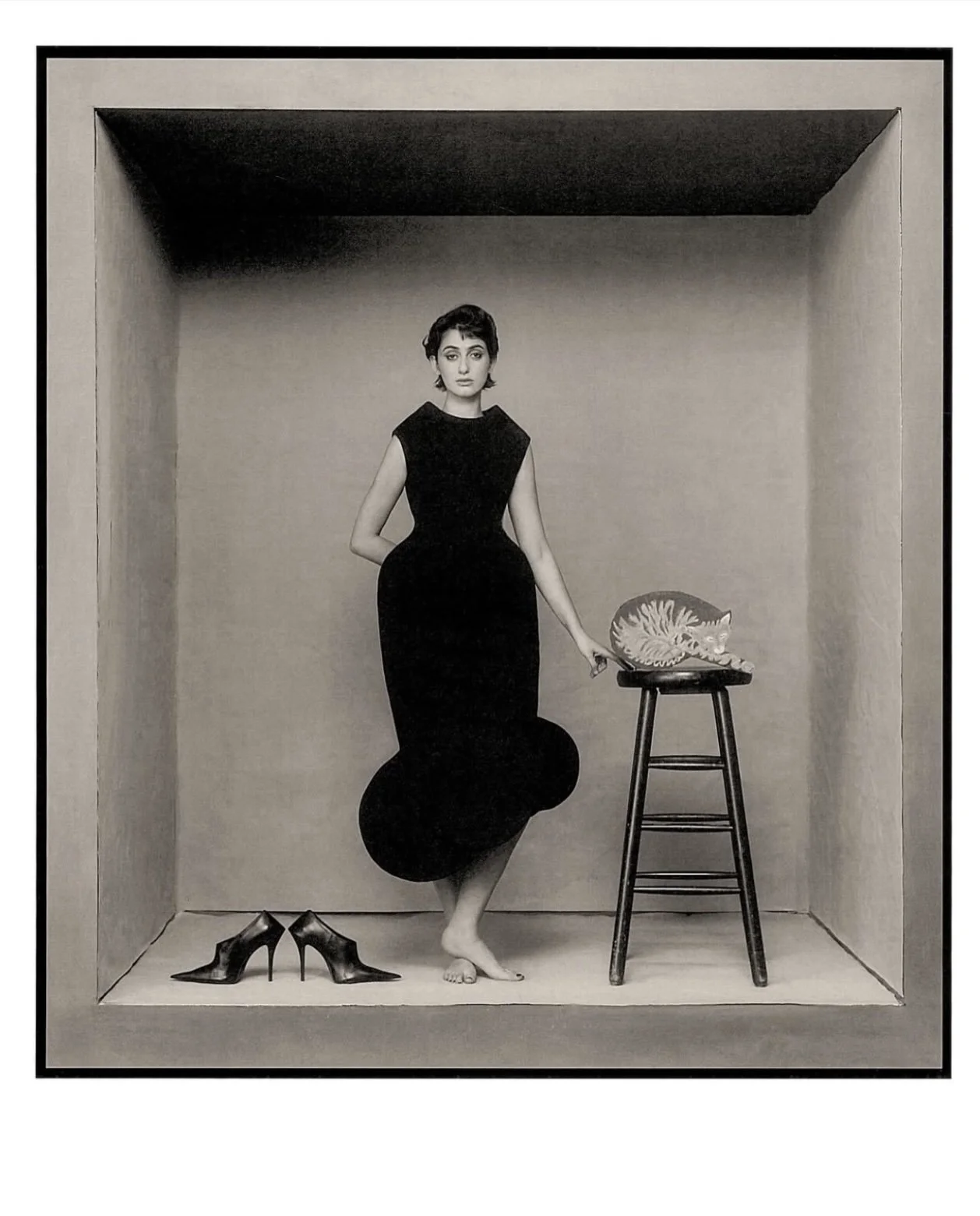
Szilveszter Makó for The Cut, with Rama Duwaji. Published in The Cut (online/print).
Afterimage by Nina Strand:.
What is this? Is it a glimmer of hope we can spot in the series of photographs accompanying the interview with Rama Duwaji in The Cut? Shot by Szilveszter Makó, the portraits of the Syrian illustrator and animator, wife of the new Mayor Zohran Mamdani, referred to here as the ‘First Lady of New York City’, seem like small life boats floating in the dark sea of the States. They playfully evoke classic fashion photographs of the 1940s, as well as the Surrealist paintings of René Magritte. I love this one, with her standing barefoot, her shoes placed on one side and a painted sleeping cat on a bar stool on the other. Her posture, her firm gaze … these are the kind of images we need while the rest of her country and so much of the world descends into free fall. The president hasn't even finished his first year in office, there are three more years to go, and so much is already broken.
Over the holidays, I read the text about photographer Donna Gottschalk by Hélène Giannecchini for the show Nous Autres at Le Bal, Paris. Gottschalk grew up in in Alphabet City, New York, in the 1950s, and Giannecchini reflects: 'The people she loved most lived on these streets, and most of them are long dead. And it’s the brutality of this city, of society as it is, the relentless poverty, everything that weighs on marginalized bodies, that killed them.' And today, all bodies that are not white male bodies seem in danger, like the woman with the last name Good, just killed by ICE in Minneapolis.
Over the past year, I have collaborated with two female photographers, Carol Newhouse and Carmen Winant, observing them creating double exposures, a technique Newhouse learned while living in a lesbian separatist community in the United States during the 1970s. They used photography as a tool to reinvent themselves. They had abandoned their families and everyday lives and built their own homes in the woods of Oregon. They were safe there. They were unsafe in the city. The houses are still standing, and I wonder if the women might feel tempted to move back there as they witness history grimly repeating itself for the queer community in the States.
Maybe we should all leave society? Or we could move to New York, where the powerful wheels of Mamdani and Duwaji are turning, there is hope. In the photo series, Duwaji’s confident gaze and half-smile bring a sense of sanity and control. Scrolling through her illustrations on her website gives even more, with the drawing of three fierce women of different races surrounded by flames. The one in the centre has her arm raised in a fighting pose as a text promises: 'Sooner or later, people will rise up against tyranny.’
Afterimage is an ekphrastic series about that one image you see when you close your eyes, the one still lingering in your mind. We invite different people to reflect on an image they can't shake. This column has been a part of Objektiv since our very first issue in 2010.