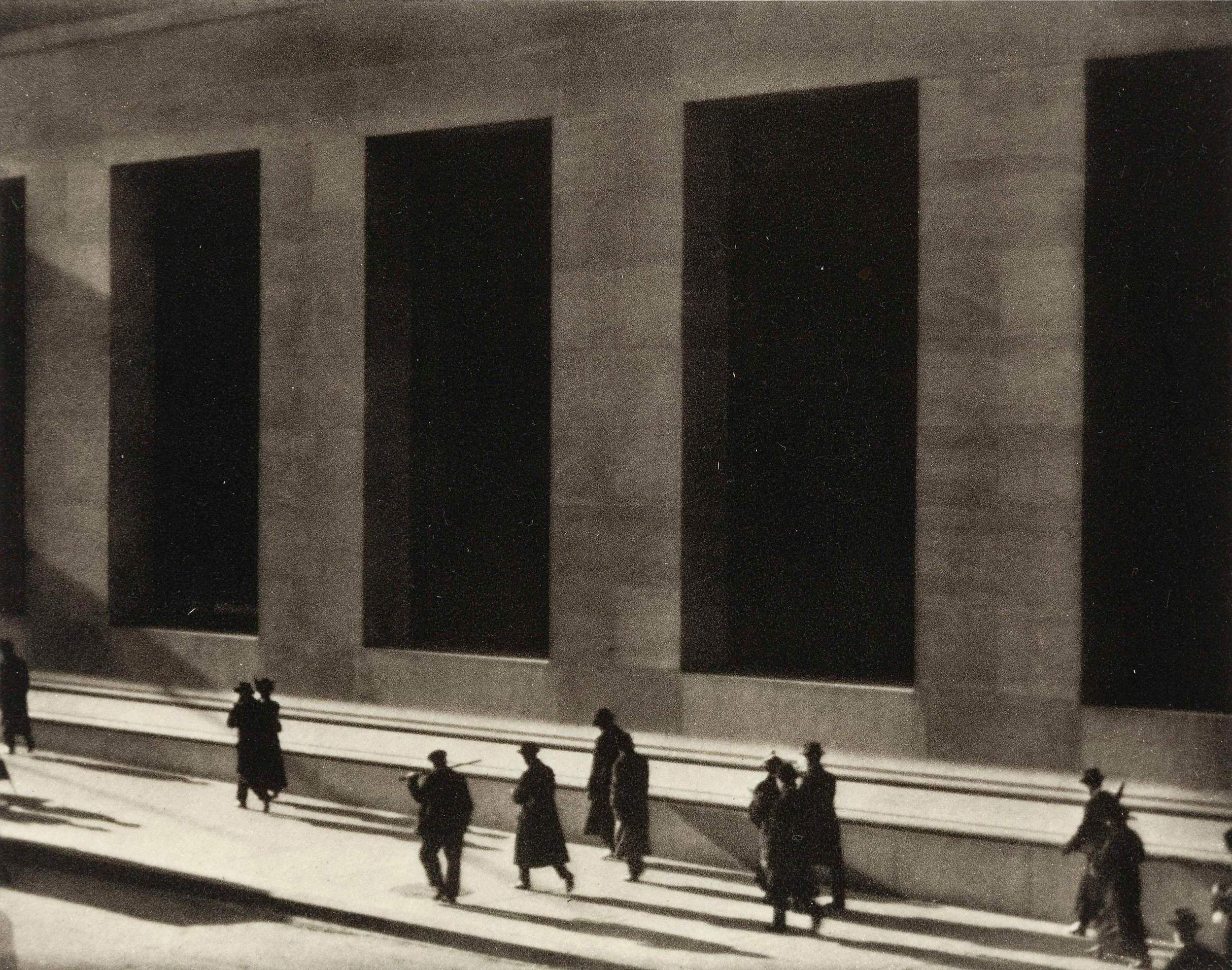
Paul Strand, Wall Street, 1915
Afterimage by Karen Hellman:
I think of this photograph as the one that made it possible for me to discover photography. I saw it in a Paul Strand retrospective at the de Young Museum in San Francisco (I grew up outside San Francisco) in 1992. I was in high school and went to see the show with my mom.
I remember being in awe of how simple the structure of the photograph is: the contrast between the large, dark rectangles of the windows of the recently completed J.P. Morgan & Co. building and the small hat-and-coated people walking to work, their shadows stretching out behind them on the sidewalk. The angle of the pavement is slightly uphill for the morning commuters as they walk against the sun.
I had this recognition of how simple yet powerful a photograph can be. I had been very interested in photography before this and had been taking photography classes in middle school and high school for five or six years. There were also some lectures that went along with the show, Paul Strand in Context.
I know it’s a very iconic image, but I really did have this moment with it, and I think this set me off on the path I’m still on today.
I love how photography can be both a social document and an abstract, conceptual one in the same image. When studying the history of photography, I was always struck by its different strands – the social and the artistic.
I gravitate toward photographs that don’t take much to understand or to react to emotionally. There is the slab of light across the photograph, and the angle: the people are walking uphill, underneath these looming, regimented windows. Because it was a new bank building, opened in 1914, it represents the monolithic financial power of New York overshadowing the worker underneath.
It is also considered a film still, because Strand photographed the same shot for Manhatta. I love that discovery, that it is both a still and a moving image. It has so much to it, while at the same time being a beautiful photograph to look at. That is what I like about photography: it can be beautiful, but also socially aware and powerful.
Afterimage is an ekphrastic series exploring that one image you see when you close your eyes—the one that lingers in your mind. We invite different people to reflect on an image they can't shake. This column originated in the inaugural issue of the Objektiv journal and continues today here on our web journal.