RACHAEL WOODSON ON RICHARD AVEDON
In her essay Touching Photographs: Roland Barthes’s “Mistaken” Identification (2002), researcher and photographer Margaret Olin describes an index as a representation created by direct contact with its referent: A thumbprint is an index. Because the item had to be there for an indexical representation of it to exist, it is often thought that an index is inherently more persuasive than an icon. A photograph is both an icon and an index; it is like an icon with a seal of approval, or, as Barthes calls it, a ‘certificate of presence.’
Though years had passed since I’d last seen the postcard, I recognized it instantly. That day, it appeared to me as a talisman. Moved by my discovery and the years of handling that had worn away its surface, I examined it more closely. Among the marks, I could make out several barely visible fingerprints. An atlas of touch, a certificate of presence.
Afterimage by Rachael Woodson:
Portrait of a Postcard
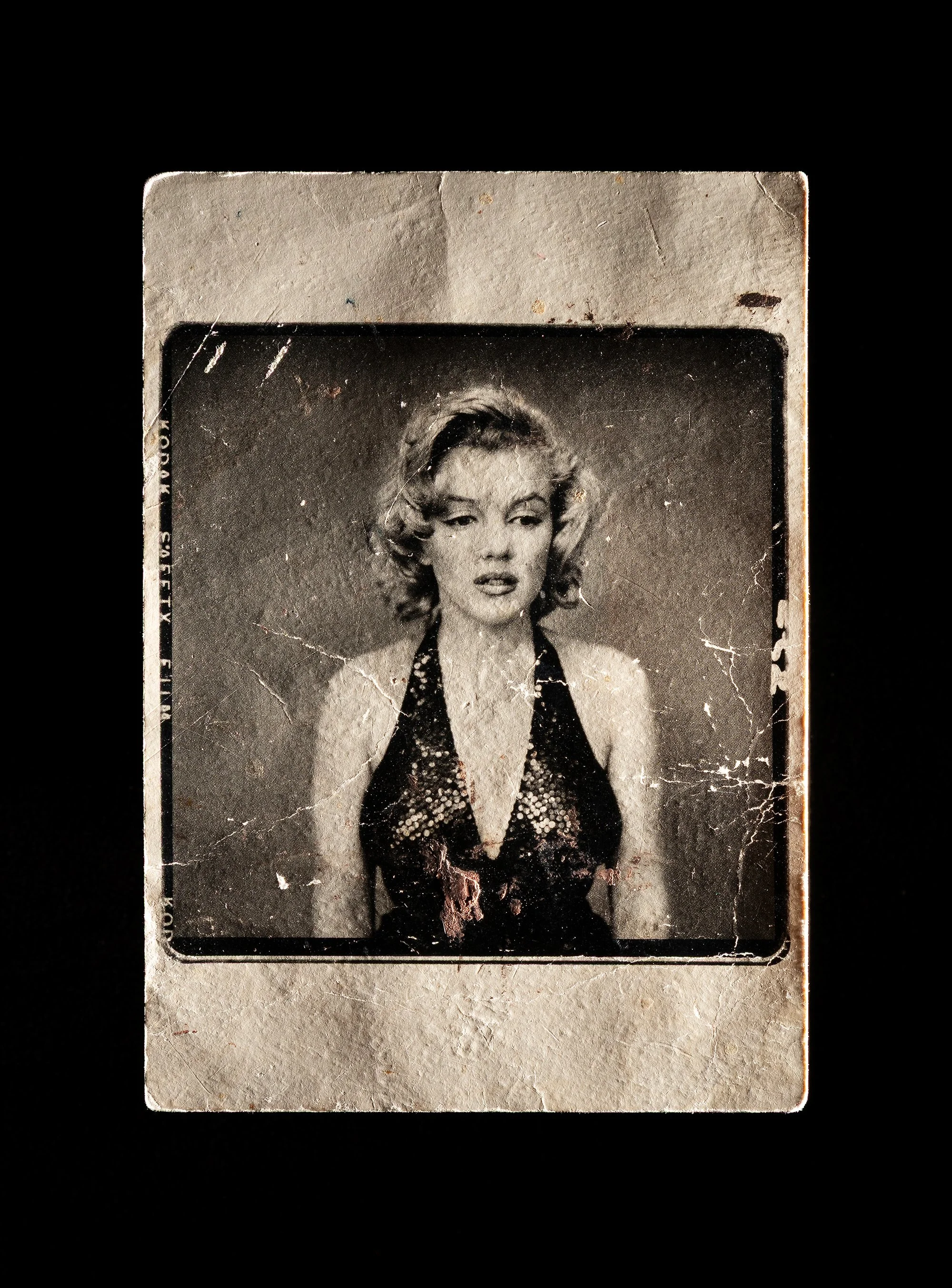
The Marilyn postcard (front), 2025. Rachael Woodson.
Yellowed with age
A weathered skin
Scuffs and stains
Fine lines like wrinkles around the eyes.
The crackling of its gelatin finish
Forms a network of small fractures.
Brownish red spots resemble dried blood
Smudges of blue, specks of beige
Dusty lipstick caked around her waistline.
Other marks reveal themselves only fleetingly -
Held at a certain angle
The light picks up traces
Of ricocheted liquids
Invisible ink.
When flipped over
The back is blank
Aside from an impressive topography
Of waves, ripples
And a corroded barcode
In a corner, the credit line reads:
MARILYN MONROE, ACTOR
NEW YORK, MAY 6, 1957
PHOTOGRAPH BY RICHARD AVEDON
©2007 THE RICHARD AVEDON FOUNDATION
Despite its condition, this postcard is hardly innocuous.
Its surface reads like a polyphonic blueprint.
The sister
In 2019, my sister Alice was killed in a bus accident. In the days that followed, I flew back to the United States to join my family. I remember how it felt to enter her apartment. Light streamed from open windows, refracting through a glass vase shaped like a skull that sat on a coffee table. Particles of fine dust drifted through fields of light and shadow. I took a few photographs that day.
We sorted through Alice’s belongings: drawers, closets, piles of clothes, photographs, and artwork. In the wake of immense loss, what is kept and what is discarded? The depth of remembrance, as expressed through objects, resonated differently for each of us as we combed over the most intimate corners of her home. It was in this archaeology of everyday life that I found the Marilyn postcard tucked inside a drawer.
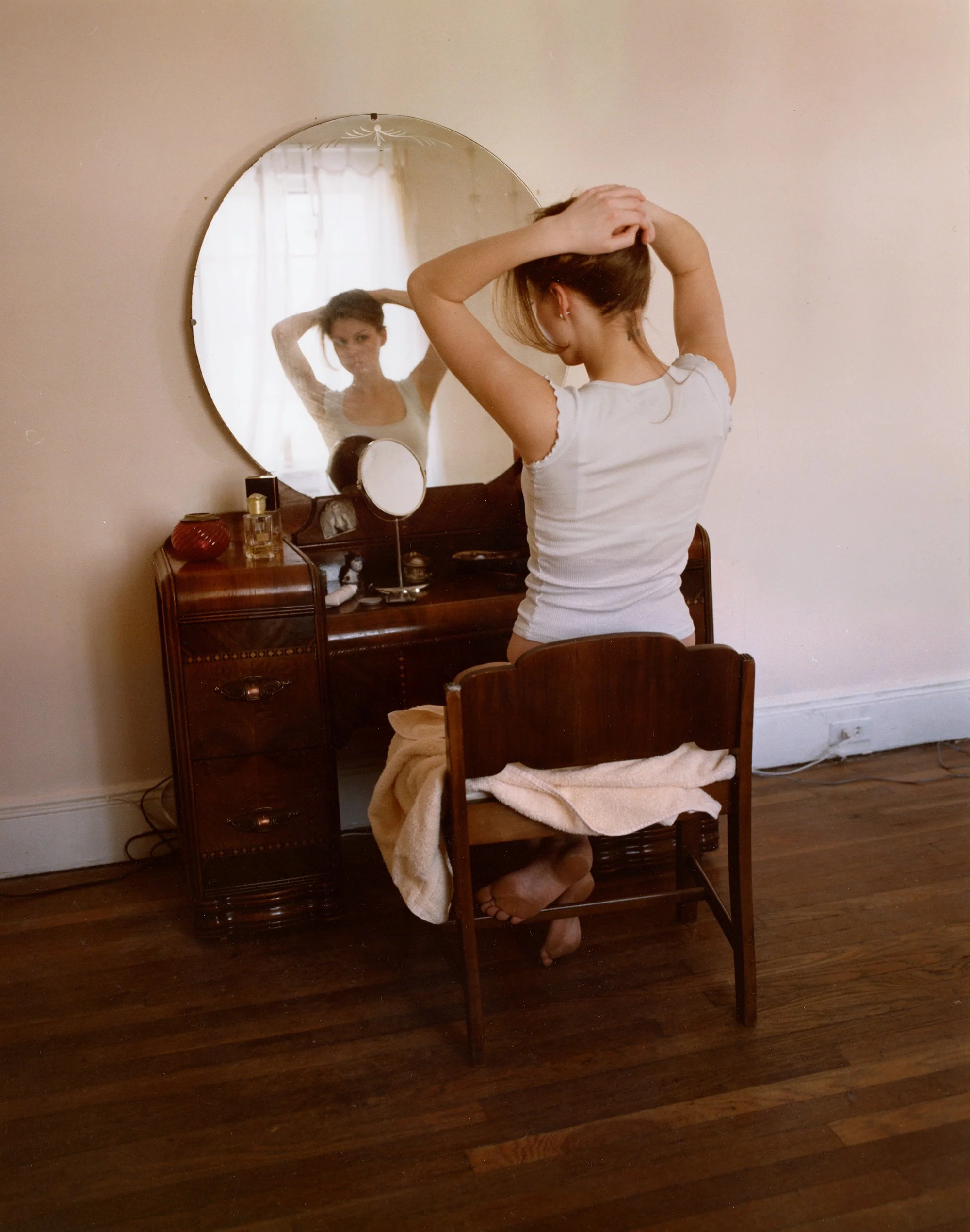
Alice, 2003. Rachael Woodson.
In her essay Touching Photographs: Roland Barthes’s “Mistaken” Identification (2002), researcher and photographer Margaret Olin describes an index as a representation created by direct contact with its referent:
A thumbprint is an index. Because the item had to be there for an indexical representation of it to exist, it is often thought that an index is inherently more persuasive than an icon. A photograph is both an icon and an index; it is like an icon with a seal of approval, or, as Barthes calls it, a ‘certificate of presence.’Though years had passed since I’d last seen the postcard, I recognized it instantly. That day, it appeared to me as a talisman. Moved by my discovery and the years of handling that had worn away its surface, I examined it more closely. Among the marks, I could make out several barely visible fingerprints. An atlas of touch, a certificate of presence.
The photographer
Richard Avedon believed in surfaces. Through his lens, they became an elastic material, full of contradictions to explore. His intention was to make photographs that mapped out a person’s “emotional geography” (“Avedon,” interview for Le Monde, July 1993). Translating such clues into image form required a total visual sensitivity; think of Andy Warhol’s belly full of scars, the textures of Isak Dinesen’s face, Sandra Bennett’s freckled skin and steady gaze.
Avedon’s technical choices reflect this. Both the medium format Rolleiflex, positioned at waist level, and the large format camera he would later use allowed for the line of vision between photographer and subject to remain unobstructed. By the late 1950s, he was established in the fashion world, creating editorials for Harper’s Bazaar and Life. In parallel, his portrait work was taking an experimental turn. Isolating backdrops and raw directional strobe light brought surface details and emotional nuance to the forefront.
Underlying Avedon’s versatility between the fashion and art worlds was a conception of beauty that drew from personal experience. He grew up in Depression-era New York, and some of his first photographs were portraits of his younger sister Louise. She was known for her enigmatic looks and would become the archetype for the models Avedon worked with early on in his fashion career. He later described the isolating effects of such objectification as having weighed heavily on Louise (“Un Portrait est une Opinion,” Égoïste, September 1984).
Avedon spoke of the theatrical lengths his family would go to when taking snapshots — posing in front of a stranger’s luxury home or an expensive car, borrowing a dog to complete their picture-perfect fantasy narrative. “All of the photographs in our family album were built on some kind of lie about who we were, and revealed a truth about who we wanted to be.” (“Borrowed Dogs,” Richard Avedon: Portraits, 2002). A photograph’s surface is understood as a porous site where reality and fiction overlap.
Readings of a star
On May 6, 1957, Marilyn Monroe arrived at Richard Avedon’s Madison Avenue studio to shoot publicity for her upcoming film The Prince and the Showgirl. This was the first and only film she would produce independent of the Hollywood studios. She was thirty years old and at the height of stardom. Avedon later recalled:
There was no such person as Marilyn Monroe… Marilyn Monroe was someone Marilyn Monroe invented, like an author creates a character… For hours she danced and sang and flirted… And then there was the inevitable drop. And when the night was over… she sat in the corner like a child, with everything gone… And as I came with the camera, I saw that she was not saying no.
(“Avedon’s Endgame,” Maria Morris Hambourg and Mia Fineman, Richard Avedon: Portraits, 2002)
The most enduring of the photographs made that day, featured on the postcard pictured here, is occasionally referred to as Sad Marilyn. This strikes me as a reductive label, conflating Avedon’s image with Charcot’s photographic experiments at the Salpêtrière. To move beyond the surface of this particular portrait, one must keep in mind Avedon’s penchant for paradox and the layers of Monroe’s performative skill, exercised both for the public and for the camera. As Sharon Marcus states in her book The Drama of Celebrity (2019):
Like any celebrity, Monroe became a distinctive star not simply by standing out from the crowd but also by multiplying herself. To read a single article about Marilyn Monroe was often to encounter many Marilyns, since editors and page compositors rarely limited themselves to one picture of the star.
The public’s fascination with Monroe’s plurality lies within the fluctuating ideologies of post-war America. In Stars (1976), Richard Dyer points out that the diffusion of Freudian thought in popular culture, the publication of the Kinsey reports and Betty Friedan’s The Feminine Mystique as well as shifts in film censorship amid competition from television all contributed to making her image so successful. In La Rabbia (1963), Pier Paolo Pasolini portrays Monroe as the perfect host for an image-hungry culture, her death a symbol for the transition into a post-atomic era.
The most photographed girl in the world
I have yet to encounter Marilyn Monroe’s account of being photographed by Richard Avedon, which leads me to reflect on her relationship to photography in general. In the first pages of her unfinished autobiography, she recalls an early experience with a photograph:
There was one object in my mother’s rooms that always fascinated me. It was a photograph on the wall. There were no other pictures on the walls, just this one framed photograph. Whenever I visited my mother I would stand looking at this photograph and hold my breath for fear she would order me to stop looking. (My Story, 1974)
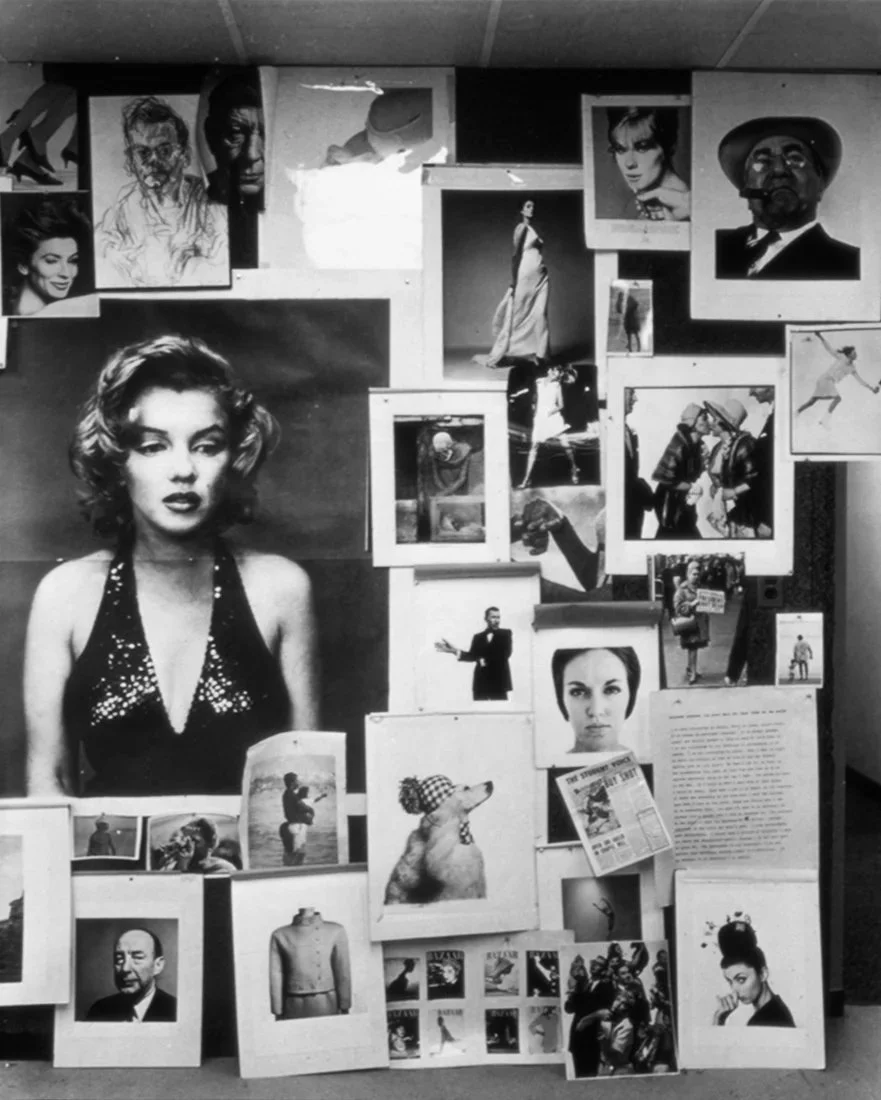
Installation view of the exhibition A Collage, McCann, Erickson, New York, 1964. Photographer : Richard Avedon. © The Richard Avedon Foundation
Marilyn was told that the man in the photograph was her father, a revelation that set off an intense emotional reaction. The portrait took on a symbolic presence, becoming a proxy for an absent man. “The night I met his picture I dreamed of it when I fell asleep. And I dreamed of it a thousand times afterward.” This suggests that photography functioned for Monroe not merely as representation but as a space of projection and fantasy, prefiguring the mirror of selves she would later construct for the camera.
Portraits
When I left Alice’s empty apartment, I carried a small selection of her things that followed me back to Paris — a moth-eaten silk handkerchief, a copy of The Autobiography of Malcolm X and the postcard. Like the framed father for Marilyn, Alice’s postcard has become a host of ideas and images that extend far beyond its material circumstances. I see it as a contemporary relic, a palimpsest of histories opening onto countless memories.
In the fall of 2002, the Metropolitan Museum of Art opened Richard Avedon: Portraits, a major exhibition spanning his sixty-year career and the last held during his lifetime. Having just moved to New York to study photography, I went to see the exhibition and spent a long time taking in room after room of people who had agreed to perform some part of themselves for Avedon’s ritual.
Alice and I must have talked about it not long after. By then, I was making a series of portraits of her and our two brothers, and would often spend weekends at our mother’s house in New Jersey photographing them. On one such occasion, I noticed the Marilyn portrait taped to the side of the round mirror in her bedroom, no doubt cut out from a review of the exhibition she’d read in one of her fashion magazines. This was later replaced by a more durable postcard version, which remained there for many years. The day Alice left our mother’s house, the portrait went with her and it never left her.
First published in French in Entre-Temps (Collège de France), February 11, 2026
Afterimage is an ekphrastic series exploring that one image you see when you close your eyes—the one that lingers in your mind. We invite different people to reflect on an image they can't shake. This column originated in the inaugural issue of the Objektiv journal and continues today here on our web journal.
SVERRE STRANDBERG ON JEFF WALL
There is something about the modernist house, the architecture, the building filling most of the picture frame. And then this figure outside. There is some realism in the photograph, and yet it is a constructed scenography. I like this dualism between realism and the constructed, where you intervene in something which is realistic.
One can choose many different details in this one. The milk being in a paper bag, for one, hidden from view, and the one holding it looking in the other direction. Turning away from the explosion. One can see the veins in his arm. It makes me think that he is holding something back, something that is about to burst out, much like the splash of milk.
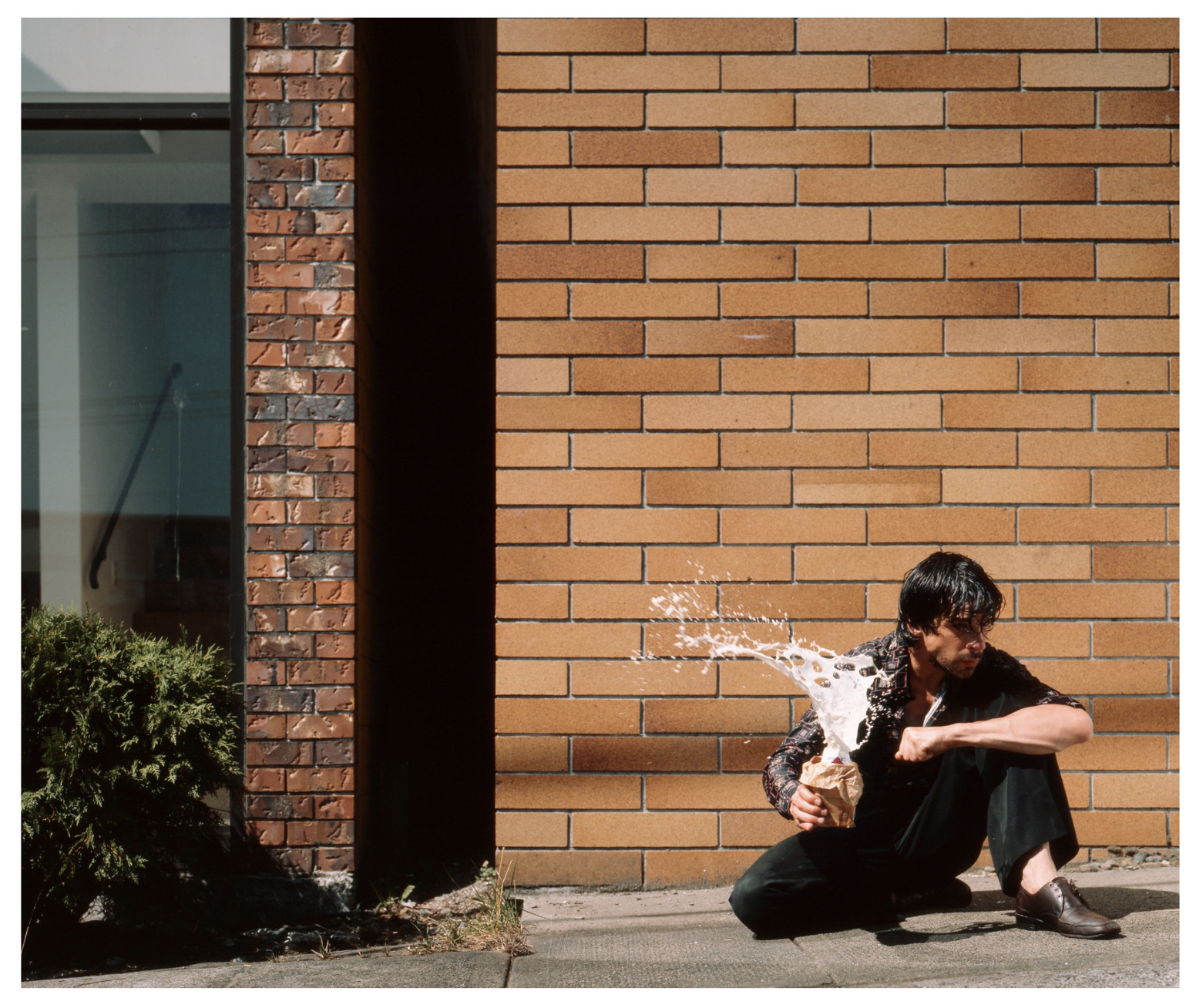
Jeff Wall, Milk, 1984.
Afterimage by Sverre Strandberg:
It is in a way a hard task to think about just one image as how I relate to photography has changed. The idea of the singular image is not on my mind these days. I think of images in a series, in a context of more images. I am no longer seeking the one glorious photograph as I used to do.
There is one very well-known work on my mind though, Milk by Jeff Wall. It is a bit scary to talk about such a known image, from a time when the formats were huge, in the 80s, with him and Gursky, Ruff, and the others.
This one stuck with me. I had started art academy working with film, and then, in my final year, I flipped through different photobooks and there it was. It sort of beat everything else in a way. Looking at it again for this, it has this composition where everything goes together, and the frozen moment of the liquid, something only photography can do. And the fundamental symbolism of milk for all humans. Milk emerged as a recurring theme in contemporary photography from the early 1960s through the 1980s.
There is something about the modernist house, the architecture, the building filling most of the picture frame. And then this figure outside. There is some realism in the photograph, and yet it is a constructed scenography. I like this dualism between realism and the constructed, where you intervene in something which is realistic.
One can choose many different details in this one. The milk being in a paper bag, for one, hidden from view, and the one holding it looking in the other direction. Turning away from the explosion. One can see the veins in his arm. It makes me think that he is holding something back, something that is about to burst out, much like the splash of milk.
Afterimage is an ekphrastic series exploring that one image you see when you close your eyes—the one that lingers in your mind. We invite different people to reflect on an image they can't shake. This column originated in the inaugural issue of the Objektiv journal and continues today here on our web journal.
BRIAN PAUL LAMOTTE ON Sonderkommando No. 283
Perhaps the political power of an image isn't simply its ability to show us something.
It is its ability to make it impossible for us to say that we did not know.
For as long as I can remember, I’ve been surrounded by photographs and steeped in image culture. An early university professor keenly observed that I had seen more images in my short lifetime than all of my classmates combined. Growing up in my father’s photo studio, I had access not only to the means of production but also to endless slides, negatives, and prints.
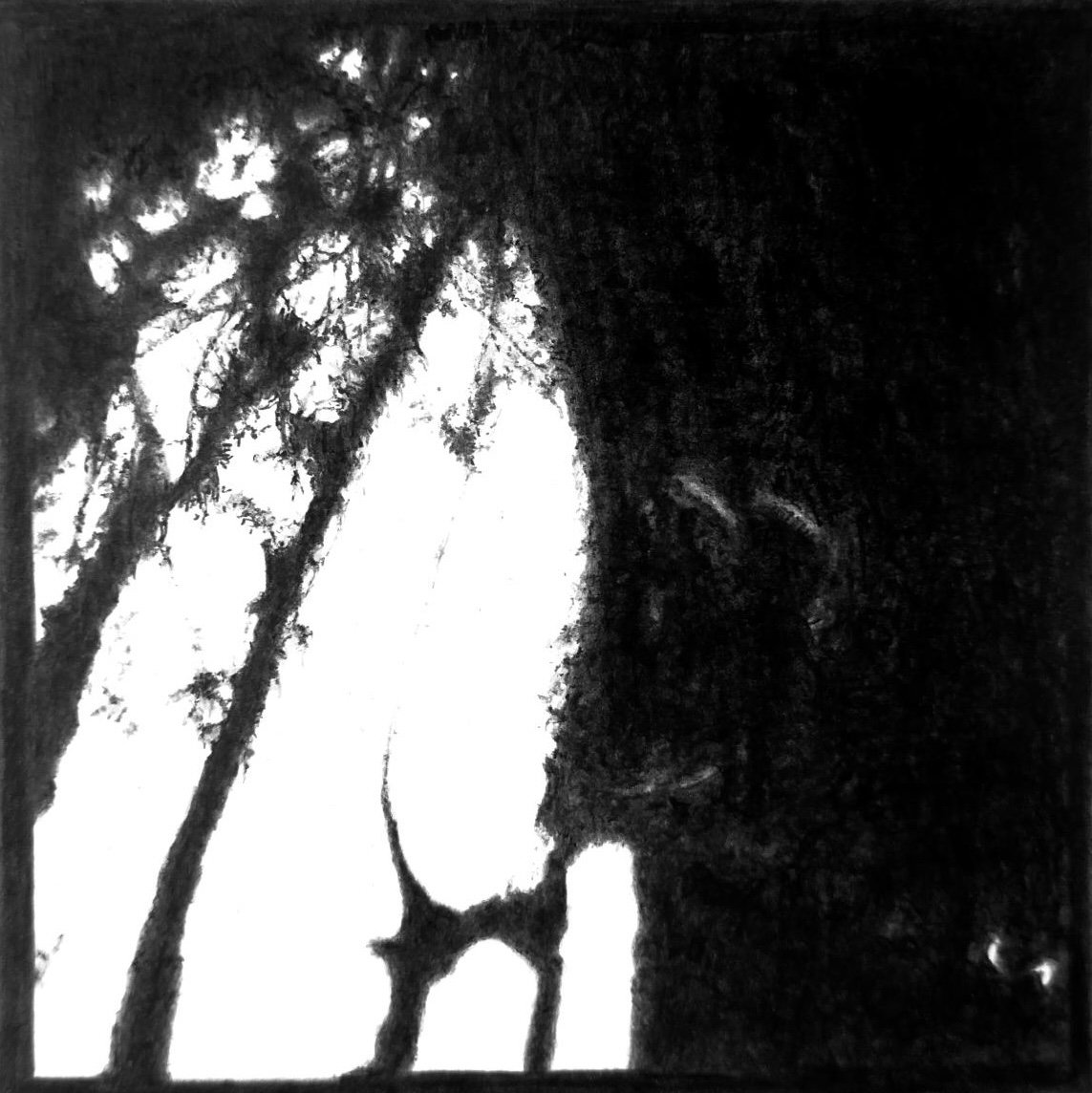
Gerhard Richter, Birkenau no. 283, Postscript.
Afterimage by Brian Paul Lamotte:
Perhaps the political power of an image isn't simply its ability to show us something.
It is its ability to make it impossible for us to say that we did not know.
For as long as I can remember, I’ve been surrounded by photographs and steeped in image culture. An early university professor keenly observed that I had seen more images in my short lifetime than all of my classmates combined. Growing up in my father’s photo studio, I had access not only to the means of production but also to endless slides, negatives, and prints. I took this for granted before that comment. I now have the privilege and pleasure of working with images daily, designing art and photography books for nearly twenty years, drawn not only to their material aspects but also to working with sequences and multiple images. It’s perhaps not a coincidence that the photograph that has stayed with me since last November cannot be separated from its place at the end of a sequence documenting one of the most horrific moments in human history.
On a brisk and grey Sunday at the tail end of Paris Photo last November, I made the journey to Fondation Louis Vuitton to see the Gerhard Richter retrospective. I went expecting blurry paintings and gestural movements to soothe my eyes and mind after a long week of photographs and books. Instead, when I reached the end of the exhibition, I was confronted with something so urgent and haunting that I couldn’t look away, and seemingly everything I had seen previously vanished. It wasn’t a painting or a book but a series of small black-and-white photographs tucked into the back left corner of a cavernous room, with four overwhelming canvases hanging adjacent and smoky mirrors on the opposite wall. The canvases were Richter’s monumental Birkenau paintings. The small photographs in the corner, framed and placed in sequence, were his source material: the clandestine Sonderkommando photographs taken inside Auschwitz-Birkenau and smuggled out through the Polish Resistance. What struck me, and what has stayed with me, is not simply the photographs themselves but the feeling of urgency and necessity when you observe them. The first two frames, No. 280 and No. 281, depict the atrocities we have come to understand and collectively reckon with. But it was the final two, and particularly No. 283 (shown above), that affected me most—not for what they depict, but for what is missing or lies outside the frame. The danger and fear we feel in the tilted frame of No. 282 become more palpable in No. 283 as form and figure fall away and we’re left with abstraction and uncertainty. Its power comes as much from what is outside the photograph as from what is inside it.
As I left the exhibition, shaken and moved in a way I hadn’t experienced before, I began an internal dialogue about political images and our contemporary image culture. We consume photographs through various feeds and endless social-media scrolls, where images of suffering become part of the same visual stream as everything else. What the Sonderkommando photographs unearthed was a more profound question for me: What has happened to our capacity to sustain attention to an image? The first two frames are figurative and frankly unimaginable, while No. 282 and, more so, No. 283 have a pastoral and abstract quality that becomes deeply unsettling once we understand their context and the frames that preceded them. One could argue they hold more resonance because of the unspectacular nature of what they don’t depict. The trees and skyline bear witness to what is outside the frame and force us to ask: What can an image make visible without showing the thing we expect it to show?
I’m writing this ten months later, sitting in a friend’s Berlin apartment I’m calling home for the next week and a half. An enormous black-and-white print sits behind me depicting a Palestinian olive tree in the occupied territories. Its monumentality and fragility, and the history carried by the tree itself, are not lost on me. Yesterday I biked past the Memorial to the Murdered Jews of Europe on my way to see a Brâncuși retrospective. Abstraction keeps reappearing. History and current politics are intertwined and colliding in this country’s collective memory as it struggles to negotiate the complexities of “never again.” What is the responsibility of memory if it does not alter how we encounter suffering in the present? No. 283 gives us trees and sky; the Palestinian olive tree carries land, continuity, displacement, inheritance, and survival; Brâncuși reduces bodies and objects towards elemental form; and the Holocaust Memorial refuses figurative representation, giving us repeated concrete forms. All, in different ways, make visible something that cannot simply be depicted.
The photographer of the Sonderkommando photographs, long identified only as “Alex” and now widely believed to have been Alberto Errera, a Greek Jewish naval officer, made these images as an act of resistance and testimony. He and the fellow prisoners who acted as lookouts risked their lives to document what was being deliberately kept unseen. The photographs survived through a chain of people who understood that this evidence had to reach the outside world. The Nazis understood that images of this nature could not be allowed to exist, that visual evidence threatened the machinery of extermination. What stays with me, and what I continue to ponder, is this contradiction: the necessity of making photographic evidence and the necessity, for those committing the atrocities, of destroying it. The image itself became an act of resistance, evidence that had to survive and reach the outside world.
We’re left with trees. Sky. Almost nothing.
Support for Palestinian Students to Study Abroad (SPSSA) is currently raising funds to help Palestinian photography students evacuate Gaza and continue their studies in the UK, covering tuition, living, evacuation, and contingency costs. Donate via Chuffed
Afterimage is an ekphrastic series exploring that one image you see when you close your eyes—the one that lingers in your mind. We invite different people to reflect on an image they can't shake. This column originated in the inaugural issue of the Objektiv journal and continues today here on our web journal.
WHITNEY HUBBS
In February 2025, one week before David Lynch died, and six months before my thirty-year high school reunion, I watched my high school in west L.A. burn down on Instagram live, in my home, in an upstate New York town, during a snowstorm. It didn't feel real, and that makes sense to me. I didn't feel sad, and I'm embarrassed that this also makes sense to me. It felt more real and more sad that David Lynch died. And then I feel sad because I felt closer to David Lynch than I did to my life during high school, or maybe that's normal?
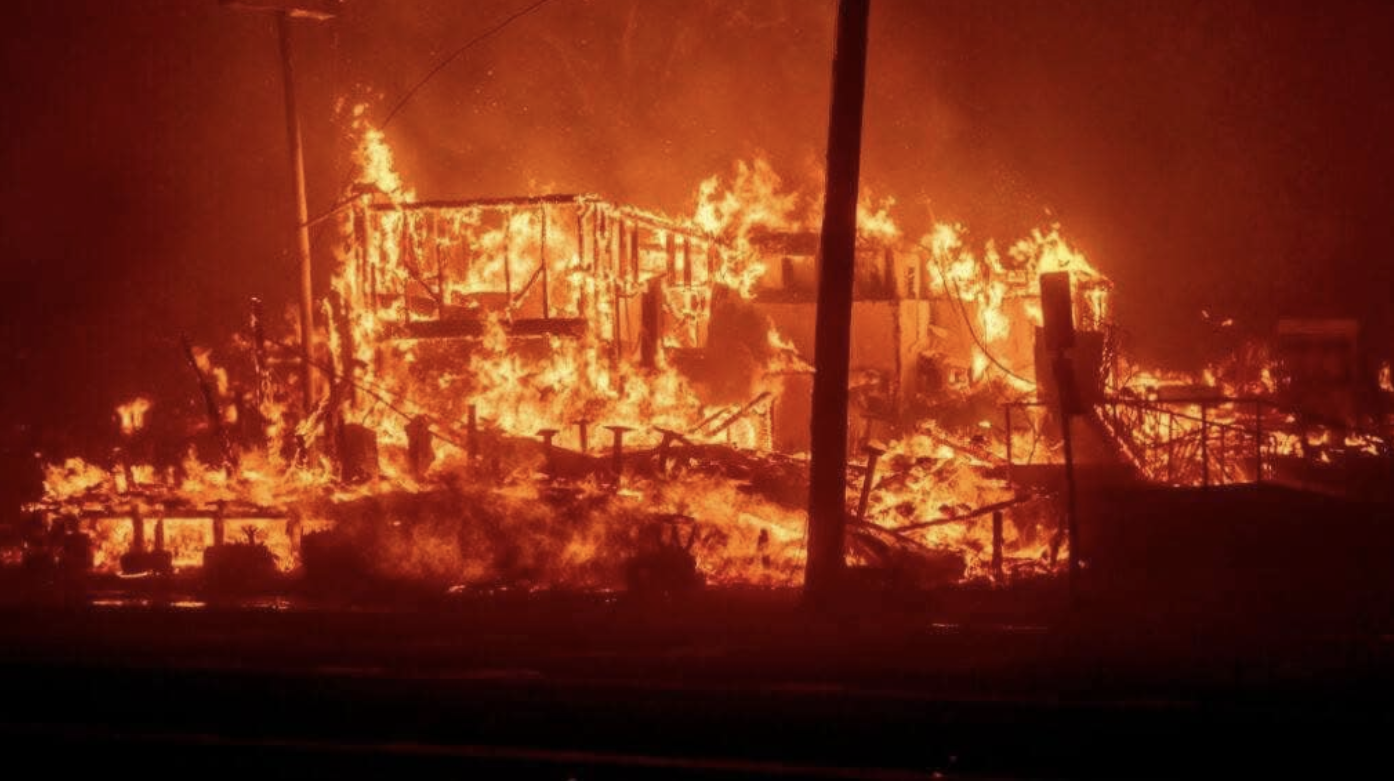
Screenshot of the fire.
Afterimage by Whitney Hubbs:
In my second round of puberty (aka perimenopause) my high school burned down. In February 2025, one week before David Lynch died, and six months before my thirty-year high school reunion, I watched my high school in west L.A. burn down on Instagram live, in my home, in an upstate New York town, during a snowstorm. It didn't feel real, and that makes sense to me. I didn't feel sad, and I'm embarrassed that this also makes sense to me. It felt more real and more sad that David Lynch died. And then I feel sad because I felt closer to David Lynch than I did to my life during high school, or maybe that's normal?
Carrie and Teen Wolf were shot at my high school that burned down. I also found out that the second house I lived in—that a reality tv star lived in with his wife—burned down.. In 2018 I watched the first house I lived in burn down on a livestream YouTube channel, shot from a helicopter. M*A*S*H and Twin Peaks were filmed around that house. I watched that house burn down in a different, but smaller, upstate New York town, and also during a snowstorm.
Back to my high school. I don't see why my locker wouldn't have burned down with the entire school, but that would mean that the photo classroom across from my locker also burned down where the only good memories are from my puberty. I took my first photo class when I was a freshman in 1991. That year I wanted to be a war photographer because my teacher showed us James Nachtwey's War Photographer. But then when I was a sophomore, he showed us Annie Leibovitz's pictures of famous people, like that Keith Haring portrait. I didn't really want to be her, because being Keith Haringg seemed cooler. And when I pretended to be him and made a self-portrait, I got photo of the week.
I am writing this in 2026, and I hear that my high school is holding classes at the empty Sears building in the next town over—a place I shoplifted knock off Doc Marten's from. By the time this second round of puberty hit, both houses from my first eighteen years were incinerated. Both times, I decided not to go back and photograph these places that aren't even places anymore, and instead I had a fun (in a macabre way) writing about it.
Afterimage is an ekphrastic series exploring that one image you see when you close your eyes—the one that lingers in your mind. We invite different people to reflect on an image they can't shake. This column originated in the inaugural issue of the Objektiv journal and continues today here on our web journal.
SERAFIN GERBER ON RYAN MCGINLEY & FERDINAND HODLER
I am on a journey to find the image in my head. I haven't reached the bottom, but I'm on it. I took the assignment literally: what's the image you see when you close your eyes? So I lay down, closed my eyes, and looked. Not one image came, but many.
I'm a melancholic person, especially in summer (I’m writing this in July); every new one makes me feel time passing, and I think of past summers, miss what has been. The older I get, the more I think: I used to be so young, so free, everything felt light, endless, limitless. Now it all feels heavier, more serious. This feeling hits me every summer.
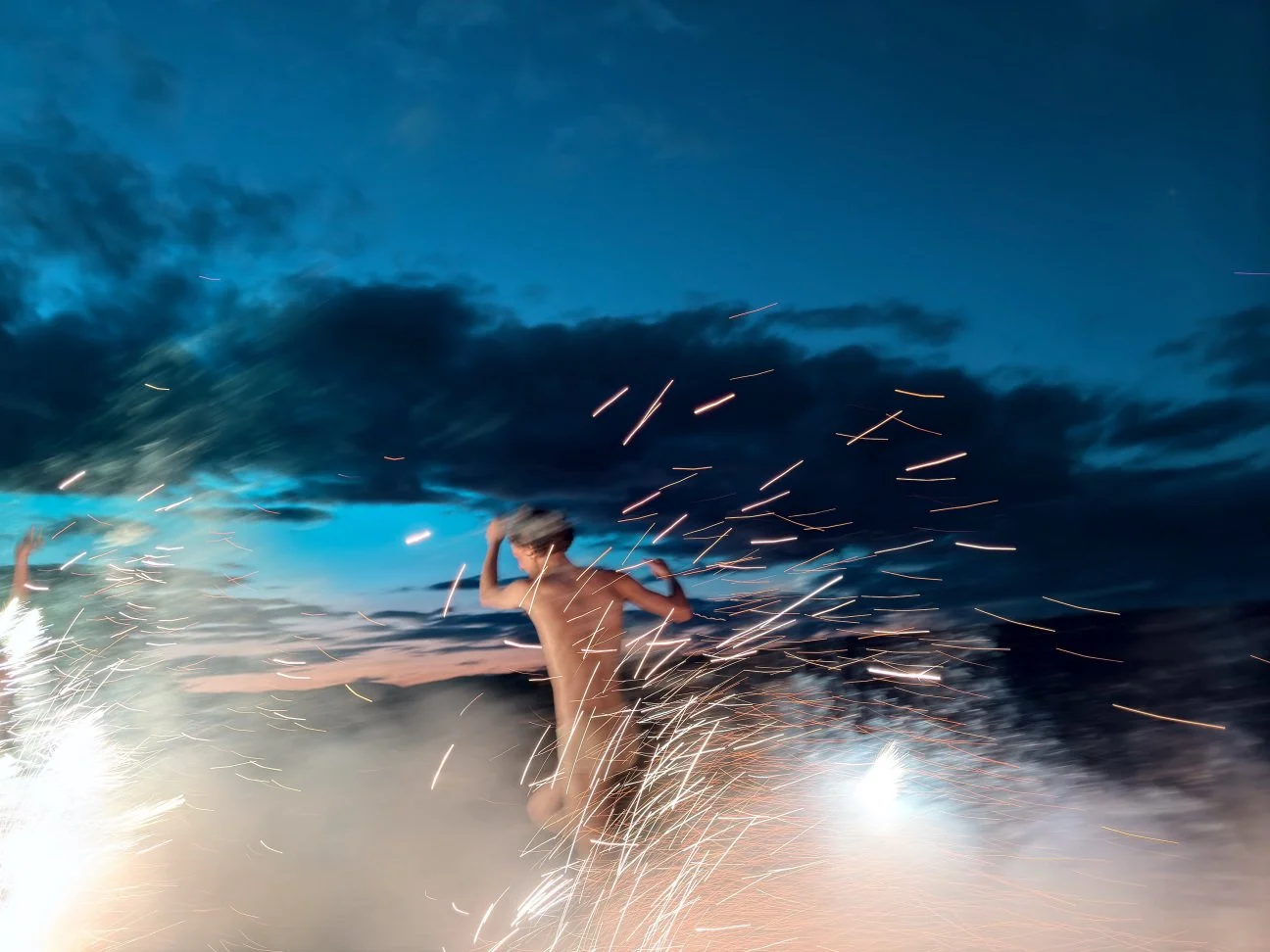
Ryan McGinley, Sparky.
Afterimage by Serafin Gerber:
I am on a journey to find the image in my head. I haven't reached the bottom, but I'm on it. I took the assignment literally: what's the image you see when you close your eyes? So I lay down, closed my eyes, and looked. Not one image came, but many.
I'm a melancholic person, especially in summer (I’m writing this in July); every new one makes me feel time passing, and I think of past summers, miss what has been. The older I get, the more I think: I used to be so young, so free, everything felt light, endless, limitless. Now it all feels heavier, more serious. This feeling hits me every summer.
There's a contrast in it. On one side I'm fully present, swimming in a river under this exact sun, hyper-real, right here, right now. But then it layers with every summer before it. It results in this sort of mental time travel, this longing for what has been, this slight fear of what's coming. The very moment becomes a timeline. Saturated, both ways at once.
I grew up in the countryside, so visually summer to me means saturated colour, late evening light lying horizontal and warm, fields, meadows, the wind in them, rivers, hills, mountains.
I have this ritual I do every time I swim: I dive, open my eyes underwater, and swim toward the sun looking straight at it, watching the light break. Full steam summer evening light, running super fast, close friends, warm beer—this is where freedom lives, where everything feels possible. Wide space, the sky, closeness, intimacy, melancholy.
Three images came out of it, layered.
The most photographic one is Ryan McGinley's early work—fireworks, figures shot against the sun. It's the same gesture: looking into the sun through water, that closeness, that youth. His images breathe. Everything is here at once. I found his work years ago, forgot about it, and it came back to me while I was trying to name this feeling—the wide lens, people close together, fireworks or sun, small flares of light. Not many photographs move me the way his do.
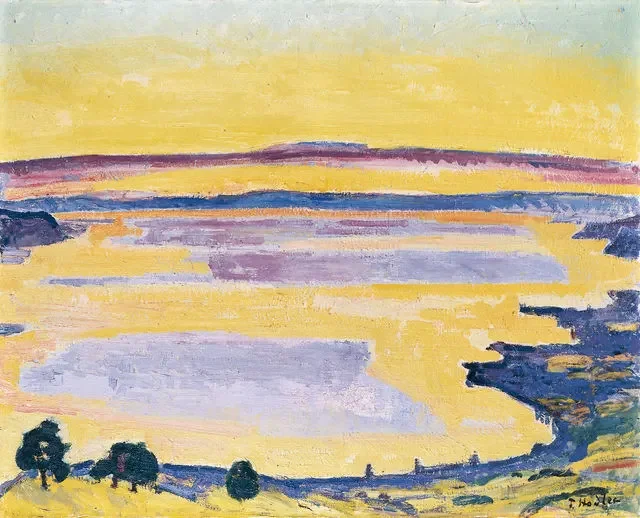
Ferdinand Hodler, Sonnenuntergang auf dem Genfer See, 1915.
The second is Ferdinand Hodler, a Swiss painter—lakes, forests, streams, rocks, his light. Figures holding each other by the hand. I can't name one painting; it's the colour and the light matching what I feel, not any single image.
The third is the sunrise emoji. I use it constantly. A small square that is also an image.
These three layer into what I see right now when I close my eyes. Together, they are my inner world right now. Not a concise answer to a simple question. The word for it might be saudade—the presence of an absence. Longing for something that isn't here now.
Afterimage is an ekphrastic series exploring that one image you see when you close your eyes—the one that lingers in your mind. We invite different people to reflect on an image they can't shake. The column began during our time publishing the journal Objektiv and continues today under Objektiv Press.
TORBJØRN RØDLAND ON DIM REVELATIONS
Following the recent release of Dim Revelations, The 2013 Journal, we present two interviews in which Rødland speaks about the book and his photographic process:
In 2013, photographic artist Torbjørn Rødland decided to write. A small piece of text every day, sometimes about photography as an art form, sometimes about his own process ("I got up early and put striped toothpaste on a frankfurter in a wheat bun, right here on the floor"), sometimes about films he watches, Edvard Munch's understanding of hell, or the joy of a fully charged electrical device.
Following the recent release of Dim Revelations, The 2013 Journal, we present two interviews in which Rødland speaks about the book and his photographic process.
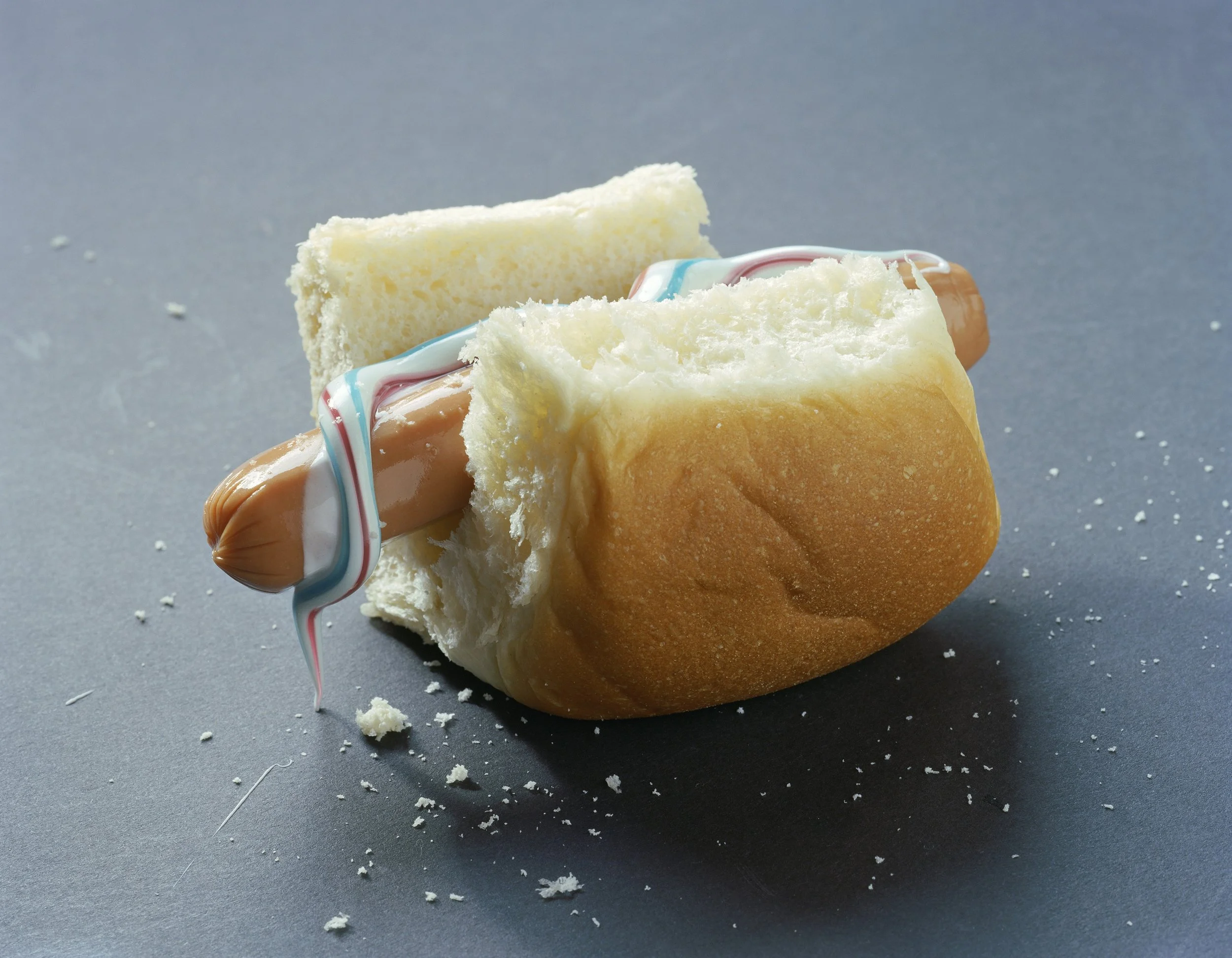
Torbjørn Rødland, Hot Dog, 2013, 28 x 35 cm.
Dark Revelations, D2
By Maja Hattvang
Torbjørn Rødland publishes his diary from 2013 and gives a rare insight into his own photographic process.
In 2013, photographic artist Torbjørn Rødland decided to write. A small piece of text every day, sometimes about photography as an art form, sometimes about his own process ("I got up early and put striped toothpaste on a frankfurter in a wheat bun, right here on the floor"), sometimes about films he watches, Edvard Munch's understanding of hell, or the joy of a fully charged electrical device.
"My best thinking is wordless," he writes, for example, on January 8: "I'm a photography-thinker, which is not quite a thinker." Nevertheless, the entries carry the same shifting between high and low, sincerity and irony that characterizes his photographs.
The idea was always that it would be published, but only now, 13 years later, has Dim Revelations, The 2013 Journal arrived.
"The year 2013 very quickly looked very outdated," says Rødland, who recently moved from Los Angeles to New York. "I had to wait until we could look at the year from a certain distance."
The book is part of Objektiv Press's essay series on camera-based art, and offers a rare glimpse into Rødland's photographic process, which tends to depend on a combination of thorough preparation and intuition.
Halfway through the year, he comes across, by chance, the American author Ken Wilber's so-called integral theory: a kind of synthesis of Eastern and Western, new and old knowledge traditions. It has a tremendously productive effect on his thinking around his own work.
"When I studied photography in Bergen, you were either straight, subjective and poetic, or you were staged, appropriating and critical. Only the latter of these two positions had validity, but it wasn't inclusive enough for me. I needed the poetic and the subjective, but I couldn't ignore the staged and the critical," he says.
"I knew that what I was searching for wasn't a nostalgic image, but I had no suitable concepts. What I wanted to do didn't exist, and therefore had no name."
This was what he found in Wilber's ideas: a concept that encompassed all layers of meaning at once.
Rødland's photographs tend to be perfectly lit, sometimes bordering on softcore or advertisement-like in their choice of subject matter, and haven't always been read in the multi-layered way he himself works from.
"Is it about a need to be understood?"
"Understood. Seen. Mostly on behalf of the images. I'm painfully aware that I fall short as a communicator. But stronger than the need to be understood is my own need to understand."
The 2013 Journal: Torbjørn Rødland, Daily Lazy
By Koshik Zaman
K.Z: This is an honor. I very much enjoyed reading your brand new book Dim Revelations: The 2013 Journal, which is based on diary entries from that year. I chuckled several times, and I loved all the references and insights. According to the preface, you had not kept a diary before 2013, or after, for that matter. What prompted you to start then? Why was that year particularly suited to this?
Torbjørn Rødland: In 2011 I published twenty sentences on photography, and the response I got to that text encouraged me to write more. I was in Scandinavia without my equipment over the 2012 Christmas holidays and decided to start writing on January 1.
K.Z: Out of curiosity, why did you leave out Sundays?
TR: I like the biblical concept of taking Sundays off. It makes a lot of sense to me.
K.Z: Right, you allude to that in one of the entries where you mention Roe Ethridge. What did an ideal Sunday look like then?
TR: Not so different from all the other days. I just didn't have to come up with a paragraph for the journal. A Sunday could be a great day for, say, making a picture.
K.Z: The format is intimate, very reminiscent of a notebook, and fits well within Objektiv Press' essay series. Had you always intended for it to be published, or did that idea come later?
TR: The idea was always to publish it, and the question was always when.
K.Z: So why is now a good time to publish it?
TR: I'm not sure it is. Objektiv Press asked very nicely for a contribution to their book series, and this journal was the best unpublished "essay" I could find on my PowerBook. A lot of people look back at the years leading up to 2016 as a different reality, so maybe 2013 is finally ripe for a revisit. Things and times have definitely changed.
Excerpts from Dim Revelations:
04/26
I think I'm violating the portrait image. They think I'm violating the portrayed person.
06/01
Sexual tension is either projection, telepathy, or a combination of the two.
10/30
A photographer is someone who has grown to love the limitations of her camera.
K.Z: It's evident that you're a talented and very witty writer. Have you not felt compelled to keep writing?
TR: No. Every generation produces a lot of writers who do it better than me, but there is a lack of exciting photographers.
K.Z: Returning to the project more than a decade later, are there any entries that made you think, "I would not write that today"?
TR: Certain artistic approaches that felt tired to me in 2013 are receiving less positive attention today, so I probably wouldn't feel the need to throw shade in those directions. I'm older and would generally throw less shade now, though I repeatedly went there because, as a reader, I'm excited by that type of frankness. I'm drawn to the directness in Edmund Wilson's diaries, perhaps forgetting that they weren't published until after his death.
K.Z: For a contemporary art audience, an introduction is almost redundant. You are one of the leading figures in contemporary photography, and your mise-en-scène approach has clearly
influenced many younger artists. I would still love to ask how you first got started in photography.
TR: I grew up with a father who read amateur photography magazines. He gave me a camera when I was maybe eleven. At that time I was already a dedicated cartoonist, but when that spark expired in my late teens, I transferred my love of image-making to photography. I never seriously considered painting.
K.Z: I read somewhere that you have also worked with video and film, which I was not aware of at all. I believe some of those works were made before you moved to Los Angeles. Has living in the city not inspired you to revisit those mediums? Reading the book, it's evident that you're very interested in film.
TR: Moving to Los Angeles in 2010, I thought the next step would be to make a movie long enough to cross over into the world of cinema, but Hollywood diminished rather than strengthened that appetite. Last year I moved away from California. Let's see if the hunger returns. I won't tell you my genre-bending idea for a feature-length film, as it has still not been attempted by anyone else.
K.Z: Finally, what is left for you to explore? You've exhibited widely, in blue-chip galleries and world-renowned institutions alike. What still excites or challenges you?
TR: Oh, I'm not as impressed by the reception as you seem to be. Have you ever seen one of my exhibitions? Very few have. In my mind, it's just getting started. It will be a long process. What else is exciting? There are still a lot of possible photographic images that just aren't being created. I'll try to make some of them.