NINA STRAND ON TOM SANDBERG
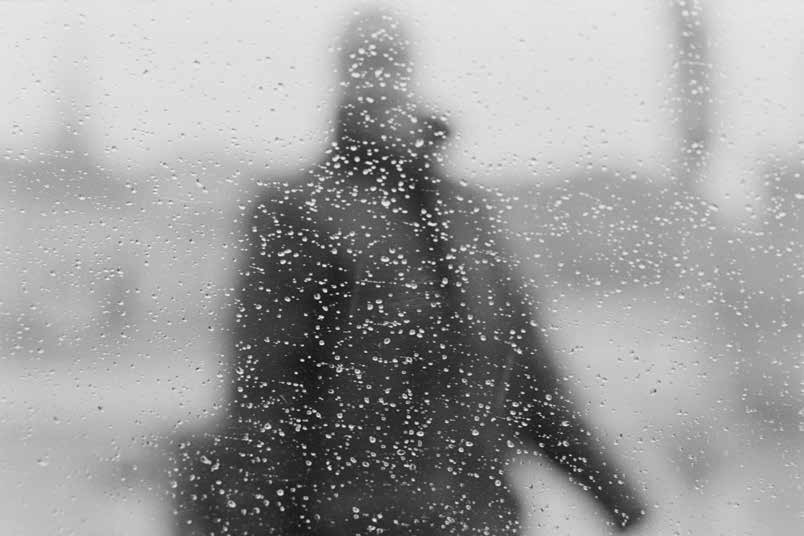
Tom Sandberg, Untitled, 1997.
Afterimage by Nina Strand:
After looking through the twenty issues of the journal Objektiv, I notice that the images that speak the loudest to me, and about which I’ve continued to think long after the issue went to print, all stem back to one singular photograph, a sort of fulcrum image. Asked about his work, the late Robert Frank said: “When people look at my pictures, I want them to feel the way they do when they want to read a poem twice.” It is a photograph by Tom Sandberg, taken in the nineties. When I first saw this image in my early twenties, printed on a postcard sent to me by a friend, it seemed to sum up my interest in photography, both as a practitioner and as a writer. The black-and-white photograph depicts a man walking in the rain, taken through a window. He is blurry; the focus is on the raindrops. Before I knew anything about the photographer, the image simultaneously evoked both loneliness and authority; his oblivion to the rain was something that I later discovered says a lot about Sandberg. He was drawn to the darkness, and this darkness and longing are in the photograph.
He lived with a curiosity and a restlessness to understand the world he inhabited, a world that was black and white in his vision. He worked continuously throughout his life because, as he put it in our interview with him in our very first issue: “Without the pictures, things would not have gone well for me.” Some situations simply had to pass through the camera.
The moment he learned that he had incurable cancer in the late fall of 2013, he started working on what he knew would be his final exhibition, Photographs, at OSL Contemporary. The exhibition presents works from his forty-year career—pieces shown all over the world, some new—and it is difficult not to ascribe a particular symbolism to them, especially the photograph from January this year of two airplane fuselages meeting. The exhibition also includes an early work from his student days at Trent Polytechnic in England: a diptych of a boy with a tennis racket. It is an artistic exercise. The boy is practising, and the young photographer Tom Sandberg is practising. He insisted on completing it despite his failing health. Photography was, as he himself said, the only thing he knew how to do, and the 16 black-and-white photographs stood as a powerful testament. He selected the images with great care; they were reprinted and refined until the very end. In the years before he passed, it might have seemed as if he was chasing the dark, but he himself said he was in control. And with that exhibition, he ensured that it is the photographs we will remember.
Four days before his passing, he made one last adjustment to a photograph of a plane in the clouds. We don’t know where we end up when we die. But when we think of Tom, maybe we can picture him, camera in hand, on a plane making lasting vapour trails in the sky.
See the retrospective with Sandberg, Vibrant World, at Henie Onstad until March 1. Afterimage is an ekphrastic series exploring that one image you see when you close your eyes—the one that lingers in your mind. We invite different people to reflect on an image they can't shake. The column began during our time publishing the journal Objektiv and continues today under Objektiv Press. This one is drawn from a text in Objektiv #11 and a chapter in the first essay in our series, Perpetual Photographs, both written by Strand.