ALAN HUCK ON NATHANIEL DORSKY
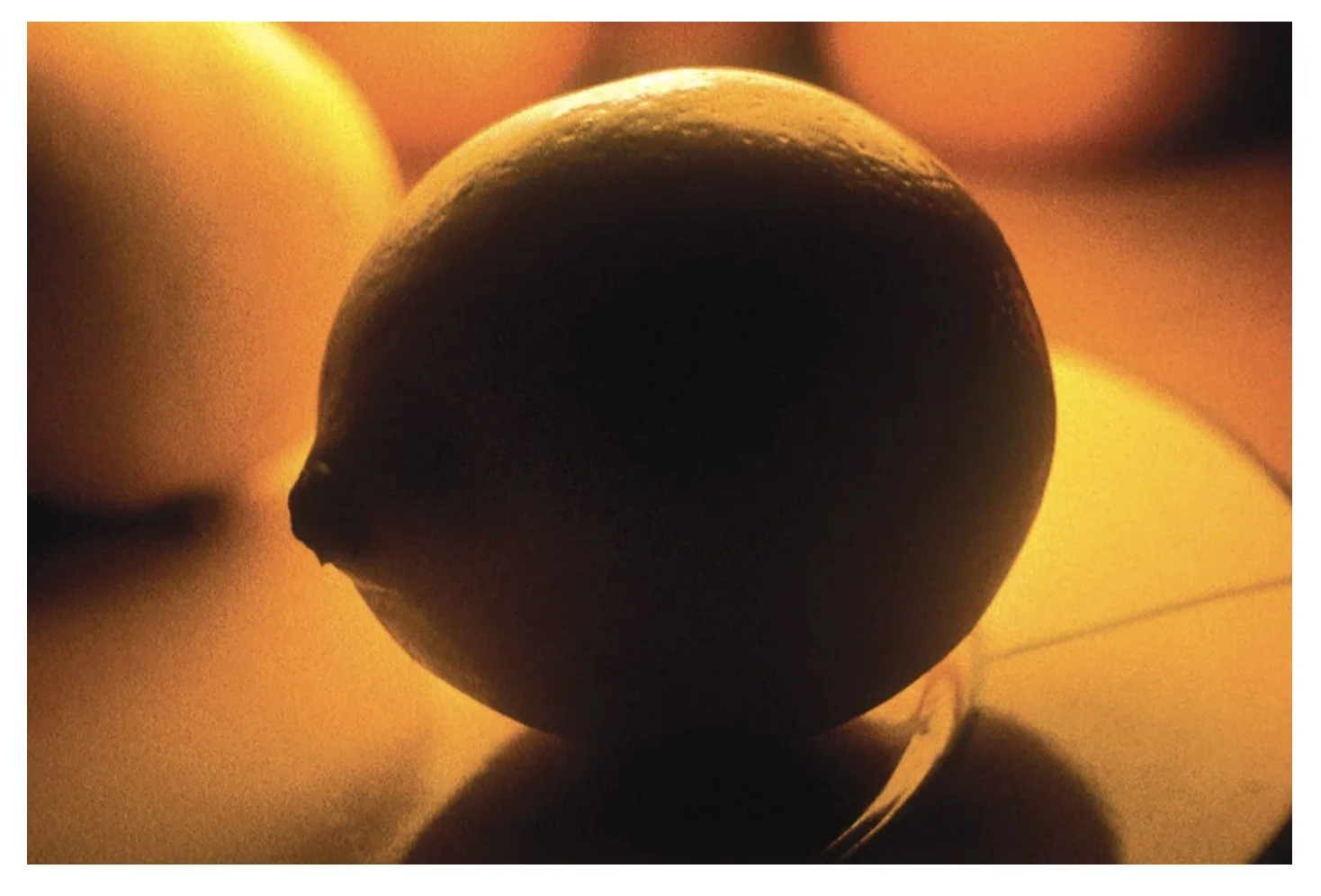
Nathaniel Dorsky, Variations (still), 1998.
Afterimage by Alan Huck:
The films of Nathaniel Dorsky unfold silently through a series of delicate observations. His camera movements are subdued if not completely absent, moving images that are mostly made up of stillness. Instead there’s just a subtle gesture, the play of light and shadow, an image that hovers there for a moment before disappearing—each one like a prayer. I find it difficult to tell his films apart in memory. Those I’ve seen share a similar tone and structure, a succession of images that float by with the same lightness of touch, free from apparent hierarchy or heavy-handed concepts. Still, there are certain images that manage to stand apart from the slow procession. They linger in the mind a little longer or, inexplicably, imprint themselves only to reappear later, in the guise of another image. The finding of an object is always, in fact, a refinding, Freud taught us.
One such image appears about three quarters of the way through Dorsky’s 1998 film Variations—the first and, probably because of this, still my favorite of his films that I’ve watched. It’s an image of a lemon, framed on either side by shots that are little more than the gentle shimmering of light. Almost eerie in its perfect roundness, the lemon is pressed into the center of the frame looking as if it’s about to burst. Its shadow faces the camera but the rest of the image is aglow with a golden yellow, as though the lemon were radiating its own light, a brilliant sun filling the room with its hue.
Thirty years earlier, Hollis Frampton made a short film that feels as though it could be an extended study of Dorsky’s frame. Over seven minutes, the camera is trained on the tough, pockmarked rind of a single lemon as darkness slowly overtakes it, rendering it into a silhouette. Another luminous, lemony sun, one whose eclipse we witness in real time. In an interview for October, Frampton confesses that he spent over an hour at the grocery store searching for the perfect lemon, the one that was “most splendidly citroid.” Both a kind of deadpan lighting instructional and a scientific experiment in object perception, Frampton claims that the film was ultimately about a “painterly conundrum.” It apparently stemmed from a conversation he’d had with the artist Robert Huot about the extraordinary number of hapax legomena in James Joyce’s Ulysses, the thousands of words that appear in the book only once. One of those words was, of course, lemon.
This past November, I stood transfixed in front of a tiny painting at the Musée d'Orsay in Paris: Édouard Manet’s Le Citron from 1880. Of all the celebrated works in the museum, it was this meager still life, only fourteen by twenty-two centimeters in size, that held my attention the longest—because, rather than in spite of its modesty, its simplicity. It was only later that I learned Manet had begun painting these kinds of miniature studies as his health declined later in life, using mostly objects that were close at hand. Like both Dorsky’s and Frampton’s, Manet’s lemon is offset by darkness—in this case, the pitch black plate it sits on, touched by a glint of white at its curved edge. It reminds me of the philosopher and theologian Jakob Böhme who, upon seeing the sunlight reflecting off a pewter dish, lapsed into a profound mystical experience. There, he saw into the divine mystery of all things, the place where the visible and spiritual realms overlap.
In the poet Mark Doty’s short book about falling in love with a Dutch still life painting, he walks out onto the steps of the Metropolitan museum and is overwhelmed by “a sense of tenderness toward experience, of being held within an intimacy with the things of the world.” Looking around at people eating pretzels in the chilly afternoon, flocks of pigeons, and exhaust trails from idling taxis, the city seems to be accorded a perfect harmony. Still reeling from the effects of having this centuries-old image draw him into its magnetic field, he feels himself and everything around him “bound together, in the warmth and good light of habitation.”
This sentiment is at one end of a spectrum that, according to Doty, we are forever sliding along—between connection and individuation, intimacy and freedom. Art is one place that we might look to find ourselves momentarily suspended between these poles. In Doty’s newly discovered painting, “there is a spectacular spiral of lemon peel” which he connects to the appearance of so many others throughout Dutch painting of the same century. They are all linked in his imagination, while remaining undiminished in their particularity. This is the strange thing about images and the objects they depict. They can appear so utterly singular in a moment of heightened awareness and yet be drawn into correspondence with others like them, joining together to form a universal mesh of analogy and significance. In Doty’s mind, it may even be that this is especially true for a certain type of citrus: “only lemons, only that lovely, perishable, ordinary thing, held to scrutiny’s light, fixed in a moment of fierce attention. As if here our desire to be unique, unmistakable, and our desire to be of a piece were reconciled. Isn’t that it, to be yourself and somehow, to belong?”
Afterimage is an ekphrastic series exploring that one image you see when you close your eyes—the one that lingers in your mind. We invite different people to reflect on an image they can't shake. The column began during our time publishing the journal Objektiv and continues today under Objektiv Press.