MARYAM JAFRI ON JO SPENCE
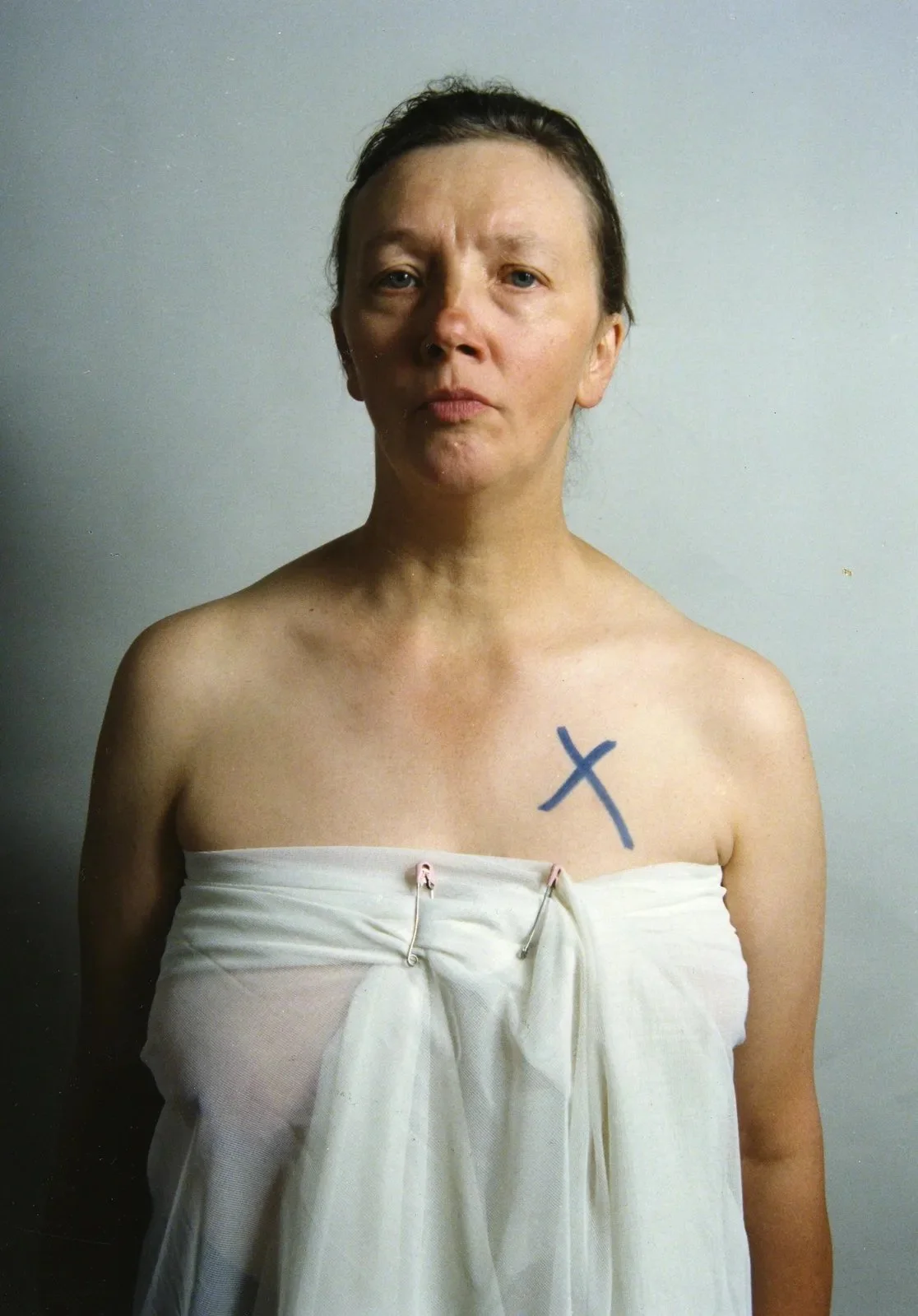
Jo Spence, A Picture of Health: How Do I Begin?, 1982-1983.
Afterimage by Maryam Jafri:
It’s really hard to identify just one image that stays with you at a time when we're so bombarded with images. Photography in our contemporary, tech-bro steered visual culture seems to have devolved into a means to make people feel overloaded, anxious and disoriented rather than a quixotic attempt to freeze a moment in time. Are we even capable of focusing on just one image anymore? So I think it's an interesting question, and a difficult one. Nonetheless, Jo Spence's work—and in particular this piece from her series The Picture of Health from 1984—comes to mind. I've never seen this work in real life, unfortunately, because her work is still not shown as much as it should be, in my opinion.
Spence’s work was pioneering in its insistence on addressing issues of gender, labor, aging, and disability. Humorous, vernacular and irreverent, her practice undermined notions of (male) virtuosity and genius. This image, however, takes a more serious and contemplative tone than in some of her other works. She was in her late forties at the time it was taken, diagnosed with breast cancer. What Spence sought to do, as I understand it, was to use the gaze of the camera—and the gaze of the spectator—to introduce other gazes besides the medical gaze onto a body defined as debilitated. The X marks her as an object, like on a survey map where X indicates something to be mined or excavated. However, although at first glance she is the object of the gaze, she wrests back control by looking directly into the camera and silently addressing the viewer with a calm, composed and determined look on her face. It is a moment of vulnerability but the expression on her face is resolute as she looks at us. Spence primarily used self-portraiture and performance in her photography, and with this image in particular I think she is very aware of, and in control of, how she comes across. She often used text alongside images in her works; but here the X is more a mark than a letter, nonetheless it communicates as clearly as any speech bubble or caption. The X may mark the spot but her breast remains covered, so she both reveals and conceals, leaving one to wonder if this photograph was taken before or after the operation. The neutral background tells me we are not in a hospital but in her studio perhaps. She is not in a hospital gown but instead wears a semi-translucent cloth held up by safety pins. To me, the safety pins look like the ones used for cloth diapers; they are pink, and make me think of the trajectory of life, from infancy to aging, bookended by birth and death.
Notable was Spence’s desire to make art about breast cancer at a time when vulnerability and illness were not widely represented or discussed, remember this work predates the AIDS crisis. Even now, if somebody has an illness or exhibits a visible manifestation of ill health, you politely avert your gaze—you don’t look there. It was important for her that this body of work, The Picture of Health?, was exhibited not just in art contexts, but in community centers and schools. Women's health issues are still overlooked and underfunded. She wished to merge art with everyday life not just in terms of subject matter but also in terms of audiences and access. In 1984, around the same time as Spence embarked on her project, the feminist sociologist Arlie Russell Hochschild published The Managed Heart: Commercialization of Human Feeling, the first work to formulate the concept of emotional labor, a concept that has only gained traction since. For me, this image helps open an affective space outside the commercialization of feelings, instead Spence uses photography to stake a claim to visibility, care and agency.
Afterimage is an ekphrastic series exploring that one image you see when you close your eyes—the one that lingers in your mind. We invite different people to reflect on an image they can't shake. The column began during our time publishing the journal Objektiv and continues today under Objektiv Press.