RACHAEL WOODSON ON RICHARD AVEDON
Afterimage by Rachael Woodson:
Portrait of a Postcard
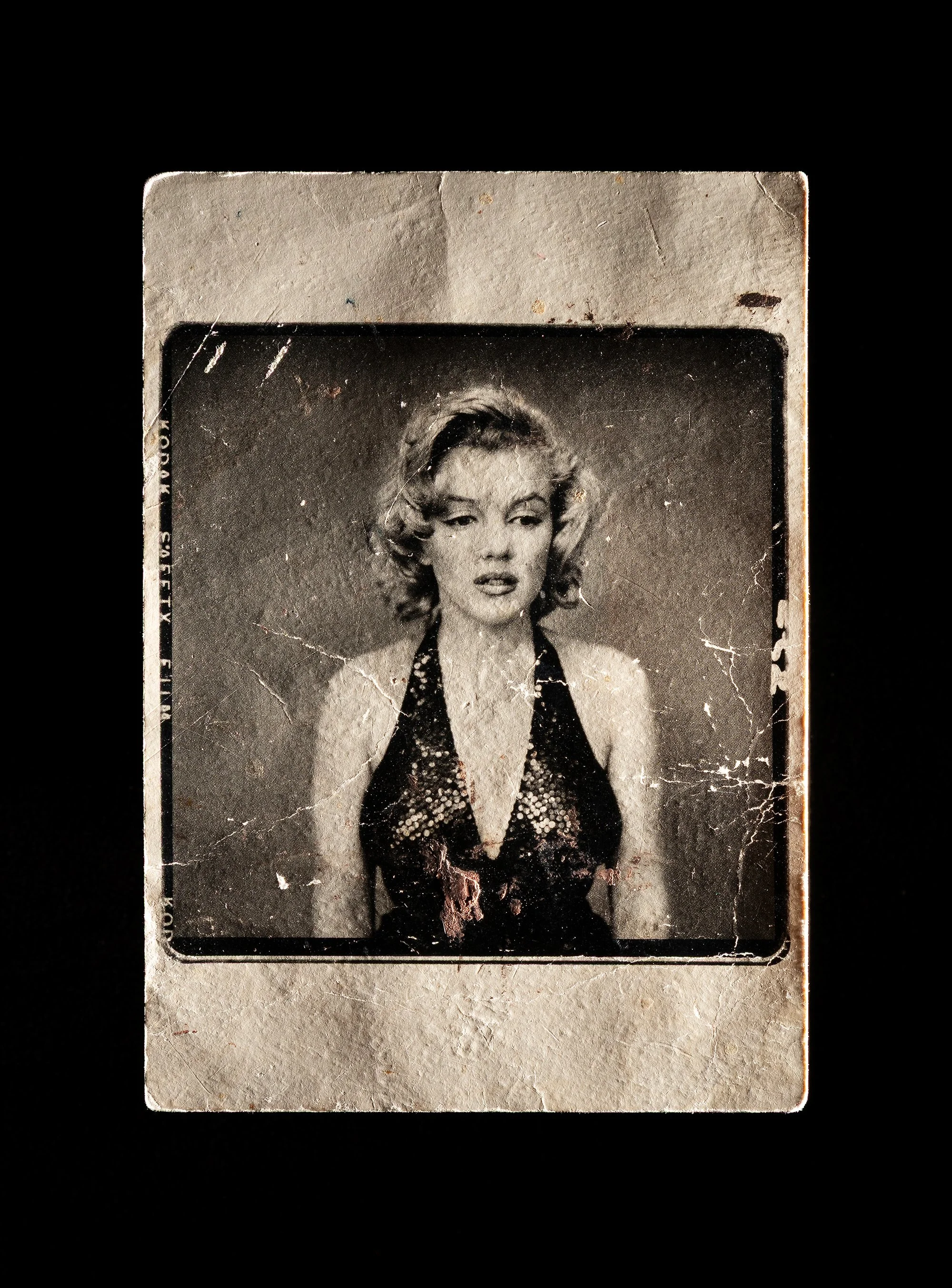
The Marilyn postcard (front), 2025. Rachael Woodson.
Yellowed with age
A weathered skin
Scuffs and stains
Fine lines like wrinkles around the eyes.
The crackling of its gelatin finish
Forms a network of small fractures.
Brownish red spots resemble dried blood
Smudges of blue, specks of beige
Dusty lipstick caked around her waistline.
Other marks reveal themselves only fleetingly -
Held at a certain angle
The light picks up traces
Of ricocheted liquids
Invisible ink.
When flipped over
The back is blank
Aside from an impressive topography
Of waves, ripples
And a corroded barcode
In a corner, the credit line reads:
MARILYN MONROE, ACTOR
NEW YORK, MAY 6, 1957
PHOTOGRAPH BY RICHARD AVEDON
©2007 THE RICHARD AVEDON FOUNDATION
Despite its condition, this postcard is hardly innocuous.
Its surface reads like a polyphonic blueprint.
The sister
In 2019, my sister Alice was killed in a bus accident. In the days that followed, I flew back to the United States to join my family. I remember how it felt to enter her apartment. Light streamed from open windows, refracting through a glass vase shaped like a skull that sat on a coffee table. Particles of fine dust drifted through fields of light and shadow. I took a few photographs that day.
We sorted through Alice’s belongings: drawers, closets, piles of clothes, photographs, and artwork. In the wake of immense loss, what is kept and what is discarded? The depth of remembrance, as expressed through objects, resonated differently for each of us as we combed over the most intimate corners of her home. It was in this archaeology of everyday life that I found the Marilyn postcard tucked inside a drawer.
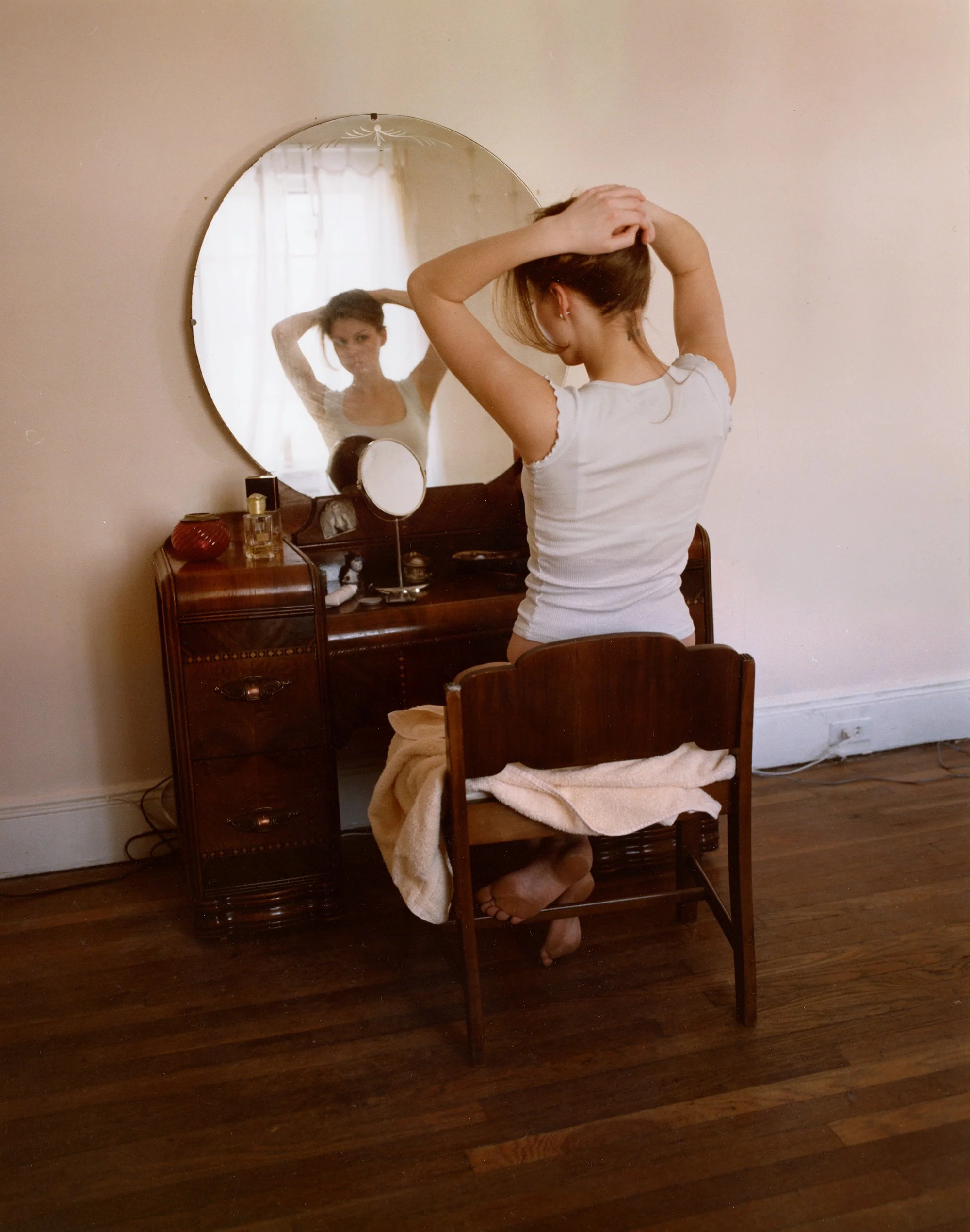
Alice, 2003. Rachael Woodson.
In her essay Touching Photographs: Roland Barthes’s “Mistaken” Identification (2002), researcher and photographer Margaret Olin describes an index as a representation created by direct contact with its referent: A thumbprint is an index. Because the item had to be there for an indexical representation of it to exist, it is often thought that an index is inherently more persuasive than an icon. A photograph is both an icon and an index; it is like an icon with a seal of approval, or, as Barthes calls it, a ‘certificate of presence.’
Though years had passed since I’d last seen the postcard, I recognized it instantly. That day, it appeared to me as a talisman. Moved by my discovery and the years of handling that had worn away its surface, I examined it more closely. Among the marks, I could make out several barely visible fingerprints. An atlas of touch, a certificate of presence.
The photographer
Richard Avedon believed in surfaces. Through his lens, they became an elastic material, full of contradictions to explore. His intention was to make photographs that mapped out a person’s “emotional geography” (“Avedon,” interview for Le Monde, July 1993). Translating such clues into image form required a total visual sensitivity; think of Andy Warhol’s belly full of scars, the textures of Isak Dinesen’s face, Sandra Bennett’s freckled skin and steady gaze.
Avedon’s technical choices reflect this. Both the medium format Rolleiflex, positioned at waist level, and the large format camera he would later use allowed for the line of vision between photographer and subject to remain unobstructed. By the late 1950s, he was established in the fashion world, creating editorials for Harper’s Bazaar and Life. In parallel, his portrait work was taking an experimental turn. Isolating backdrops and raw directional strobe light brought surface details and emotional nuance to the forefront.
Underlying Avedon’s versatility between the fashion and art worlds was a conception of beauty that drew from personal experience. He grew up in Depression-era New York, and some of his first photographs were portraits of his younger sister Louise. She was known for her enigmatic looks and would become the archetype for the models Avedon worked with early on in his fashion career. He later described the isolating effects of such objectification as having weighed heavily on Louise (“Un Portrait est une Opinion,” Égoïste, September 1984).
Avedon spoke of the theatrical lengths his family would go to when taking snapshots — posing in front of a stranger’s luxury home or an expensive car, borrowing a dog to complete their picture-perfect fantasy narrative. “All of the photographs in our family album were built on some kind of lie about who we were, and revealed a truth about who we wanted to be.” (“Borrowed Dogs,” Richard Avedon: Portraits, 2002). A photograph’s surface is understood as a porous site where reality and fiction overlap.
Readings of a star
On May 6, 1957, Marilyn Monroe arrived at Richard Avedon’s Madison Avenue studio to shoot publicity for her upcoming film The Prince and the Showgirl. This was the first and only film she would produce independent of the Hollywood studios. She was thirty years old and at the height of stardom. Avedon later recalled:
There was no such person as Marilyn Monroe… Marilyn Monroe was someone Marilyn Monroe invented, like an author creates a character… For hours she danced and sang and flirted… And then there was the inevitable drop. And when the night was over… she sat in the corner like a child, with everything gone… And as I came with the camera, I saw that she was not saying no.
(“Avedon’s Endgame,” Maria Morris Hambourg and Mia Fineman, Richard Avedon: Portraits, 2002)
The most enduring of the photographs made that day, featured on the postcard pictured here, is occasionally referred to as Sad Marilyn. This strikes me as a reductive label, conflating Avedon’s image with Charcot’s photographic experiments at the Salpêtrière. To move beyond the surface of this particular portrait, one must keep in mind Avedon’s penchant for paradox and the layers of Monroe’s performative skill, exercised both for the public and for the camera. As Sharon Marcus states in her book The Drama of Celebrity (2019):
Like any celebrity, Monroe became a distinctive star not simply by standing out from the crowd but also by multiplying herself. To read a single article about Marilyn Monroe was often to encounter many Marilyns, since editors and page compositors rarely limited themselves to one picture of the star.
The public’s fascination with Monroe’s plurality lies within the fluctuating ideologies of post-war America. In Stars (1976), Richard Dyer points out that the diffusion of Freudian thought in popular culture, the publication of the Kinsey reports and Betty Friedan’s The Feminine Mystique as well as shifts in film censorship amid competition from television all contributed to making her image so successful. In La Rabbia (1963), Pier Paolo Pasolini portrays Monroe as the perfect host for an image-hungry culture, her death a symbol for the transition into a post-atomic era.
The most photographed girl in the world
I have yet to encounter Marilyn Monroe’s account of being photographed by Richard Avedon, which leads me to reflect on her relationship to photography in general. In the first pages of her unfinished autobiography, she recalls an early experience with a photograph:
There was one object in my mother’s rooms that always fascinated me. It was a photograph on the wall. There were no other pictures on the walls, just this one framed photograph. Whenever I visited my mother I would stand looking at this photograph and hold my breath for fear she would order me to stop looking. (My Story, 1974)
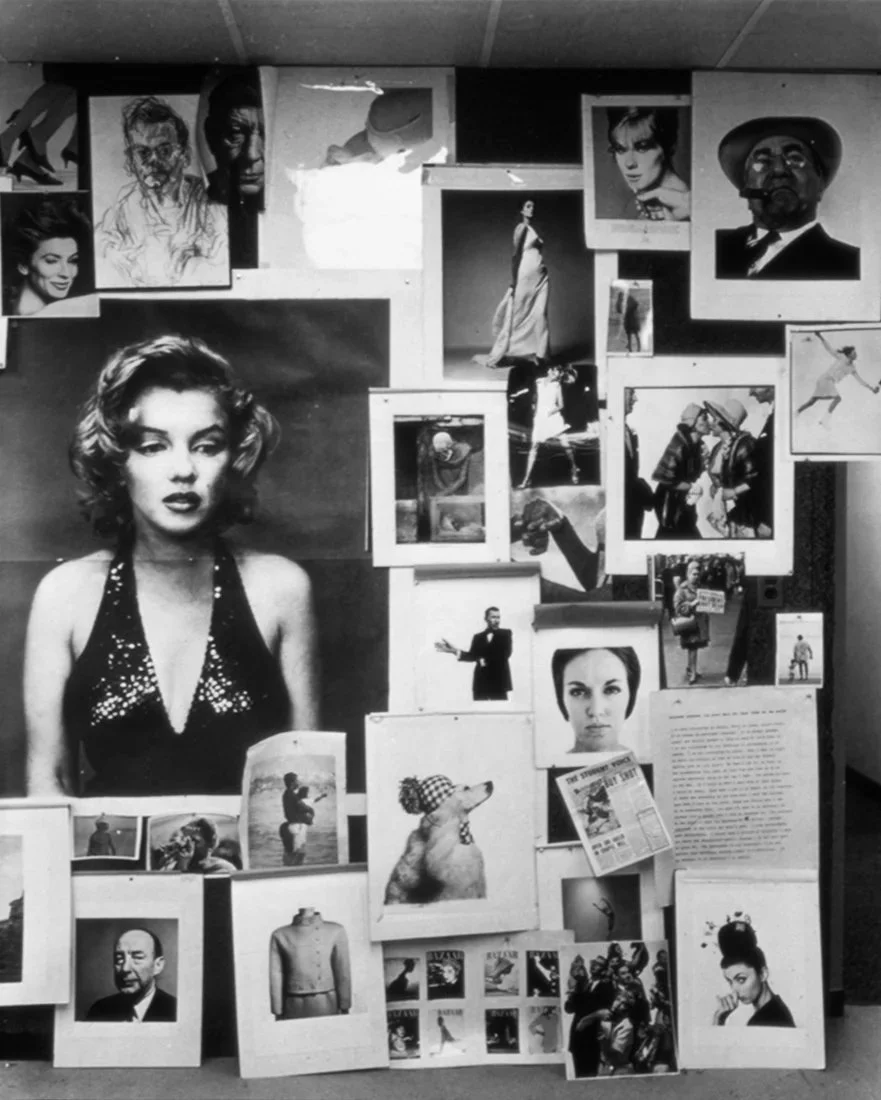
Installation view of the exhibition A Collage, McCann, Erickson, New York, 1964. Photographer : Richard Avedon. © The Richard Avedon Foundation
Marilyn was told that the man in the photograph was her father, a revelation that set off an intense emotional reaction. The portrait took on a symbolic presence, becoming a proxy for an absent man. “The night I met his picture I dreamed of it when I fell asleep. And I dreamed of it a thousand times afterward.” This suggests that photography functioned for Monroe not merely as representation but as a space of projection and fantasy, prefiguring the mirror of selves she would later construct for the camera.
Portraits
When I left Alice’s empty apartment, I carried a small selection of her things that followed me back to Paris — a moth-eaten silk handkerchief, a copy of The Autobiography of Malcolm X and the postcard. Like the framed father for Marilyn, Alice’s postcard has become a host of ideas and images that extend far beyond its material circumstances. I see it as a contemporary relic, a palimpsest of histories opening onto countless memories.
In the fall of 2002, the Metropolitan Museum of Art opened Richard Avedon: Portraits, a major exhibition spanning his sixty-year career and the last held during his lifetime. Having just moved to New York to study photography, I went to see the exhibition and spent a long time taking in room after room of people who had agreed to perform some part of themselves for Avedon’s ritual.
Alice and I must have talked about it not long after. By then, I was making a series of portraits of her and our two brothers, and would often spend weekends at our mother’s house in New Jersey photographing them. On one such occasion, I noticed the Marilyn portrait taped to the side of the round mirror in her bedroom, no doubt cut out from a review of the exhibition she’d read in one of her fashion magazines. This was later replaced by a more durable postcard version, which remained there for many years. The day Alice left our mother’s house, the portrait went with her and it never left her.
First published in French in Entre-Temps (Collège de France), February 11, 2026
Afterimage is an ekphrastic series exploring that one image you see when you close your eyes—the one that lingers in your mind. We invite different people to reflect on an image they can't shake. This column originated in the inaugural issue of the Objektiv journal and continues today here on our web journal.