GEIR MOSEID ON SARAH DOBAI
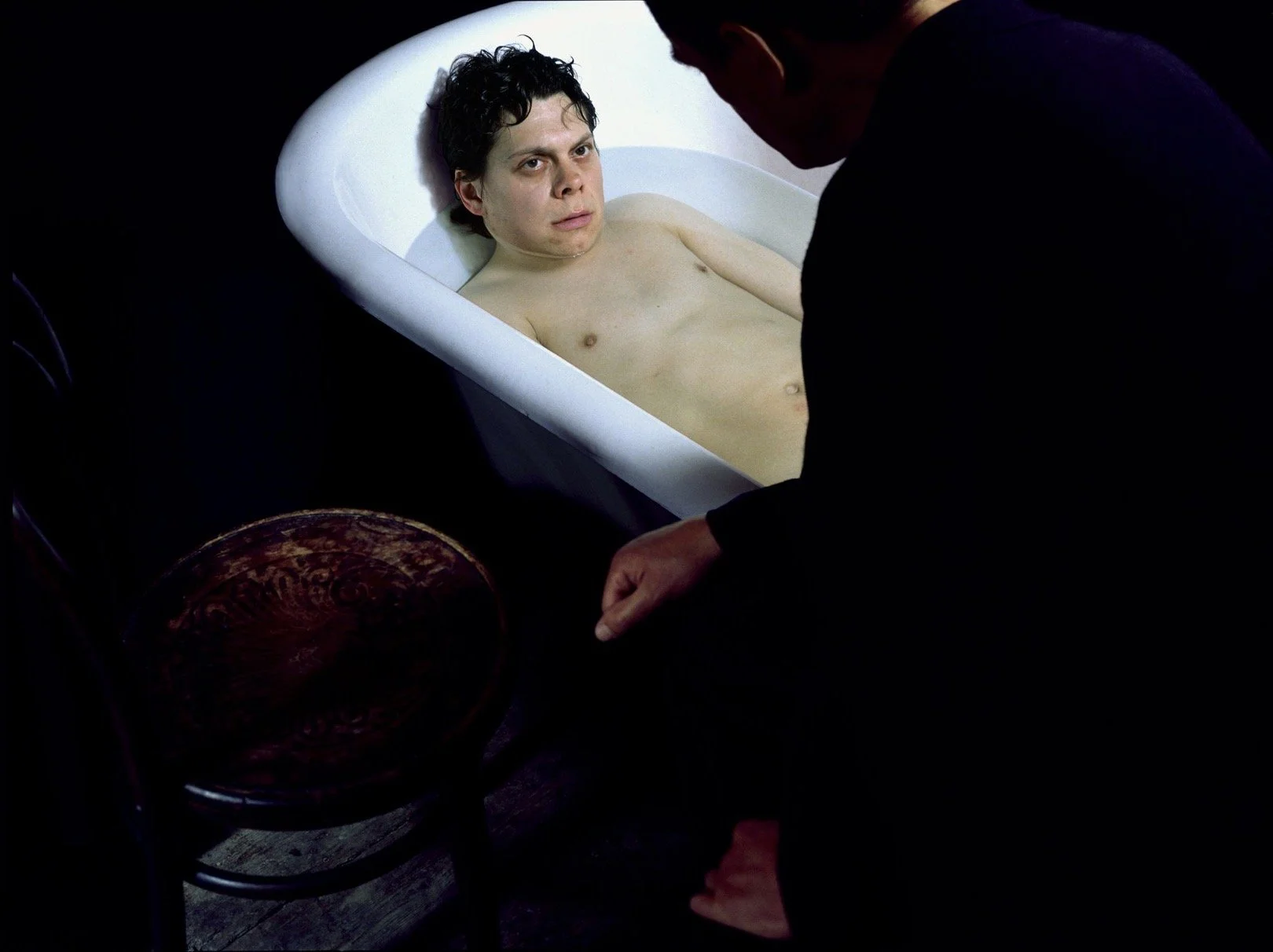
Afterimage by Geir Moseid:
The image on my mind is one made by Sarah Dobai, whom I assisted when I was a student and for a few years afterwards. The image shows a person lying in a bathtub with another person sitting above them looking down towards the person in the tub. You can see the upper body and face of the one in the bathtub, and then you can see the other person's back. The person in the water must be called Mike, I think, as that is the title of the work.
"Mike" has a childlike body, but an adults face. And immediately when I looked at him, I saw him as a victim. But the longer I sit and look at the image, the less certain I become about whether he's in fact the one in control of the whole situation. And then the hierarchical relationship between the two shifts. I looked at it earlier today and still, twenty years on, I can't settle on it. I think of it as that certain itch on your back you can't reach, an image you want to return to. An image that can never quite be completed. And that's what I strive for myself in my own work.
Sarah was very meticulous about how she wanted things. Whereas when I work, I'm looser about it. I let chance happen. But the casting here, because it is a staged image, is perfect. I first developed my interest in visual communication through film clubs and going to the cinema, and have always really appreciated good casting — it can truly make or break a work. And Mike is so generic and so cinematic too, so there are also lots of such connotations. In all its simplicity it still becomes very complex. It's an image I love.
Often when you assist people you don't quite understand the importance of the work at the time. But then, several years later you realise that the methodology you observed, you've taken on and made yours somehow. Those years with Sarah were very formative for how I work myself, with micro-expressions and gestures. How the mouth moves, hands. Finding those in-between positions where you get what you might call ambivalence. The thing you can't quite figure out. I keep returning to that, I can't seem to finish with that kind of uncanniness.
There's often one specific thing that triggers why I need to make a certain type of image. And with Mike, it's that indeterminate gaze towards the other character. Which I'm not finished with. It's wonderfully satisfying that he owns the image. That he's perhaps not the victim. And then suddenly he's owned by the image too. That's what keeps shifting.
Of course, for me as a man, manoeuvring around other men has changed a great deal over the years. I'm not some macho type of guy. But you do mirror yourself in other men, and especially in different types of masculinity. And Mike has an undetermined masculinity I would say. A feminine childlike body, but a masculine face, almost menacing. And it's quite simple too. It's just a bathtub, two men and a chair. Surrounded by black. Many people think staged photography is so advanced and meticulous, and of course it can be, but it can be incredibly simple too. A few people or objects and some light he he. That's something I always kept coming back to when teaching. You don't need to search for the perfect location or the most attractive friend. That's not what makes an interesting image. It's like the social anthropologist who goes to the highest mountain to find the tribe not yet photographed. Maybe you should just knock on your neighbour's door instead. You might get so much more.
Afterimage is an ekphrastic series exploring that one image you see when you close your eyes—the one that lingers in your mind. We invite different people to reflect on an image they can't shake. This column originated in the inaugural issue of the Objektiv journal and continues today here on our web journal.