NANCY WECHTER ON A PICTURE NOT TAKEN
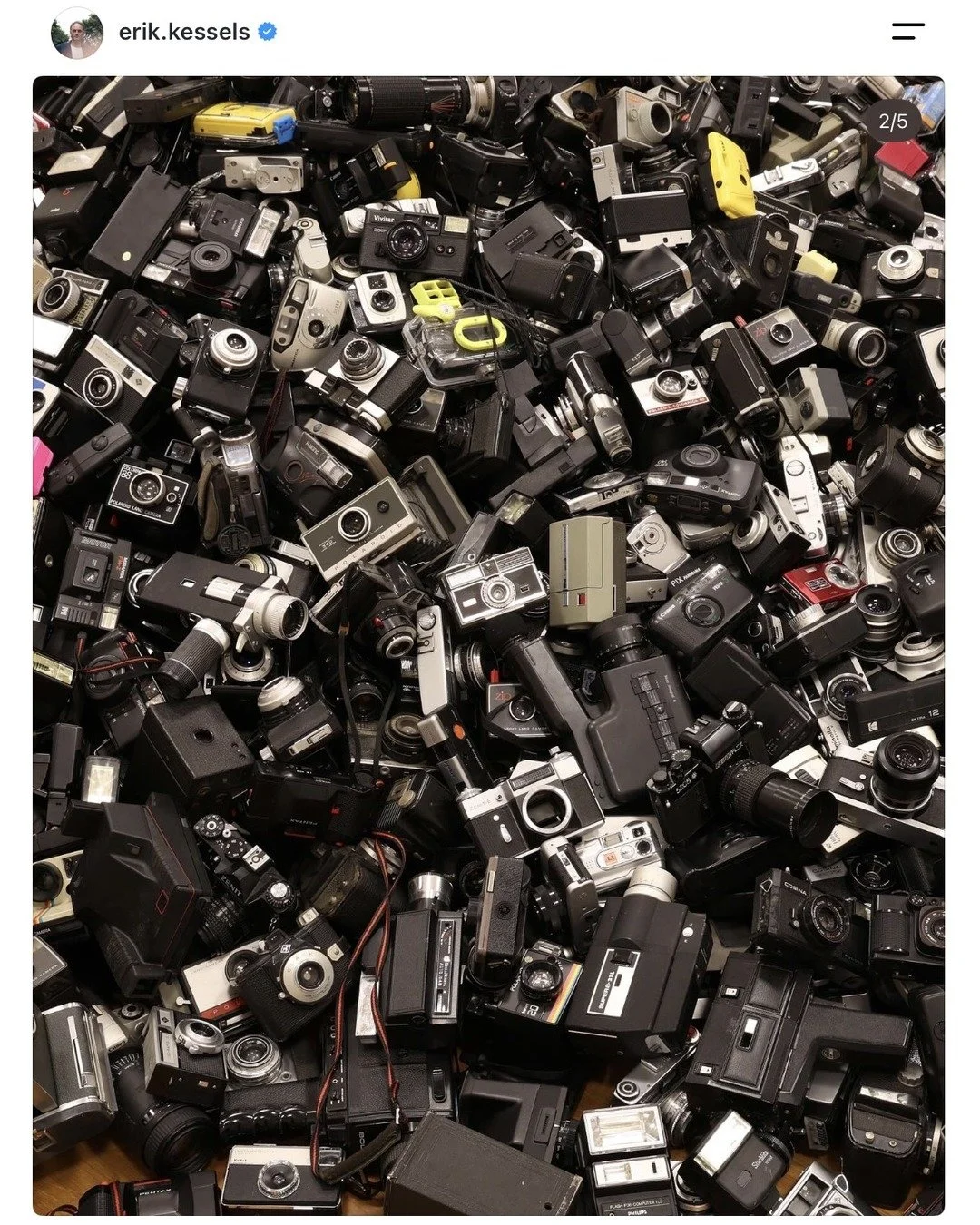
Erik Kessels, The Last of the Lens, 2026. Installation view, Oslo Negativ, Nasjonalgalleriet. Image via Kessels’ Instagram.
Afterimage by Nancy Wechter:
Before I ever had a camera or made much use of one, I experienced the world as a big, insatiable pair of eyes. Taking in everything. I didn’t own a camera until after college, when I could buy myself an Olympus SLR. I bought it with a macro lens; I knew I wanted to get close to things. Seeing is done with more than one’s eyes.
Even though my current home environment is unquestionably rural, I am an urban photographer. Shaped from childhood by New York City, where I grew up and lived until not so long ago. Shooting humans in their environment, being active, quickly perceiving what was fleeting came without thinking. Without thinking is how I like to photograph (and write). Or rather, without thinking beforehand or without overthinking.
My current environment is beautiful. Green from abundant rainfall, resulting in grass-carpeted hills and fields. And then there are the cows. Just yesterday, I walked past the electric-fenced field where my neighbor confines young heifers and where there is an adolescent bull calf with whom I have fallen in love. He stands still while I talk to him, and I take his photo as he is such a willing subject. Am I turning my urban honed gaze onto something quieter? Less clogged with humans? I used to say (and it is still true) that I photograph to find out what I am seeing.
The most vivid story of a picture not taken (an ekphrastic image) that came to mind was the first time I met my rural neighbors. We had just closed on the house and spent our initial night there on a mattress on the floor of the bedroom. That morning, as soon as I woke, I started pulling red contact paper off the lower part of the kitchen walls. Took a break. Took a walk. It was late November, just after Thanksgiving, and there was a light coating of snow on the ground. We saw some activity on the farm next to us and thought it would be nice to go over and say hello and meet our neighbors. As we approached the barnyard, we spotted two men dressed in hunters’ red and black buffalo check jackets and hats. They wore these bright garments to prevent other hunters from mistaking them for deer. The men were one of our neighbor’s grown sons and his grandson.
As we descended into the barnyard, we were greeted by the grisly sight of a deer head, then a ribcage, and finally a bloody red heart lying on the snow. In spite of my distaste for hunting and fear of firearms, all I could think of at that moment was: “Where is my camera?” Of course I hadn’t thought to bring it and I wasn’t yet carrying a cell phone everywhere.
It is this image that remains. Indelible.
P.S. I eventually did get to take pictures of deer carcasses hanging from the beams in their barn during hunting season, like an animal crucifixion. I learned to see this as a local source of good, untainted, even organic meat. Like the smell of manure, it is something you get used to.
Afterimage is an ekphrastic series exploring that one image you see when you close your eyes—the one that lingers in your mind. We invite different people to reflect on an image they can't shake. This column originated in the inaugural issue of the Objektiv journal and continues today here on our web journal.