TOMINGA O’DONNELL ON YVES KLEIN
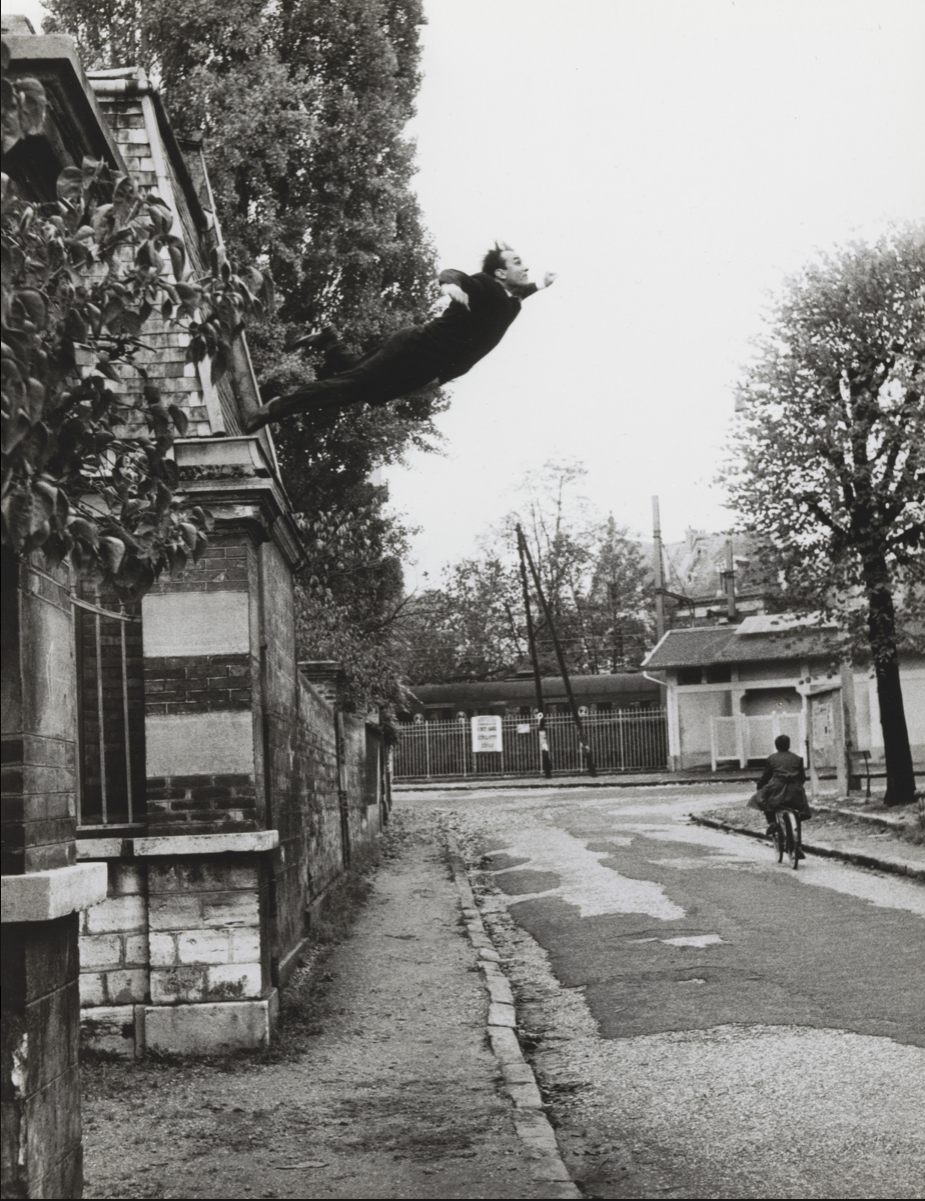
Yves Klein, Leap into the Void, 1960. © 2026 Artists Rights Society (ARS), New York / ADAGP, Paris. Photograph: Shunk-Kender © J. Paul Getty Trust. The Getty Research Institute, Los Angeles
This photograph is the visual equivalent of an earworm: a catchy tune that you can't get out of your head. Often an annoying one. The fact that this photo emerges when I close my eyes perturbs me. I wish my mind had decided to conjure up something more worthy or urgent. Something that captured the Zeitgeist or made an important political point. Not a manipulated photo of a white male artist seemingly launching himself into the void. The Met Museum in New York called it a seminal gesture. It is – in the sense that the etymology of seminal is semen, and this work bears all the hallmarks of male privilege as Klein made sure that the photograph was widely distributed in a four-page newspaper, Dimanche, that mimicked the Sunday paper Journal du Dimanche, with the headline: A man in space!
It is impossible to read the gesture separately from Klein's other well-publicised performative acts: ordering naked women around on canvases as "living brushes", dipped in his characteristic ultramarine International Klein Blue. I adore this colour, but even as I first encountered these works as a teenager at the Museum of Contemporary Art in Oslo in 1997, something felt a bit off. It evoked the misogynist stereotype of using women as objects – tools for the great male artist to show off his genius. Nonetheless, the image of Klein launching himself seemingly into mid-air has stayed with me over the subsequent years, surviving in the private database of my mind, pushing itself to the forefront past worthier, more beautiful, richer, more colourful analogue photographs, not to mention vast swathes of digital, enhanced or AI-generated imagery. Why?
First some contextual information: Leap into the Void was staged in October 1960 on a street in the Parisian suburb of Fontenay-aux-Roses. Klein was 32 years old at the time and would die just two years later. The artist had hired photographers Harry Shunk and János (Jean) Kender to take a series of pictures of him launching himself from the rooftop of a building onto a tarpaulin that his friends held up beneath. By printing two negatives of him falling and one of the street scene together (sans friends and tarpaulin), he was able to create an image that looked like he had launched himself into the void. He claimed this was a restaging of an actual leap from a second-storey building earlier that year. Klein's helpers were sworn to secrecy, and it was several years before images of how the process was staged emerged.*
In today's media landscape of image manipulation, deepfakes and swift, AI-generated pictures, the status of the photograph as a truthful witness has all but evaporated. In the aftermath of Klein's trick in 1960, however, the veracity of photography was relatively undisputed. That made the image all the more intriguing. The tongue-in-cheek references to space travel Klein made in his newspaper insert, along with an established history of "trickery" including showing "invisible paintings" at Galerie Colette Allendy and an empty display case in an empty space in the exhibition The Void at Galerie Iris Clert in 1958, all added to the intrigue. For the opening of the latter, Klein famously posted Republican Guards at the entrance to the gallery, which was painted IKB on the outside, and served blue cocktails to his many visitors (some 2000–3000), which resulted in their urine turning blue for several days. Like Leap into the Void, these works thematise absence but are ultimately about performance, which is why Klein holds such influence both within the histories of Conceptual Art and Performance Art.
Both the "leap" and the "void" had long interested Klein, the former from his experience of judo and falling techniques, and the latter as a form of dematerialised art practice. On 27 October, just over a week after the staging of Leap into the Void, the manifesto of the New Realists was signed in Klein's apartment. It was drafted by the critic and curator Pierre Restany and signed by several artists, including Arman, Raysse, Spoerri, Tinguely and Klein.* In Restany's obituary in Artforum in 2003, curator and proponent of relational aesthetics Nicolas Bourriaud wrote, "To Restany, art represented a 'cleansing of vision'—that is, not a set of more or less well-made objects but an optical device that allowed us to look at the new world surrounding us, whether that meant supermarkets or streets."* Klein's rather polished and crafted works are not immediately resonant with the other New Realists' emphasis on readymades and the manipulation or collaging of everyday objects, but his Leap into the Void instead fits into this notion of "the streets" that Bourriaud mentions.* Another famous image by Klein "from the streets" captures the dematerialised essence of the work and shows him throwing gold leaf into the Seine – having just received it as payment for one of his invisible paintings.
Leap into the Void can also be connected to the notion of a leap of faith. Klein had a complex form of spirituality, derived from different religious sources: his judo and long stays in Japan had familiarised him with Japanese Zen Buddhist traditions, whereas he was also a member of the Catholic confraternity The Order of the Archers of St. Sebastian, and the Rosicrucian Order, which was based on Christian mysticism. Combined with the widely publicised space exploration of the time, which challenged many people's conception of a "heaven above", and which Klein played with in his publication of Leap into the Void, this makes the philosophical backdrop of the work both metaphysical and highly topical.
My father was an art student in the early 1970s and stresses the impact of Klein's work, citing its novelty and originality. Ten years after his death in 1962, seemingly no other artist had done what Klein had done. My father describes his initial memories of Leap into the Void as "uplifting". I think this is the source of my inability to shake this doctored photograph from my mind's eye. The analogue doctoring of the image has long since been made redundant. Rather, it is about what it represents both performatively in the physical leap, which was captured by the cameras, and conceptually as the potential for human flight or levitation. It invites the imagination to soar like the artist in the photograph.
* According to Thomas McEvilley, the first time these images came into public view was in the exhibition Yves Klein (1928–1962): A Retrospective at the Institute for the Arts, Rice University, in February 1982. Thomas McEvilley, “Yves Klein: Messenger of the Age of Space”, Artforum, January 1982.
** Despite the movement initially being rather male-heavy, Restany spent his career championing a number of female artists, as this 2018 article by Hélène Gheysens notes: “Pierre Restany et les artistes femmes”, AWARE: Archives of Women Artists, Research and Exhibitions, 2018.
*** Nicolas Bourriaud, “Pierre Restany”, Artforum, 2003.
**** In Norwegian exhibition history, New Realist artists can be seen in the exhibition Our World of Things – Objects, which Harald Szeemann co-curated at Henie Onstad Art Centre in 1970. This exhibition was one of my case studies for my PhD thesis, Space as Curatorial Practice: the exhibition as a spatial construct (AHO: Oslo School of Architecture and Design, 2016).
Afterimage is an ekphrastic series exploring that one image you see when you close your eyes—the one that lingers in your mind. We invite different people to reflect on an image they can't shake. This column originated in the inaugural issue of the Objektiv journal and continues today here on our web journal.