DANH VÔ
There’s something about this image and my relationship with it, from a photographic and representational point of view, but also in the sense of reproduction, that really fascinates me. It is a photograph of photographs, printed as a photogravure, which has then been digitised, and I view it through my computer screen. Three figures, three photographs on the wall. Multiple picture planes, intentions and techniques, all operating in tandem. I adopt the same position as the young men in the image, almost as if I am standing behind them, facing the same direction, becoming a part of their group. I feel invited into the scene, like a safe and benign presence. On the other hand, I am isolated from them entirely. I feel the weight of cultural difference between Carrier and these young men, the impossibility of touch, as well as the vast gulf of years and geographies.
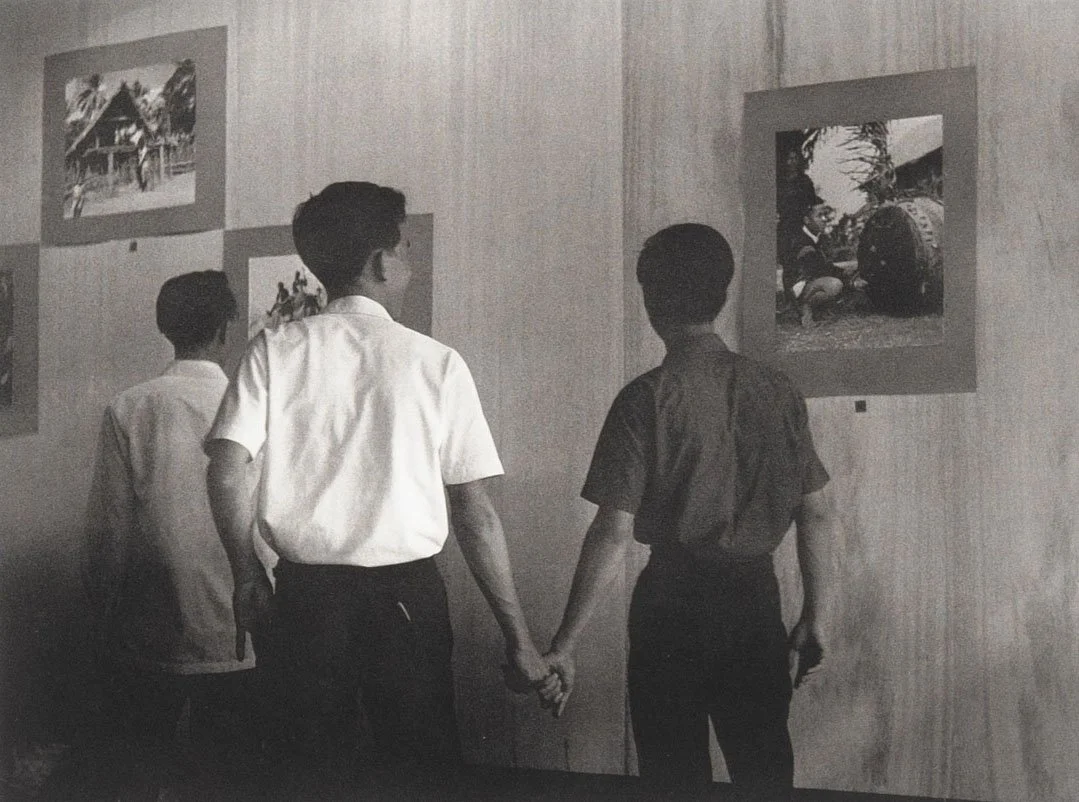
Danh Võ, Archive of Dr. Joseph M. Carrier 1962-1973, 2010.
Afterimage by Lillian Wilkie:
This is the photograph I look at perhaps more than any other. Or rather, I see it multiple times a day, but perhaps I don’t always look at it so well. I didn't really know very much about Danh Võ when I went to see his show Danh Võ: Untitled at South London Gallery in 2019. I’d recently been with the photographer Jason Evans, who had loved it and encouraged me to go. This series really stayed with me, and when a little while later I happened to buy a new computer, and was wondering what to use as a desktop image, this one came to mind. All these years—and a second computer—later, I still have it. Now, it's just so part of the architecture of my workspace, and typically scattered with folder icons and screenshot thumbnails. It’s become the furniture, in a way. Considering it for Afterimage has forced it back into the foreground, and given me the opportunity to kind of fall in love with it again.
Danh Võ is not known as a photographer, although photographs are very functional in his practice. He’s more widely known for installation, sculptural and object-based works, reappropriating or co-authoring the work with others. He was born in South Vietnam during the American war, but his family escaped when he was about four, on a handmade boat. They were picked up by a Danish container ship, and Vo ended up growing up in Denmark.
The photograph is from a series called Archive of Dr. Joseph M. Carrier 1962–1973. Carrier was an American anthropologist, counterinsurgency specialist and closeted homosexual who was stationed in Vietnam from 1962–1973. His black-and-white photographs depict young Vietnamese men and boys in everyday moments of intimacy, within a culture where non-sexual, physical affection between men was much more normalised and accepted. Carrier had come from a very conservative American culture where such liberated tenderness felt impossible. These behaviors and gestures moved him, and perhaps produced a sense of longing or yearning, quietly mourning the lack of such tenderness in the place he grew up.
Carrier never showed these photographs to anybody until he met Võ. Apparently, he just came up to Võ after a talk the artist had given in LA, and told him about his experiences in Vietnam around the time of Võ’s birth. They developed a friendship, and even visited Vietnam together, leading Carrier to show Võ these photographs, and eventually giving him permission to make work with them. Võ was in touch with a master printer in Denmark who was reviving a historical photographic etching process, and Võ eventually worked with him to print a selection of Carrier’s images as photogravures.
There’s something about this image and my relationship with it, from a photographic and representational point of view, but also in the sense of reproduction, that really fascinates me. It is a photograph of photographs, printed as a photogravure, which has then been digitised, and I view it through my computer screen. Three figures, three photographs on the wall. Multiple picture planes, intentions and techniques, all operating in tandem. I adopt the same position as the young men in the image, almost as if I am standing behind them, facing the same direction, becoming a part of their group. I feel invited into the scene, like a safe and benign presence. On the other hand, I am isolated from them entirely. I feel the weight of cultural difference between Carrier and these young men, the impossibility of touch, as well as the vast gulf of years and geographies.
So much is concealed in this image. We can never be sure what exhibition these young men, or boys, are visiting. Their ages are ambiguous. One, in the white shirt, could be smiling, but it could be a grimace. The contrasting tones of the two central figures’ shirts contributes to the image’s brilliance; our eyes dance between the two shirted backs, the cotton crisp and cool-seeming, and down to their interlocked hands. You notice that they are holding hands in quite an unusual way, with the figure on the right grasping two outstretched fingers of his white-shirted friend. Who knows, maybe this kind of configuration is more normal than I realise.
Maybe the image reminds me of all the ways that cultural difference can manifest, from small gestures and inflections, to the ways homosexuality can be deeply problematised, criminalised and brutalised. It also makes me think about the significance of photography to the war in Vietnam, and the ways in which it both challenged and reinforced dominant narratives. Whilst much photography from Vietnam ultimately held up a mirror to the American psyche, I also think about the broader use of photography as an anthropological tool, and its colonial underpinnings.
I also just really love photogravure, it’s so romantic, so alluring, so rich and deep. I love Jack Davison’s portrait work with this technique. But when used to render street photographs it gives the work a really cinematic quality, they feel like film stills. There's something about this series that reminds me a lot of the essay films of Chris Marker, and the cinema of Alain Resnais, a decade before. There’s a stylisation and poise, a real sensitivity to silhouette and the form of the body. The texture of skin against wood, water and masonry. And the implication of the viewer in the scene, the sense of quiet complicity. I can’t help but speculate if Carrier had watched something like Hiroshima Mon Amour or Last Year At Marienbad in the years before he left for Vietnam.
Afterimage is an ekphrastic series exploring that one image you see when you close your eyes—the one that lingers in your mind. We invite different people to reflect on an image they can't shake. The column began during our time publishing the journal Objektiv and continues today under Objektiv Press.
TOM SANDBERG
After looking through the twenty issues of the journal Objektiv, I notice that the images that speak the loudest to me, and about which I’ve continued to think long after the issue went to print, all stem back to one singular photograph, a sort of fulcrum image. Asked about his work, the late Robert Frank said: “When people look at my pictures, I want them to feel the way they do when they want to read a poem twice.” It is a photograph by Tom Sandberg, taken in the nineties. When I first saw this image in my early twenties, printed on a postcard sent to me by a friend, it seemed to sum up my interest in photography, both as a practitioner and as a writer. The black-and-white photograph depicts a man walking in the rain, taken through a window.
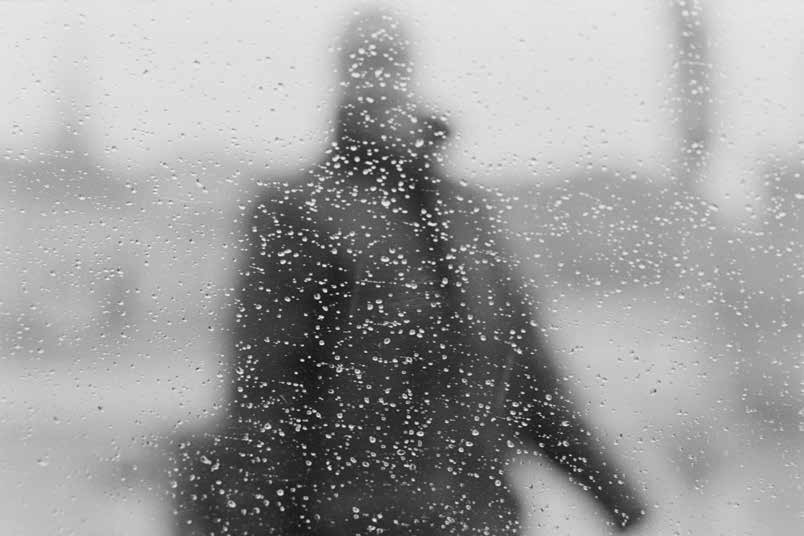
Tom Sandberg, Untitled, 1997.
Afterimage by Nina Strand:
After looking through the twenty issues of the journal Objektiv, I notice that the images that speak the loudest to me, and about which I’ve continued to think long after the issue went to print, all stem back to one singular photograph, a sort of fulcrum image. Asked about his work, the late Robert Frank said: “When people look at my pictures, I want them to feel the way they do when they want to read a poem twice.” It is a photograph by Tom Sandberg, taken in the nineties. When I first saw this image in my early twenties, printed on a postcard sent to me by a friend, it seemed to sum up my interest in photography, both as a practitioner and as a writer. The black-and-white photograph depicts a man walking in the rain, taken through a window. He is blurry; the focus is on the raindrops. Before I knew anything about the photographer, the image simultaneously evoked both loneliness and authority; his oblivion to the rain was something that I later discovered says a lot about Sandberg. He was drawn to the darkness, and this darkness and longing are in the photograph.
He lived with a curiosity and a restlessness to understand the world he inhabited, a world that was black and white in his vision. He worked continuously throughout his life because, as he put it in our interview with him in our very first issue: “Without the pictures, things would not have gone well for me.” Some situations simply had to pass through the camera.
The moment he learned that he had incurable cancer in the late fall of 2013, he started working on what he knew would be his final exhibition, Photographs, at OSL Contemporary. The exhibition presents works from his forty-year career—pieces shown all over the world, some new—and it is difficult not to ascribe a particular symbolism to them, especially the photograph from January this year of two airplane fuselages meeting. The exhibition also includes an early work from his student days at Trent Polytechnic in England: a diptych of a boy with a tennis racket. It is an artistic exercise. The boy is practising, and the young photographer Tom Sandberg is practising. He insisted on completing it despite his failing health. Photography was, as he himself said, the only thing he knew how to do, and the 16 black-and-white photographs stood as a powerful testament. He selected the images with great care; they were reprinted and refined until the very end. In the years before he passed, it might have seemed as if he was chasing the dark, but he himself said he was in control. And with that exhibition, he ensured that it is the photographs we will remember.
Four days before his passing, he made one last adjustment to a photograph of a plane in the clouds. We don’t know where we end up when we die. But when we think of Tom, maybe we can picture him, camera in hand, on a plane making lasting vapour trails in the sky.
See the retrospective with Sandberg, Vibrant World, at Henie Onstad until March 1. Afterimage is an ekphrastic series exploring that one image you see when you close your eyes—the one that lingers in your mind. We invite different people to reflect on an image they can't shake. The column began during our time publishing the journal Objektiv and continues today under Objektiv Press. This one is drawn from a text in Objektiv #11 and a chapter in the first essay in our series, Perpetual Photographs, both written by Strand.