SHIRIN NESHAT
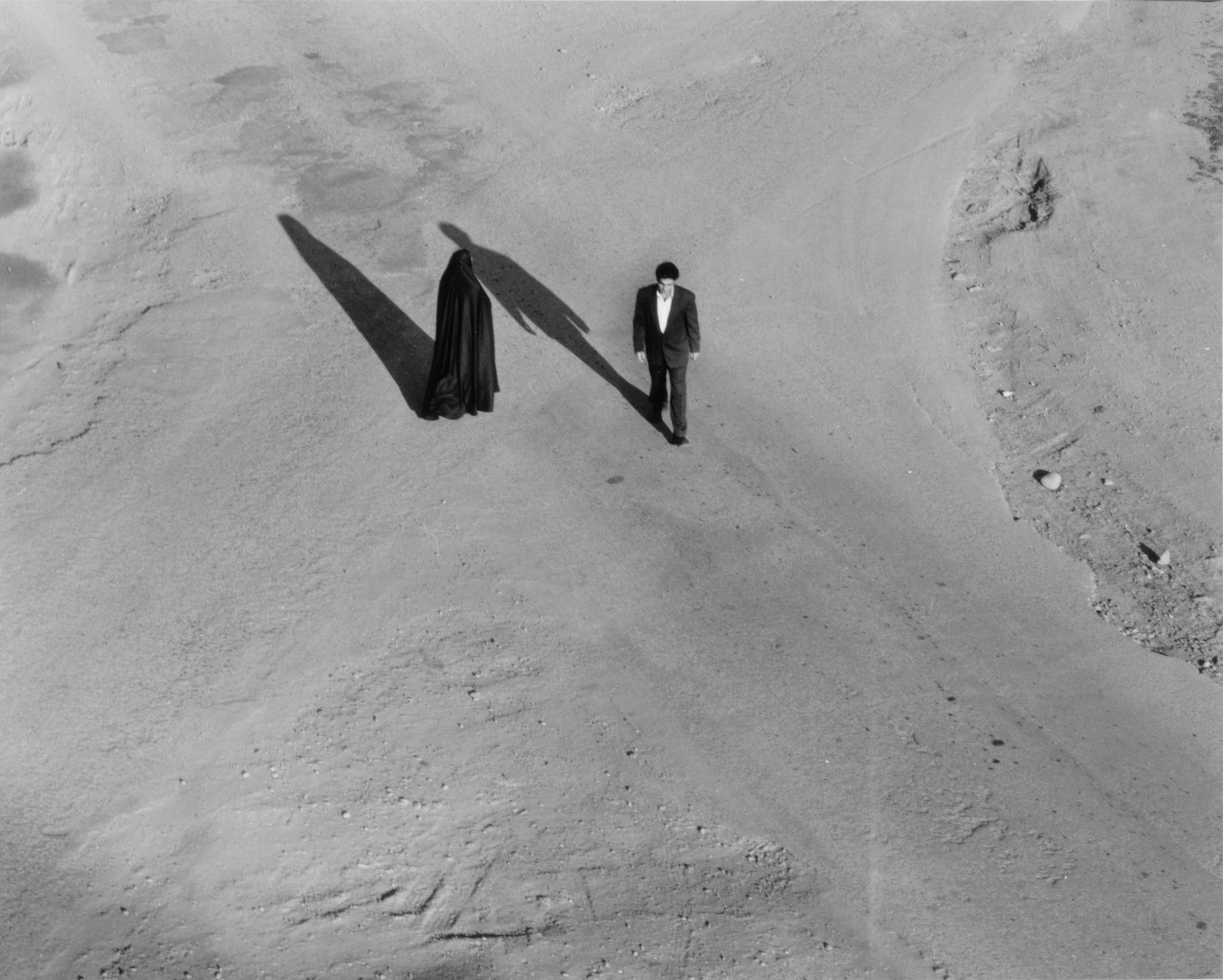
It is a meeting at a crossroads. A man walks towards a woman on the other side of the road. They sneak glances at each other as they pass, and keep on walking.
One Image chosen by Nina Strand:
It is a meeting at a crossroads. A man walks towards a woman on the other side of the road. They sneak glances at each other as they pass, and keep on walking. He stops and looks back at her and smiles. But they keep on walking, both headed to the same place, though taking different routes.
Next scene: The man and woman meet again, with a curtain between them; a mullah is preaching about chastity. They look at each other through the blinds. At one point the woman has heard enough and leaves. He follows shortly afterwards, but again they walk away from each other. I want them to meet, we all do, but they never will.
The two-channel video Fervor by Shirin Neshat from 2000 was filmed in Morocco, but purports to be Iran. Shown now in the 30-year jubilee show Before Tomorrow for Astrup Fearnley in Oslo, it is unfortunately still topical today. I see it after having had a swim, and think about the two never meeting while walking home, my wet hair made wetter still by the summer rain. I think about my luck to be living as a woman here, and not there. And then I remember a recent conversation with a friend about the chances he felt he’d missed, and the imaginary family life he’d envisioned. He’s fifty and says it’s over; he doesn’t think it will ever happen for him.
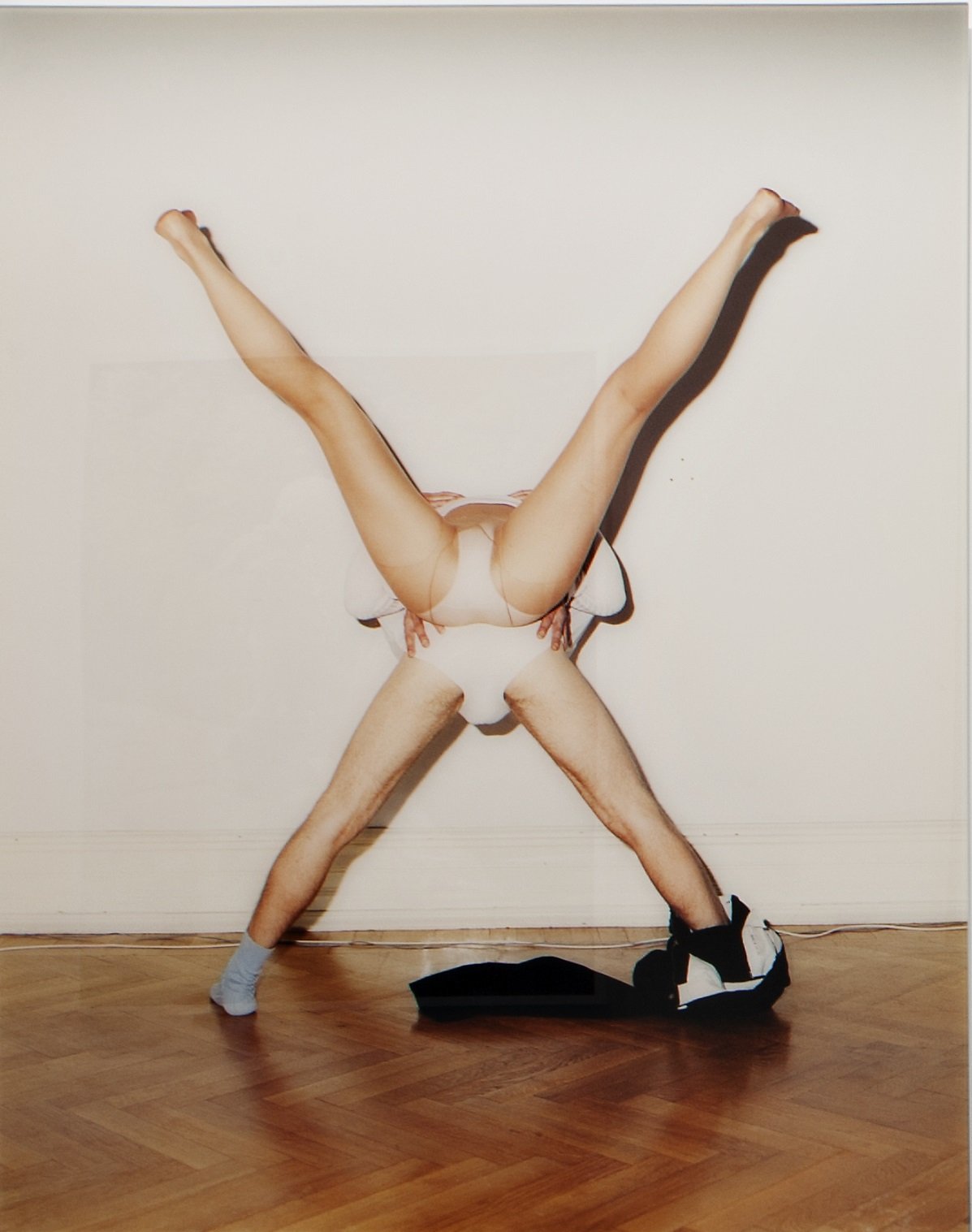
Also on view in Before Tomorrow is Annika Elisabeth von Hausswolff's 1999 photograph Mom and Dad Are Making Out. Two human bodies form a cross, the woman balanced on the man’s back with her legs in the air. The joyful colour contrasts with Neshat’s passionate black and white. These two people, mom and dad, did actually make it together. We can still make it too.
Still, Shirin Neshat, Fervor, 2000
Annika Elisabeth von Hausswolff, Mom and dad are making out, 1999.
TALA MADANI
Rushing through yet another art fair last fall in Paris, a small canvas stopped me dead in my tracks. Iranian-born, Californian by choice, Tala Madani is an artist I first heard about in painters’ studios.
Afterimage by Lillian Davies:

Rushing through yet another art fair last fall in Paris, a small canvas stopped me dead in my tracks. Iranian-born, Californian by choice, Tala Madani is an artist I first heard about in painters’ studios. Artist Xinyi Cheng, for one, is a fan. Inside the fair tent, set up over the park and playgrounds of Champ de Mars, I’d spotted one of Madani’s latest canvases: a muddy zigzag in glossy oil paint on a white gessoed square.
‘She’s made an abecedarium out of them. This one is Zed. From the Shit Mom series,’ a fashionable British gallerist brightly explained. ‘There’s one for each letter of the alphabet! Would you like me to send you more information?’Scribbling my email address in her tanned leather notebook, before admitting I’m a writer, not a collector, I asked the price: ‘30,000 euros.’
Warmly embraced by the art world, in the language it speaks best, Madani is nonetheless a skilled social commentator, taking aim at received ideas about value and gender as perpetuated in traditions of painting and motherhood. With children of her own, Madani explains that her Shit Mom character emerged after her first was born. She was exhausted by a certain sentimentality that had crept into her work, and wanted to come to terms with the prevailing model of a sacred Mother and Child.
In addition to her ABCs on canvas, Madani’s created a single channel animation featuring her Shit Mom character. Her gallerists helpfully shared a link to the work on Vimeo, but it wasn’t until this spring, tunneling through a press visit at Palais de Tokyo, that I saw this work projected full size. Until January 2024, Madani’s Shit Mom Animation 1 (2021) will illuminate an entire gaping room of Hugo Vitrani and Violette Wood’s group exhibition La Morsure de Termites (The bite of the termites).
Made with wide strokes of earthy brown, Madani’s animated figure betrays a feminine silhouette. Her hips flare wider than her shoulders. She’s given birth, voie basse. And she’s tired. Moving languidly as if from one room to another, her animated form sways across a series of static interior photographs. Reminiscent of the Hearst Castle or a gaudy spread from a late 70s Architectural Digest, Madani’s Shit Mom smears across a white bedspread, beige couches, and a lacquered dining table surrounded by mock Old Master paintings. She marks nearly every item of furniture with her signature burnt sienna. Like a dung beetle, rolling her ball of feces for food and breeding (symbol, for the ancient Egyptians, of the rising sun), Madani’s Shit Mom radiates across her bourgeois landscape in colors of excrement.
For her canvases in this series, Madani employs an unctuous pigment, like chocolate frosting on a child’s birthday cake. And she replays this sticky glimmer in her animated film. A recipe for a nauseating attraction and repulsion, Madani’s glossy surface juxtaposes gluttonous desire with visceral disgust at an eventual defecation. Reveling in the play of painting, the beauty of this creature is that she is both destructive and fecund. Like a heap of steaming compost, she is nutritive. Armed with comedy and a fertile motif, Madani tackles motherhood’s oppressive myth making: injunctions of purity and serenity that persist across cultures and over time. Shit Mom is a foil for la Madonna. And a Virgin? Far from it. She acts on her desire for sexual pleasure.

This spring, writer Jiayang Fan published her story ‘A mother’s exchange for her daughter’s future.’Fan describes shit running down her mother’s leg as she lies in her hospital bed, nearing the end of her days. Trying to finish her first book, Fan observes her mother’s impatience as she points her frail fingers at an alphabet card: DEADLINE. Her question of just when Fan will get her creative work out is also a question about whether she’s ready to let her story show itself in colors of an overflowing colostomy bag and a soiled vitrine. Fan’s story is an exquisite attempt. And like the place she writes from, Madani also works from the insides, what’s left. Because, that, really, is all we’ve got. It’s fertile, shit. The stuff of a life’s work.
Installation images from Shit Mom Animation 1 2021, by Tala Madani at Palais de Tokyo taken by Aurélien Mole.
MARIA PASENAU
On my mind an image by Maria Pasenau, intimately exposing herself and her fiancé in a show about herpes. Standing in a small cubicle in the gallery’s cellar, covered in wallpaper containing a mix of patterns and positive and negative portraits of the fiancé, feels like being in their love-making room.
Afterimage by Nina Strand:

On my mind an image by Maria Pasenau, intimately exposing herself and her fiancé in a show about herpes. Standing in a small cubicle in the gallery’s cellar, covered in wallpaper containing a mix of patterns and positive and negative portraits of the fiancé, feels like being in their love-making room. On the three walls, many photographs and drawings are installed salon-style, showing viewers absolutely everything of their relationship, and I find myself worrying about the exposure. Many of the photographs depict their genitals in close-up. I feel safer laughing over the drawing of the mind map about what’s good and bad about herpes, where every thought reads:‘It Hurts’.
There’s a triptych where Pasenau undresses in a field full of yellow flowers. The way her garment gets stuck on her head in the last one also makes me smile. On the other wall is a picture of her partner in a similar field. Their love for one another is so clear. These works ease the Peeping Tom feeling I had in the rest of the show. I felt like a voyeur, but honestly, who owns the gaze here? She does, because she’s behind the camera as well as in front of it, and I wonder why I can’t see a young woman in love, having sex, without thinking protective thoughts about how she should cover up, show less, hide the images in private albums, when in fact maybe she should do more of this. She’s taking over from Goldin and others working with slice-of-life self portraits, continuing to challenge our inhibitions and prejudices. Enough of my scepticism. She’s got it right.
Maria Pasenau, In the middle of my actions, 2022.
SHEYI BANKALE
Ever since I first came across this image, it has been on my mind. Charged with human and civil rights protest, it played with the idea that Smith and Carlos gave us the answers, with just one symbolic gesture. The gesture rose questions of belief, courage, sacrifice and dignity.
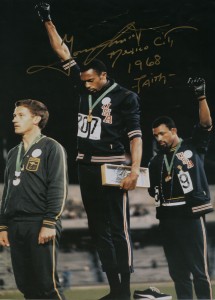
1968 Olympics Black Power Salute, Mexico City, signed by Tommy Smith, photographer unknown / AP, gifted to Autograph ABP by Iqbal Wahhab, courtesy of: Autograph ABP
Afterimage by Sheyi Bankale:
With the euphoria of the London Olympic games, photographs of sporting moments form fixed notions of symbolic endeavour that inspire and create role-models. The one photograph that captures this notion for me best, is the 1968 Olympics Black Power salute by athletes Tommie Smith and John Carlos during their medal ceremony at the Mexico City Olympic games.
Ever since I first came across this image, it has been on my mind. Charged with human and civil rights protest, it played with the idea that Smith and Carlos gave us the answers, with just one symbolic gesture. The gesture rose questions of belief, courage, sacrifice and dignity. Under the gaze of the world, Smith and Carlos faced their respected flag and listened to the Star-Spangled Banner anthem. They both raised a fist, coated in black leather gloves, penetrating the dark sky until the anthem had finished.
The emotional experience conveyed in this symbolic act, following years of training and commitment as athletes, will forever resonate with me.
WOLFGANG TILLMANS
“Sloppy has always been good, meant sexy,” Eileen Myles wrote in her iconic book Chelsea Girls. I would agree with Eileen. Her statement is contemporaneous with when Wolfgang Tillmans was photographing youth culture, in the first half of the ‘90s. His images depict people who are sloppy in the most gratifying sense: casual, heedless, uninhibited.

Wolfgang Tillmans, Adam’s Crotch, 1991
Afterimage by Sarah Moroz:
“Sloppy has always been good, meant sexy,” Eileen Myles wrote in her iconic book Chelsea Girls. I would agree with Eileen. Her statement is contemporaneous with when Wolfgang Tillmans was photographing youth culture, in the first half of the ‘90s. His images depict people who are sloppy in the most gratifying sense: casual, heedless, uninhibited. He captures a state of being, a shrugging feeling that trickles down to posture and style. The Berlin Wall had come down, and ideas of structure and stability wobbled profoundly along with it — what could be re-conceived? Everything. Anything.
Tillmans counters photographic flatness through sheer proximity to the body, in almost invasive close-up: right up in an armpit with sweaty tufts of hair, right up alongside the shimmer of sweat slicking the clavicle. In Adam’s Crotch, ripped, fringed, scuffed, hole-riddled jeans go beyond heavy wear to a reflection of living hard: thighs rubbing together for all-consuming movements and reckless experiences, which translate into garments shredded thin, patchworked back together — and still are coming undone. Whatever party has been cut out of the frame out can still be felt from the tight crop. Hands resting lightly, underwear showing indifferently: there’s a serenity to not fretting about what looks appropriate, because propriety is a myth.
The photo is simply a display of being comfortable in a laissez-faire setting; it’s observing leisure and idleness. A close-up of a crotch could ostensibly be an aggressive move, but here it speaks to ease between photographer and subject, the camaraderie of not having to be polite and careful: that Adam’s boundaries melt into Wolfgang’s.
ZOE LEONARD
Consider American artist Zoe Leonard’s recent photographs, presented in New York in an exhibition titled In the Wake. They depict family snapshots from the period after World War II when her forebears were stateless. The original images, taken as her family fled from Warsaw to Italy to London to the United States over the course of more than a decade, offer scenes of intimacy that contrast with the era’s international clashes and their messy aftermaths.

Afterimage by Brian Sholis:
Consider American artist Zoe Leonard’s recent photographs, presented in New York in an exhibition titled In the Wake. They depict family snapshots from the period after World War II when her forebears were stateless. The original images, taken as her family fled from Warsaw to Italy to London to the United States over the course of more than a decade, offer scenes of intimacy that contrast with the era’s international clashes and their messy aftermaths. Leonard, in re-photographing the originals, opted not to reconstruct lost moments, to close the gap between then and now. Instead, she examines the earlier photographs as printed objects that bear physical evidence of their own histories: we see scratches and other blemishes, edges of paper curling upward. Sometimes, too, Leonard aims her camera from an oblique angle, shrouding the original subject with a splash of reflected light and revealing a wavy postmark. (These objects made the same journeys as their subjects.) She flips one photograph to document its inscription. “It’s not that one sees less,” Leonard has explained of these works, “but that different information becomes visible.”
Leonard’s artworks are in the “wake” of the originals in multiple senses. A wake is the path behind a ship marked by choppy waters – a useful metaphor for migrants seeking safe harbor, as the pictures’ subjects are doing, or for the compositions, in which the originals “float” against featureless backgrounds. A wake is also the act of keeping watch with the dead, of meditating on lives as they were lived. For every migrant who forged a life in a new home, as did some of Leonard’s family members, there are others who could not. And to “wake” is to come to consciousness, to become alert to the world around you when before you were unaware. The narrative emphasis placed on their subjects’ statelessness ensures the pictures’ relevance in our present moment of geopolitical instability and its attendant migrations. These intimate pictures are linked to – awaken us to – some of the broadest and most pressing social concerns of the day. Many of the original pictures are bounded by thin white borders. By re-photographing them and placing them within this conceptual and narrative frame-work, Leonard ensures that the meanings they convey are not similarly restricted. We know little about the lives of the people depicted, the knowledge of which remains the province of Leonard and those close to her. But in imagining those stories, empathy compels us to relate at both intimate and grand scales.
JULIAN FAULHABER
I’m currently looking a lot at images like this, which are in a kind of hybrid state between the hyperreal and the abstract, between fact and fiction. It is perhaps not this particular photograph by Julian Faulhaber that fascinates me, but rather the type of photography it represents, images that with crystal clear sharpness depict something with a detailed and zealous attention and yet does not really reveal anything.
Afterimage by Jenny Rydhagen:
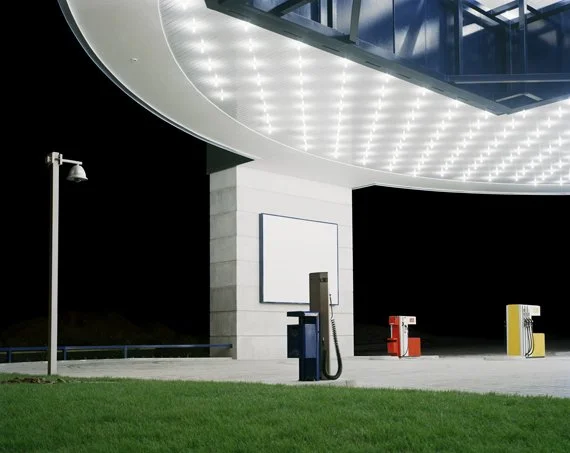
Tankstelle, 2008, © Julian Faulhaber / VG Bildkunst.
I’m currently looking a lot at images like this, which are in a kind of hybrid state between the hyperreal and the abstract, between fact and fiction. It is perhaps not this particular photograph by Julian Faulhaber that fascinates me, but rather the type of photography it represents, images that with crystal clear sharpness depict something with a detailed and zealous attention and yet does not really reveal anything. The image is as expressive as an architectural rendering and I find it both repulsive and attractive this lack of signs or clues. I don't quite know where to fix my gaze in this image, it sweeps over the polished surfaces in search of a little friction, for a rustle on the ground, a withered strand of grit, a crack in the perfection, until it is finally sucked into the darkness somewhere behind the petrol pumps. I’m trying very hard to get into a place I don't really want to be.
PATTI SMITH
This photograph of young Patti Smith and Robert Mapplethorpe, was taken by an old man with a box camera on Coney Island in 1969. The image is used on the cover of Smith's book Just Kids, which revolves around the relationship between the two, and on how they together began their respective artistic careers.

Afterimage by Ingvild Langgård:
This photograph of young Patti Smith and Robert Mapplethorpe, was taken by an old man with a box camera on Coney Island in 1969. The image is used on the cover of Smith's book Just Kids, which revolves around the relationship between the two, and on how they together began their respective artistic careers.
I have seen several iconic images of these two, together and apart, but this one is still on my mind. There is something snapshot-like about it, while at the same time it's a fantastic portrait. You can see how it was them who initiated the image, wishing to preserve a moment in time.
There's something reserved and graceful and at the same time mysterious about them, as if they already know something, something great and fantastic. The picture was taken before either of them became famous artists in their respective fields.
It is of two young people, hoping to become something, but right there and then only hanging around. They wanted to document themselves then and there, and had, according to the book, put a lot of effort into their appearance.
That the picture is from Coney Island, is of course no coincidence, and the place becomes here, as often else, a character in itself: the very incarnation of nostalgia connected with the future. Although my reading is of course charged with what Smith and Mapplethorpe achieved later, we have all of us stood there, just like that, on Coney Island.
EIRIN STØEN
This is an image still processing in my mind, which isn’t a photograph on its own but a documentation of a work I haven't experienced, but which I still try to interpret. Ivan Galuzin invited Eirin Støen for a one night only at Brown Dude Projectspace. I didn’t make it in time to Sørligata's old factory premises in Oslo, but I’m nevertheless bewitched by the work as a photograph.
Afterimage by Maria Veie:

This is an image still processing in my mind, which isn’t a photograph on its own but a documentation of a work I haven't experienced, but which I still try to interpret. Ivan Galuzin invited Eirin Støen for a one night only at Brown Dude Projectspace. I didn’t make it in time to Sørligata's old factory premises in Oslo, but I’m nevertheless bewitched by the work as a photograph. Støen had, with simple means, climbed to heaven in Perfect Strangers (2010). A ladder of untreated wood, lashed together by wooden ropes that looked as if they were from the mountains, leaned against an open skylight window. I don’t know wether the audience could actually climb the ladder, but Støen as an artist had all the power in the documentary process, and makes the view part of her work. In the photograph that was shared on social media, we see a sun-filled, classical city loft, partly filled with old furniture. Støen's image makes a radical shift. Some would say that she’s s just built a ladder of rope and branches and set it up against a window. But the genius move to me lies in the choice of angle. The light from the skylight dazzles the viewer, making you feel enveloped in total darkness.
This contribution has been featured in a previous issue of Objektiv.
NAN GOLDIN
In 2001, Nan Goldin took photographs of a couple, Jens and Clemens, somewhere in Paris. Back then, no one knew what to expect, because they were waiting for something else. Back then, love was enough in many ways. It was all still playing out to the soundtrack of the 90s, when walls, fences, eastern blocks and cheap techno music fell to the ground, allowing people to meet at eye level in places that needed an embrace.
Afterimage by Tomas Lagermand Lundme:

In 2001, Nan Goldin took photographs of a couple, Jens and Clemens, somewhere in Paris. Back then, no one knew what to expect, because they were waiting for something else. Back then, love was enough in many ways. It was all still playing out to the soundtrack of the 90s, when walls, fences, eastern blocks and cheap techno music fell to the ground, allowing people to meet at eye level in places that needed an embrace. There were many places that needed embracing. The same year Goldin took her photos of Clemens and Jens, another war broke out. The war of fear. All wars bear their own name.
I was in Paris in January 2020. By then, Paris had experienced its own war. A war of pain. This war tore out everyone’s hearts. A war that seems impossible to win does this to you. At the airport, people were already talking about something coming. You should report any flu-like symptoms. I always have symptoms, if I'm asked. Not that I'm a hypochondriac. More because I have anxiety, and anxiety sets the symptoms in motion. I rarely travel alone because I have anxiety about that too, so I had my husband with me. We didn’t fail the test, so we could go to the old Jewish quarter. We’ve made a rule never to be in Paris without going there for a falafel. Only Tel Aviv and the Turkish area of Berlin can beat that taste. My husband says it’s the spice. I say it's the love. You can always taste it.
We were in Paris for a long time. We should have been there even longer, but something began to happen. It closed the world down. We flew back to Denmark in the middle of the night in March. I thought this war should have a name. I wrote down many suggestions in my notebook. I didn't need to find the culprit, to vilify a nation or a bat. Everyone has carried something with them of this war, in which we all, in our own way, became both soldiers and our own enemies. I thought we could learn something from it. Not the postulating platitudes of community triggered by retreating, staying at home in what quickly became our little fortresses. From there, we could engage in our own strategies and systems, deploying a cold, unhelpful militia that did nothing but fall into trenches that only got deeper and deeper. No, I thought, we could learn something else. I walked around the Danish forests, hoping we would learn something from them.
When I came back from Paris, I went into exile. I got to know the silence. That must be the name of the war. Because it created the spaces that I think we needed. We didn't need death. You rarely do. But we needed the pause. I've lived in a forest for a long time. A forest that's miles away from Paris and Nan Goldin. Far away from Clemens and Jens. But not from love. And I guess that's what we've learned. Not that this was or is the decade of love or fever. It's a different virus altogether. Silence has a different voice, a different war. We were wounded by those shots.
We all have someone we've lost. There are still many places that need an embrace. We know that again. And we’ve learned to act on it. So I hope that's what we will do. All of us from the old world who have moved on and have started living in a new world. When I came back to the city, I stood in my own driveway and embraced my husband. Nan Goldin should photograph it one day.
ANNIE LEIBOVITZ
This is everything that is wrong with the world and how dangerous photography can intersect with it. The idea of a conflict zone as a backdrop for an Annie Leibovitz shoot for Vouge is vile. Posing the “First Lady” against a destroyed airplane in which people presumably died. Depicting a politician as an icon hero without any nuanced understanding of their function and complicity in this 155 day old brutal war.

Afterimage by Adam Broomberg:
This is everything that is wrong with the world and how dangerous photography can intersect with it. The idea of a conflict zone as a backdrop for an Annie Leibovitz shoot for Vouge is vile. Posing the “First Lady” against a destroyed airplane in which people presumably died. Depicting a politician as an icon hero without any nuanced understanding of their function and complicity in this 155 day old brutal war. A superficial glossy depiction of a hero in the Hollywood mould. The whole way this conflict has been covered (from the hierarchy of empathy we witnessed in the way white refugees were embraced) to the “cowboy and indians“ genre analysis of the actual conflict. Somehow deep down I think these pictures confirm our need for a binary understanding of the world as good and evil, for an outdated model of male heroes with their female enablers. All the while the faceless and for now nameless youth die daily. Don’t get me wrong, I’m not in any way supporting Putin but this shoot feeds into all the toxic heteronormative patriarchal ideas that make war inevitable.
Both images by Annie Leibovitz for Vouge.
This text was first published at Broomberg’s Instagram.
MAX DUPAIN
Whenever the word photography comes up, this image always comes straight to my mind. When I was introduced to the art of photography, around the age of 13, I was captivated by Max Dupain and the influential nature of his career – particularly his pioneering influence of modernism to Australia.
One Image by Julia Clark:
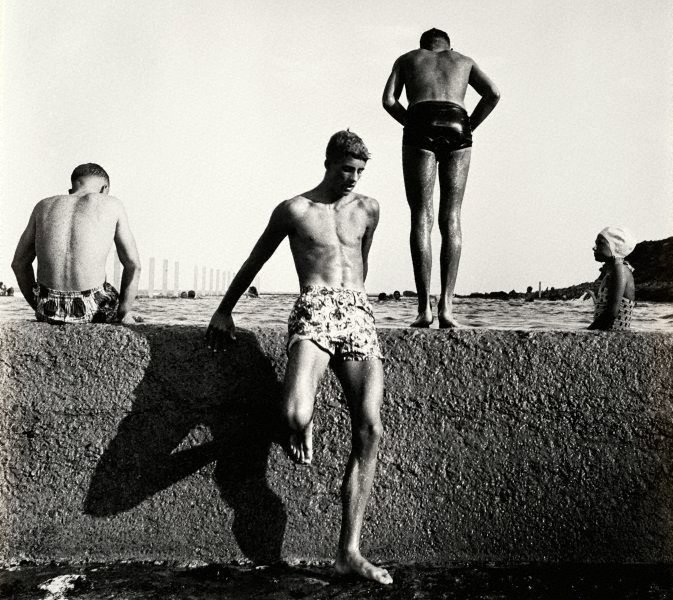
Whenever the word photography comes up, this image always comes straight to my mind. When I was introduced to the art of photography, around the age of 13, I was captivated by Max Dupain and the influential nature of his career – particularly his pioneering influence of modernism to Australia. For me, this image At Newport will forever be engraved in my mind. The composition, the leading lines, the shadows and the illusion of it being cut in half, are all so engaging and aesthetically complex that I find myself thinking about it all the time. All the subjects seem so perfectly propped that anyone would be forgiven for assuming it was staged, and the fact that it’s completely candid just speaks volumes about the skilled and watchful eye of Dupain.
One of the shapes that captures my gaze in this image is the shadow of the man standing in the middle. Despite his position being central in the frame, his shadow is as engaging to the eye, and even more so, it manages to compete with all the subjects as the most eye-catching aspect of the photograph. Aside from the shadow, this image has influenced me in so many ways, most notably the varied layers and textures in the image, the shapes and their interplay, and the objectification of the human subjects – making them shapes rather than people – their organic forms make the viewers eyes bounce from subject to subject making the image circular, causing the eye to view the image as a whole.
This image is even more interesting due to its positioning of a subtle undertow of social discomfort in an otherwise idyllic scene. There is something slightly unsettling about the disjointedness of the bathers, the hunched over, spine exposing stance of the man furthest to the left, the positioning of the man in the middle – looking as though he is bracing to hold back the weight of the ocean on the other side of the wall. Beach scenes, in Australian photography, are iconic for their imagery of the ideal summertime, but Dupain, in At Newport, very subtly challenges this norm, capturing both the glee of post war Australia, and the uncertainty of what was to come.
DIANE SEVERIN NGUYEN & LUCAS BLALOCK
I met Diane Severin Nguyen last August as she was passing through New York on her way back home to Los Angeles having finished the second of three summers on the MFA program at Bard College. Torbjørn Rødland, an enthusiastic advocate of Nguyen’s work, had suggested we meet. Nguyen’s visceral, materialist approach stayed with me. So last winter, when the 28 year-old artist was staging exhibitions of new work in both New York (at Bureau) and Los Angeles (at Bad Reputation) I was thrilled to catch up with her and talk more about her pictures, their fugitive subjects and how these two exhibitions came together.

Flesh before Body, 2019. All images here are by Diane Severin Nguyen.
ANIMAL, VEGETABLE, MATERIAL
A conversation between Diane Severin Nguyen and Lucas Blalock.
I met Diane Severin Nguyen last August as she was passing through New York on her way back home to Los Angeles having finished the second of three summers on the MFA program at Bard College. Torbjørn Rødland, an enthusiastic advocate of Nguyen’s work, had suggested we meet. Nguyen’s visceral, materialist approach stayed with me. So last winter, when the 28 year-old artist was staging exhibitions of new work in both New York (at Bureau) and Los Angeles (at Bad Reputation) I was thrilled to catch up with her and talk more about her pictures, their fugitive subjects and how these two exhibitions came together.
Lucas Blalock I want to start with a general question about the impulse to make these pictures. Where do they come from?
Diane Severin Nguyen It comes out of a desire to juxtapose physical tensions and the failures of their linguistic counterparts. Sometimes words can claim entire bodies with their symbolic force, but sometimes they’re nowhere near enough. Working within a non-verbal space can bring about very specific material qualities relating to touch. I work from these minute tensions, of being pressed on, pierced, pulled apart, submerged, falling, twisting, which are often related to pain. And I’m curious to see if they can be empathised with photographically, or how they can be transfigured into a different feeling.
LB The images are kind of ‘grunty’: they present more as sounds than as words. And this can be set in opposition to the central activity of the camera, which has been to show things clearly in order to enable one to name a thing.
DNS There’s a poetic impulse in that sense to rearrange the language, because photography’s claims to representation and the real should be the departure point for an artist. There’s also a lot of political potential in being immersed in a medium that claims so much accuracy, which helps me think through many different texts that deconstruct essentialist approaches. For instance, my title for the show Flesh Before Body at Bad Reputation came from Hortense Spillers’ words: before the “body” there is “flesh”. Which is to say that before there’s this symbolic unit there’s the substance that makes it up and fills in the parameters of the symbolic unit, and how that dis-individuated life-form is what makes possible the individuated one. So I began to ‘flesh out’ this naming process that the camera relies on for its power, and work against its trajectory of naming bodies by starting with the nameless. I was also thinking about the word ‘impressionability’ through this other text I was reading, The Biopolitics of Feeling by Kyla Schuller, which in one section emphasised the difference between the elastic and the plastic. When you apply force to a material that’s elastic, and then you remove that pressure, it will return to its original form. When you pressurise something that’s plastic, it will be permanently changed. So there are certain words that describe these physical tensions, and how they might affect consciousness.
LB Plastic strikes me as a very sculptural term, but you’ve folded these concerns into photography. Can you talk about the delimited space of photography in your work?
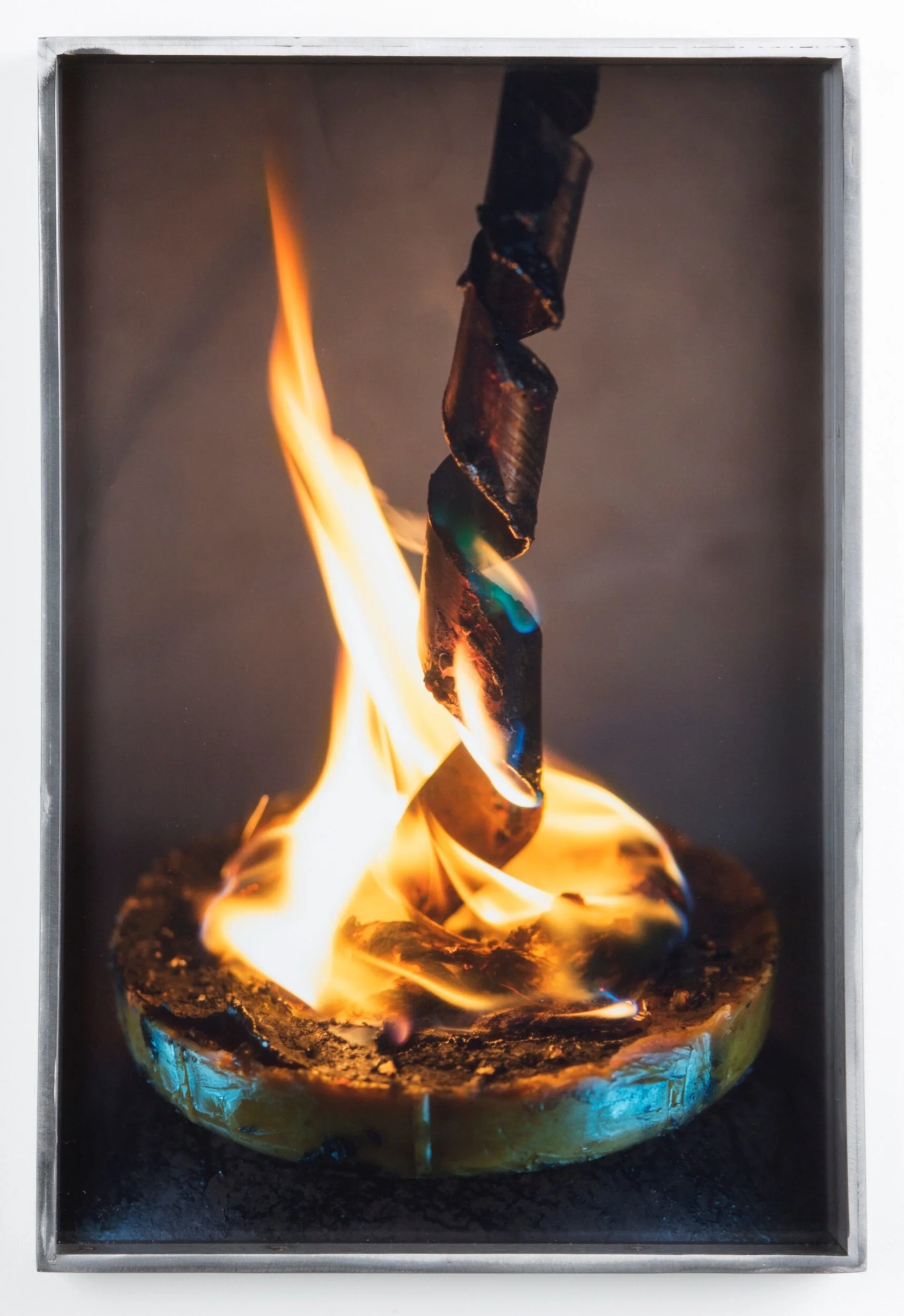
Wilting Helix, 2019.
DNS I like approaching photography as a set of limitations, and also as something problematic. It forces me to begin art-making from a non-safe space, and reckon with this very violent lineage of indexicality, the pinning down of a fugitive subject in order to understand and place it. But when those tools and thought processes are exhumed or applied uselessly, we can make this Cartesian method less confident of itself. To accept the impossibility of ‘knowing’ takes us somewhere else, perhaps a more intimate place.
LB The connection to the fugitive subject is really apt because your material choices seem to be directly addressing this kind of pinning down. There’s something about fragility or flow that comes up over and over again in your work.
DNS I think it’s a lot about the provisional – almost like a material or bodily extension of ‘the poor image’ as proposed by Hito Steyerl, but actually enacting that in all of its precarity. Materials and bodies slip in and out of contexts, permeable to the elements but also political contexts. I try to echo materially what I find unstable about images, and I try to observe how materials are photographically disfigured, alienated from ‘native’ environments. I try not to rest in the place of sculptural object-making for this reason. A moment of re-birth relies on the possibility of everything shifting at once.
LB Yes, in object making, the thing is in the room with you and has to behave and remain stable, whereas the space of photography and of pictures has another set of possibilities. To me, it sounds as if you’re kind of using the photograph against itself. You’re talking about its history of violence enacted through this objectifying tradition of isolating and making a subject.
DNS It’s like a process of essentialising. Which is problematic, but I see it everywhere around me. I guess the photograph has always been used in this way, but I see people trying to assign their identities optically. And I find this to be a dangerous space. I thought we’d worked past this, but maybe we’ll never work past it.
LB There is this other way of looking at it that suggests some potential. Because we’ve used it as a parsing machine or an indexer, there’s a way in which we’re willing to read the photograph back into a bigger space as a portion of ‘reality’. This is something we don’t often do with objects.
DNS I think the reason why I’m not interested in claiming the sculptural labour in my work (even if I enact a certain kind of material experimentation) is because I’m too aware of the dispersion, the loss of authorship no matter how detailed the attempt – the permeability of an image. There’s a certain relinquishing with photography, a constant referent to an Other. And there’s a certain ownership with sculpture as an artist. I think what I’m doing is in dialogue with that dispersion, knowing that it will circulate. Even as I’m slowing it down, it’s in reaction to knowing how images can be sped up, over-circulated. But I have to be on that time scale, and the moments I harness in my work are surrounded by that anxiety. They try to reference it.
LB When I look at your pictures, I'm aware of this sense of threshold, both between the interior and the exterior, and between the animate and the inanimate. It’s something that has a particular resonance with the photographic. I was wondering if you could speak to this: how you see these thresholds, and if it’s something that you’re actively interested in?
DNS I’m always thinking about ‘life’ in this very big way, wondering how and why it’s so unevenly designated. And photography plays a crucial role in such constructions. By working with these ‘still lifes’, a traditionally inanimate space, I’m allowing myself to study the bare minimum requirements for ‘life’ to be felt. Ultimately, I’m not interested in assigning binaries between the organic and the inorganic, or indulging in the ego of an anthroprocentric status, which just recourse to human centeredness in a particularly Western way. The suspension I try to invoke is that it could be both or neither. Somehow, when the human body is removed, we get to start more immediately from a place of ‘death’, which I think photography serves much better.
LB It feels less like a trade between the terms than like a membrane, as if elements are threatening to shift into the other space.
DNS Yes, that precariousness feels so inherent to the medium itself, the rapid swapping of reality and perception. And I’m very invested in having photographic terms converse with this ‘language of life’. I believe that they’re born out of one another. Maybe this is a very Barthesian way of approaching things.
LB Can I ask you to say a little more about that – the ‘photographic language’ and the ‘language of life’?
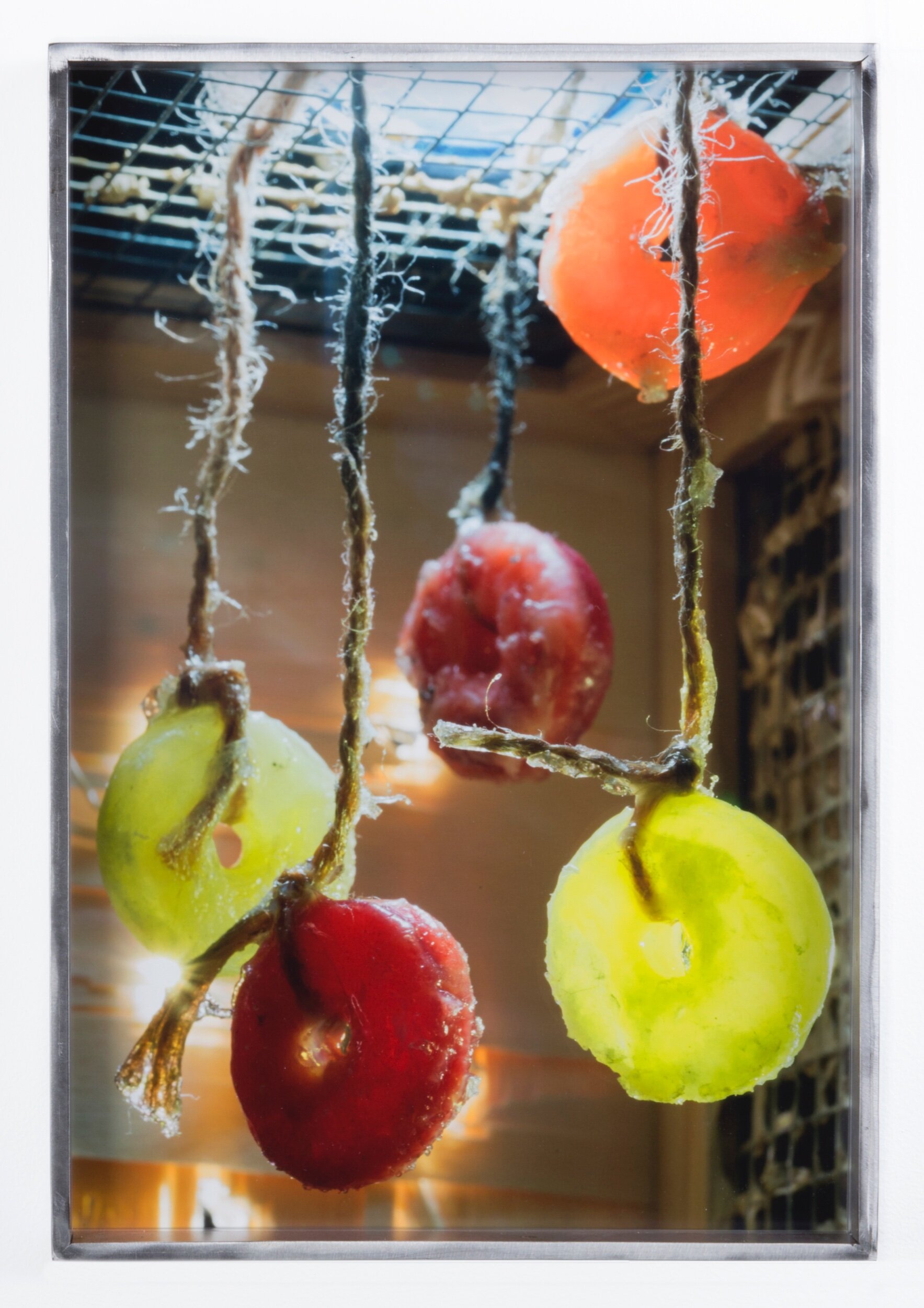
Co-dependant exile, 2019.
DNS For instance, I’m always creating these wounds and ruptures for my photographs, this broken-ness which I think speaks to what a photograph can do to a body or to the world. But I’m also speaking to this photographic concept of a punctum, and wondering if it relies on the excavation of ‘real’ pain within a social space. I’ve depicted these evasive ‘wetnesses’. I really see photography as this liquid language, literally and materially being born out of liquids. But also, socially and economically, photography is liquid in that it can shift in value very quickly. Symbolically, liquidness can represent a very female substance and that potential immersion, like within a womb space. Historically, photography’s terms were developed alongside psychoanalytic concepts, Impressionistic painting, advertising, military technologies, and they continue to generate from/with these other sets of vocabularies. Within contemporary art, I really see the confluence with sculptural terminology as well. I guess I’m working with all those terms and trying to translate them materially.
LB This ‘evasive wetness’ you mentioned, or the way fire or burning or char act as subjects – it feels as if there are a number of ways or methods by which you get me as viewer into this prelinguistic space. One of them seems to be describing certain kinds of chemical or physical reactions.
DNS These elemental qualities provoke or catalyse moments of becoming or un-becoming. The elements speak to pressures and their transferences into new forms. Traditional Chinese medicine has a whole logic built around these types of transformations, and there’s definitely a primordial aspect to them that’s pre-linguistic. Again, it’s not revealing the ‘natural’ that I’m interested in, but more all the adjacencies that can be triggered by a photographic moment. For instance, studying photography made during the Vietnam war is fascinating to me, an era when 35mm film cameras and toxic chemicals were mass weaponised in conjunction with one another. On one hand, we have this Western-liberal pro-peace photojournalism; on the other, we have something like napalm, which is incredibly photographable. So with the fire in my images, I recreated napalm by following an online recipe. It burns in a very specific way. It’s sticky and can be spread into the shapes that I want. It lasts longer; it waits for me.
LB This makes me think about the myriad of histories you’re drawing together. Photography was certainly part of the toolkit that set the scene for the secularisation of the world and the rise of our current era of scientific, technological understanding. And this of course was produced through forceful displacements. Looking at your pictures I think about these adjacent traditions that have a stake in patterns that aren’t so ready to celebrate this turn: namely alchemy and science fiction. I’m wondering if either of these lineages play into your thinking?
DNS I like this idea you’re proposing of science fiction opposing secularisation or being displaced by it. Maybe the displacement is the part I relate to the most, the space of disaster that science fiction is always addressing, and the kind of resourcefulness that’s required in those conditions. Again, with the Vietnam War, the North was at such a great material disadvantage and couldn’t disseminate photographs at the same rate as Western-backed forces. There was a small agency set up by the Communists to glorify Vietnam through images, but the small number of war photographers would each receive a smuggled Russian camera and have something like two rolls of film for six months. There wasn’t the privilege of ‘choosing later’. So the results ended up being incredibly staged and remarkably ‘beautiful’, a twisting of poverty and political agenda. That sort of desperation to make an image that communicates is something I relate to deeply. And it’s how work in a sort of literal way, this grasping. It’s muchless rational than it should be really. It’s more desperate than I’d even want to admit.
LB I relate to that a lot. So in some ways maybe the alchemical aspect is closer because it shares a thirsty quest for knowledge.
DNS It is alchemical, though I’m not sure to what end, besides the image. But it’s also just me conducting bad science experiments. Everything is in the realm of amateur. Which I also find interesting in the space of photography. I find that echoed in what photography is: the accessibility of it and its amateurish qualities, its ‘dilettanteness’. The thing is, if I was a really pro ‘maker’, I wouldn’t be making photographs, so it’s about what I can’t do as well.
LB I understand that. It’s funny though because I hear the way you’re channelling this amateur quality, but there’s also something really seductive about the pictures. Particularly the quality of light. There’s a real fullness to them. You’re not a ‘Sol Lewitt / conceptual art’ amateur. You’re doing something else. Could you talk about that?
DNS It’s the amateur imagination, an amateur expertness. There’s a deep subjectivity to my work, and an emotion that I want to convey that usually has to do with the things that I can’t convey, and a constant attachment to that loss, like melancholia: what can’t be conveyed through a photograph. The images arespeaking to the fact that they can only exist under these terms and under these lighting conditions. And then without me, or me without them, there’s nothing. So the lighting is also very provisional. I’ll use my iPhone flashlight and I’ll use anything that’s around. have an aversion to studio lights, and everything is in this small scale. I appropriate lighting in a certain sense, looking at how light creates different situations. And it becomes a personality of its own in the way that light disturbs time. Even when I use natural light, a certain time of day, it should be an in-between moment. I think it speaks to this journalistic mood that I’m working into, even though it’s very staged. The mode is the capture.
LB Can you say a little bit more about this, because I love this idea of journalism in your work.
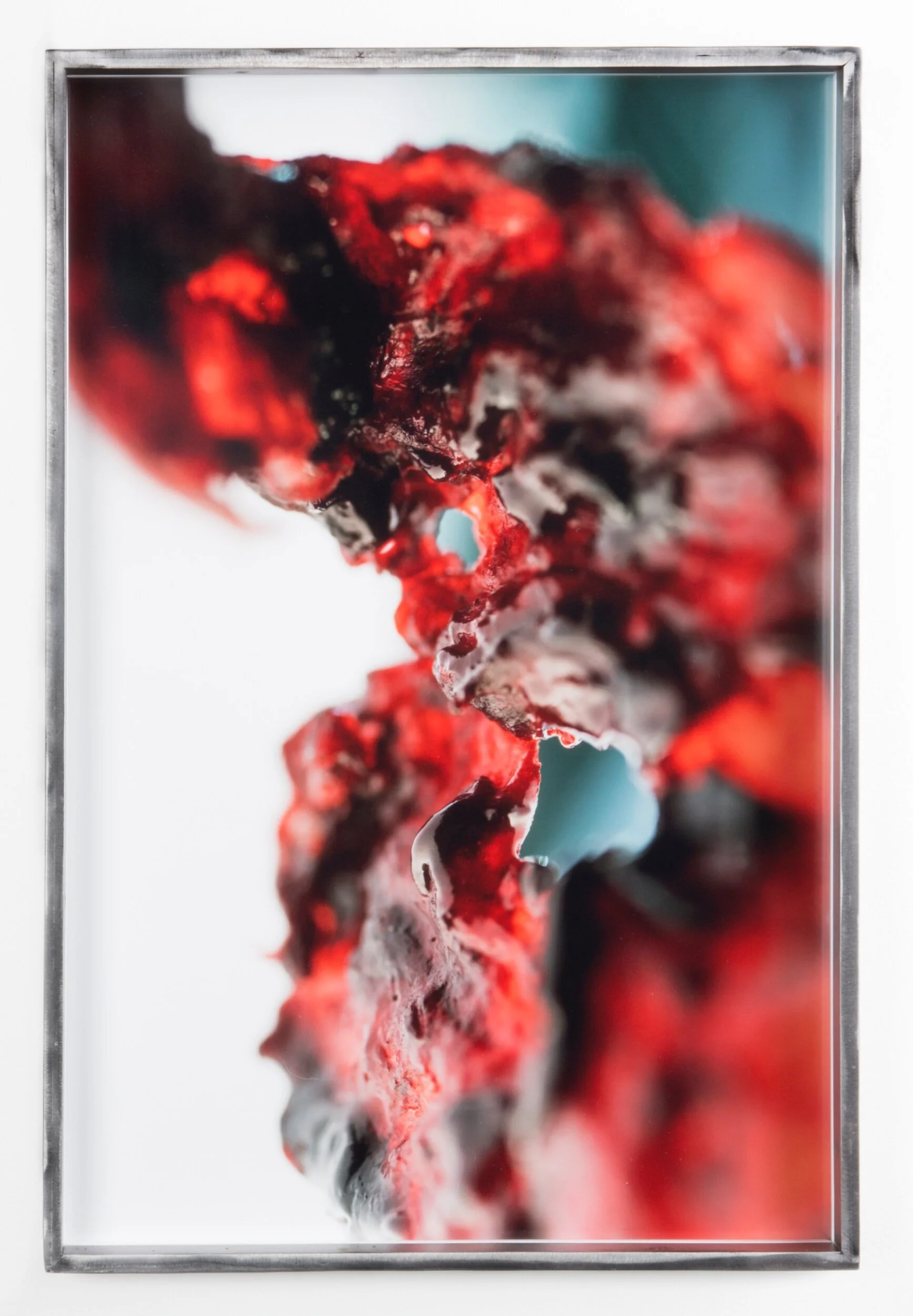
Pain Portal, 2019.
DNS I’m obviously aware of the lineage of journalism and it’s probably what I’ve always worked against. There’s some deep-seated aversion to street photography. But I can’t escape it, and I realised recently that this is the very mode that I take on. What does this mean for me to set up these fugitive subjects, to recreate this model of violence and photograph it? I need to admit to myself that this is the moment that I work with. And so, the more I delve into that, the more I find it a way to speak to that directly. That mode of capturing a temporary state of being is something that photography can do really well.
LB This is all coming through very clearly: the encounter in terms of subject and also in terms of picturing trauma, the sense of possibility in the provisional, and the passing ability to see. One of the things that I thought a lot about in your show at Bureau was the tension in the work between the seductive and the repulsive. There are things that actually feel traumatic – even forensic moments. But then there are other pictures where there’s much more of an invitation. I started to think about this group of situations as elements from a kind of nature film, in your attempt to capture this greater thing, a spanning from something that’s beautiful and what we might see, in the natural order, as grotesque.
DNS I think that there are these different moments of propaganda and emotionality that I’m trying to express. And it comes through in the actual installation of the images, where I worked more poetically than, say, essayistically. The way that I view a body of work holds this concurrent repulsion and beauty and different levels of accessibilities. I don’t really make these distinct series in a traditionally photographic way, but view the body of work as an actual body and part of a larger body. But I would say that most of the emotionality comes from trying to contain all the life within one image. Each image can operate on a really individual level.
LB One of the things that ‘drives them home’ is this sense of the irreversible: that though these objects themselves might not easily show what they are, it’s evident that the processes they’re going through can’t be fixed.
DNS You asked earlier about the science fiction and I wouldn’t say that my work is about any lived past or any lived future. A future is tethered to a narrative progress, which I’m really not interested in. But I do think a lot about the concept of the future of trauma and what happens during and after an event. Trauma, and how it’s rendered as an image that reoccurs in this tension that I’ve spoken about between the material and immaterial, this ordinary and potential moment – all those things add up to this kind of irreversibility. Also, at the core of my work is a deep desire to de-essentialise everything; to not let anything be trapped by someone else’s knowledge of it. So that irreversibility speaks to there being no state of purity to return to. That’s what I’m into, the non-purity.
LB The way you just described it makes me think of the tradition of vanitas. Because in a sense it’s a still-life practice you’re working through and I’m curious to read the images as still lifes engaging questions of mortality or passing. I mean a vanitas that’s denatured, pre-linguistic, more sensory than symbolic.
DNS They’re very self-portraity in a lot of ways. They’re more in that tradition than anything. They’re making active lives. I do get asked if I work in the lineage of still life and I would say that I’m only working from that to understand something else.
LB Even asking if it’s still life doesn’t feel like a good way of approaching it.
DNS The more I think about that term, the more I think about how it has this political relevance: what does it mean to have a still life?
LB Initially it was a presentation of wealth and painterly acumen. I think a lot of the things you’ve been talking about are in some ways in direct opposition to this tradition.
DNS But it is nice when things get condensed into a moment of stillness. When new changes happen, with me embracing the distance, or holding on to a physical tension that’s provoked by distance from the thing itself. That’s all within that vocabulary.
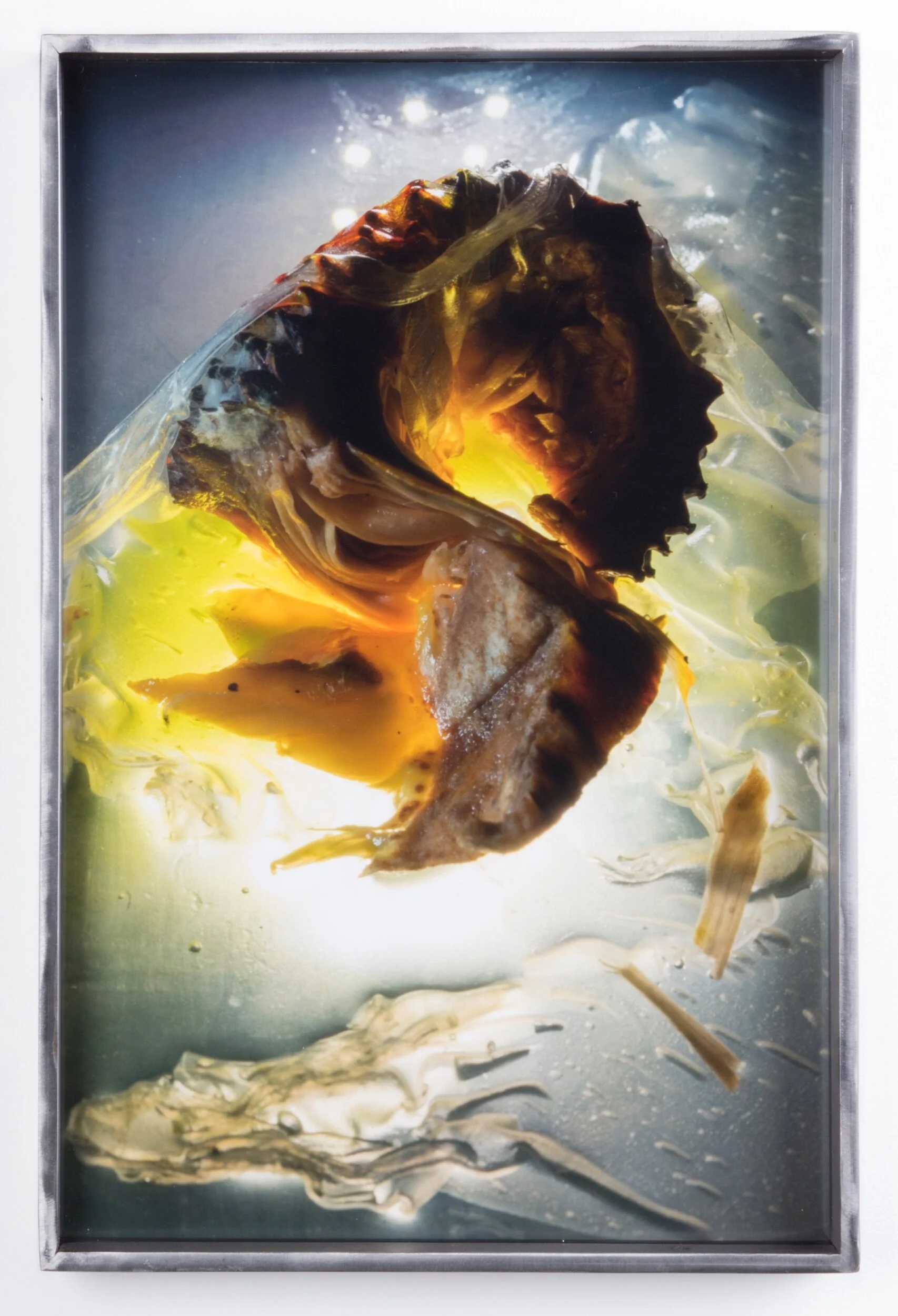
Malignant Tremor, 2019.
LB I think that this whole idea of the provisional that you’re bringing into your photography makes it so that the stillness is actually achieved in the picture making, which is different from still life. Still life will kind of stay there, whereas this is an interruption of flows of various speeds. It feels very central to the work that something is coming unglued.
DNS I think the touch of the pictures reveals a certain force that’s applied by me, the artist, in order to create this still-life. Which hopefully brings their stability into question, and also my intentions as an arranger. To me it’s a way of holding two positions at once - as a deconstructive critic of the apparatus but also as a highly subjective human artist.
LB You had two exhibitions this year, one at Bad Reputation in Los Angeles, and a two-person with Brandon Ndife in New York at Bureau. Are these two projects part of a body of work or do they feel separate for you?
DNS They were instigated by the installation requirements and conditions, by these two different spaces. I thought around those things. Obviously, it was interesting showing with Brandon because there’s this sort of content forwardness – his work also is also quite photographic in its stilling of things. With Bad Reputation I installed a circular window in the room, which is very small. There’s a more immediate relationship to the body and I felt I could invoke through that. I’d say that they’re an ongoing set – the images are part of a larger set of terms and tones that I’m piecing together before an exhibition.
LB It was interesting to see your work shown with an object maker, since your photography has been in a dialogue with sculpture for the past ten or fifteen years. But I feel your take on it is quite different. It’s not the photograph as object at all. It’s really a proposition.
DNS Because I can so easily indulge in the sculptural, or indulge in the painterly, I can abstract to a crazy extent, playing with lighting … and then I have to stop to remind myself what is the photographic moment. And that goes back to the journalistic mode, which maybe is the essence of photography and what we’ve been grappling with all of these years. In the way that I’m not interested in indexing an object that I made, or found, it’s about that object being pushed through the threshold of what photography is.
LB In the press release, there’s an interview between you and Brandon, and one of my favorite moments in the conversation is this kind of pairing you talk about between the ordinary moment and the potential moment.
DNS Which I think is when we talk about Eastern spirituality or object-oriented ontologies. It’s about this object that can be talismanic on some level. There’s this sort of spirituality to this idea that we’re here, now, in this body and we’re everything. But at the same time, I find that to be very closely related to experiencing trauma and how you’re in your body, and experiencing the feeling of being somewhere else completely. They’re two sides of the same coin. Part of me is dealing with certain political questions around how a body is identified and how you can change it. I’m interested in those narratives and those dialogues.
LB I was also really interested in your exchange with Brandon on found objects. It made me wonder about your relationship to the ready-made, and to Duchamp’s act as a kind of trauma – a shifting of categories or states of being.
DNS I started out with things that were much more recognisable. I was looking at the condition of the photograph within these objects, and I viewed photographs as being plagued by objecthood. But now, I don’t think that as much. The barriers between an object and a subject, they’re just shifting at times and it’s kind of difficult to pin down an object in that way. With the ready-made, it’s less about an object space and more about materiality in a cleaner sense – literally more about surface.
LB The flesh instead of the body?
DNS Exactly!

Liquid Isolation, 2019.
This conversation is from Objektiv #19. Objektiv is celebrating its tenth year in 2019, and this year's issues will look both backwards and forwards. For this issue, we've asked artists who have featured in our first eighteen issues to ‘pay it forward’, so to speak, and identify a younger artist working with photography or film whom they feel deserves a larger platform. Torbjørn Rødland pointed out artist DIANE SEVERIN NGUYEN and chose Lucas Blalock from our editorial board to interview her.
GORO TRONSMO
…My colleague, wearing dark glasses for the occasion, doesn’t look convinced. While actors pretend they inhabit the space, doing everyday chores, he expresses his relief that the museum has finally opened, but points out that this show of artists not from the collection had become outdated even before it opened.

Goro Tronsmo, Staged Institutions, 2022. Installation photo by Ina Wesenberg/The Nationalmuseum. Note photographed by the author.
Afterimage by Nina Strand:
The big installation by Goro Tronsmo, in the main exhibition I Call it Art, resembles a small apartment on the top floor of the new museum. I laugh over a note placed on one of the railings: Beware! Art
The museum’s opening show has been met with much criticism, and the architect of the institution is furious about the various new works with which the big light hall has been filled. The government has spent too many millions on all the delays, while the curators have tried to make a show for an imaginary nineteen-year-old woman who rarely sees exhibitions. There’s so much noise around this building that this handwritten piece of paper cheers me up.
My colleague, wearing dark glasses for the occasion, doesn’t look convinced. While actors pretend they inhabit the space, doing everyday chores, he expresses his relief that the museum has finally opened, but points out that this show of artists not from the collection had become outdated even before it opened.
‘They should have re-curated it when they realised how delayed the opening would be. The artists here are way too established now – there’s nothing new to see,’ he says while walking into the pretend gallery in the gallery, which is so meta it almost makes him laugh.
I came to the preview in order to write about the photography in the collection, but all that was on display was the generation from the Bergen school from the 1990s, with one or two newer artists in other rooms. So I joined him to see I Call it Art.
‘The architect has renamed it, ‘I call it Garbage’,’ he is saying as we go out on the balcony to look at Siri Aurdal’s monumental sculptures from the permanent collection. ‘But actually it isn’t bad.’
The note is a small but welcome reminder of who this experience is for. If the show is made for someone who needs a gentle push to see more art, and at the same time is funny and weird enough for my truly critical critic friend, then maybe it’s working. And once this large space for temporary exhibitions is filled with its next show, like any other museum showing art, no-one will need to warn anyone about anything.
GABRIEL OROZCO
I’ve loved this photograph for years. The tender way in which dog is portrayed sleeping over these rocks. The dog looks so gentle, almost like a floating figure. There’s a harsh beauty in the photograph, a tension between the delicate creature and the hardness of the vertical rocks.

GABRIEL OROZCO, Sleeping Dog (Perro durmiendo), 1990
Afterimage by Daniel Mebarek:
I’ve loved this photograph for years. The tender way in which dog is portrayed sleeping over these rocks. The dog looks so gentle, almost like a floating figure. There’s a harsh beauty in the photograph, a tension between the delicate creature and the hardness of the vertical rocks.
This photograph speaks really well about the figure of the street dog, which is an integral part of the urban landscape in Latin American. The street dog is something that is common to cities across the continent, including in my hometown, La Paz. I think for example of Alex Soth’s beautiful book Dog Days Bogotá (2007), where the street dog is kind of like an omnipresent figure and a symbol of different aspects of the Latin American metropolis: informality, precarity and violence. Like Orozco, Soth portrays this figure with a lot of tenderness and dignity.
Throughout the history of photography, the street dog has also come to stand as a metaphor for the photographer. The idea that the photographer wanders the streets very much like an errant dog. Photographers have very much seen themselves reflected in this figure. I am reminded for instance of the book cover of Josef Koudelka’s Exiles (1988). You have this very famous photograph of a black dog on a snowy field that looks like a demon. I think it’s very telling that he chose this image to speak of his own exile, of his years of rootlessness, drifting across different countries. There is also the strikingly similar photograph Stray Dog (1971) by Daido Moriyama, which depicts a dog with a similar pose and menacing allure. Moriyama also shows himself as this stray dog, as an outsider or a renegade living within a rather strict Japanese society.
There are other well-known photo series that come to mind such as Dogs Chasing My Car in the Desert (1996 – 1998) by John Divola, which I also find really beautiful. Dogs can be threatening but they also symbolize freedom. They are above all instinctive creatures. Why are dogs so urged to chase cars? Why are photographers so urged take a specific photo?
So, there's this interesting history about how photographers have captured street dogs. I also recently discovered Francis Alÿs’ Sleepers (1999 – 2001). The series combines photographs of street dogs and homeless dwellers taken from the ground-level in a rather tender way. There is even something noble about the way these two figures are portrayed here. And we’re back again to the question that was sparked by Orozco’s photograph when I saw it all those years ago: how can artists portray something in a dignified manner? Scholar Dork Zabunyan has argued that we all have a “right to a dignified image”. It’s an issue that ceaselessly fuels my own practice.
JENNIFER BOLANDE
A few years ago, my companion over a hyper-inflated hotel breakfast was a loud Italian gesticulating furiously over the amount of food available and the inevitable waste. The hotel advertised itself as the most generous hotel breakfast of the north. The man was Oliviero Toscani, who in 1991 famously made an image for a billboard depicting a kissing nun and priest, promoting the clothing brand Benetton in Catholic Italy.

Jennifer Bolande, Visible Distance/Second Sight, 2017, Palm Springs, California, installation view documented by Lance Gerber, courtesy of Desert X.
Afterimage by Bjarne Bare:
A few years ago, my companion over a hyper-inflated hotel breakfast was a loud Italian gesticulating furiously over the amount of food available and the inevitable waste. The hotel advertised itself as the most generous hotel breakfast of the north. The man was Oliviero Toscani, who in 1991 famously made an image for a billboard depicting a kissing nun and priest, promoting the clothing brand Benetton in Catholic Italy. Amongst other campaigns were a depiction of a woman of colour breastfeeding a fair skinned child, and three seemingly identical human hearts with the superimposed text ‘White, Black, Yellow’. The provocateur Toscani confessed that he’d never had a gallery exhibition, but that he saw his photography as belonging to the realm of art. The billboard was his arena, in which he reached millions of people through an overstated use of OOH – Out Of Home Advertising.
The OOH created for an audience in the moving car is credited to the advertisements for Burma Shave shaving cream, placed along US highways from 1926 until the 1960s. Single words were scattered throughout the landscape, only conveying a meaning as one passed by in a vehicle at speed. In Tom Waits’ song of the same name, depicting a woman on the run, who’d ‘rather take my chances out in Burma Shave’, he draws on this nostalgic image of the American highway.
In contrast to aired advertising, whether over the radio or through a televised message, the billboard became an arena for the development of the still image, a potential perhaps overlooked in the history of photography. Walker Evans, however, showed an early fascination with billboards, as in his famous Houses and Billboards in Atlanta of 1936, a sign of the times contrasting vernacular housing with mass-produced advertising. OOH calls for the punctum, a form of imagery where an immediate impact is key, in contrast to much of the pensive imagery traditionally found in the art world. The mega-scale advertising image might have developed in parallel with its cousins in the print media or the gallery, yet it usually still relies on a slogan or caption. It is thus interesting to follow the shift in billboard advertising on the west coast of the US, where the usual product placement recently is seen replaced by billboards promoting content, often simply advertised by a hashtag and an image in where only the know-how will follow suit. While pensive images have traditionally run the risk of being overlooked in an ever-more attention-seeking climate, perhaps they will gain a new focus due to this content-driven form of advertising, targeting ever increasing sub-cultural populations or markets.
For the first edition of Desert-X, artist Jennifer Bolande photographed the desert landscape on her commute between Los Angeles and Joshua Tree. The resulting artworks were plastered over massive billboards along the highway. During a split second, one was able to witness a merging of the real horizon in the background and the superimposed image floating above the highway, resulting in a brief stopping of time. A tribute to fleeting time, and the contrast between image and reality, the images were powerful, yet bore no slogan or apparent message.
The potential for billboard images to draw a response from passers-by in public space fits well with the ideals of public art. The same is also true for video works, aided by increasing advances in technology, as demonstrated by the Times Square Arts: Midnight Moment project, which has broadcast video works by artists from Andy Warhol to Fischli & Weiss on billboards since 2012. The question asked by Wolfgang Tillmans for his Mexico City billboard at Sonora 128 in 2016, ¿dónde estamos? (Where Are We?) sums up the existential power of this format.
XAVIERA SIMMONS
It is an image in a image. A woman holds a black and white photograph in one hand; in the other is an old Roloflex camera. One eye is looking through the camera, and the other is staring directly at us. Do we see and understand? In the black and white image she holds, a group of Black men sit on a stoop.

Xaviera Simmons, Nectar, 2022. Installation photo by Aurélien Mole
Afterimage by Nina Strand:
It is an image in a image. A woman holds a black and white photograph in one hand; in the other is an old Roloflex camera. One eye is looking through the camera, and the other is staring directly at us. Do we see and understand? In the black and white image she holds, a group of Black men sit on a stoop. The one on the highest step, in the middle, points to his black eye. It is a story of violence. This gesture of an image of an image is repeated in other works that make up a larger series of portraits, where different figures hold images and apparatuses, all part of the current exhibition Nectar by the New York-based artist Xaviera Simmons at KADIST in Paris.
For her first show in France, Simmons has included photographs from the AFRO American Newspaper’s collection of historic images in her large-scale portraits. The newspaper, which has ‘crusaded for racial equality and economic advancement for Black Americans for 128 years’, was formed in 1892 by John Henry Murphy Sr., a former enslaved man who gained freedom following the passage of the Emancipation Proclamation of 1863. Simmons’ work deals with the United States‘ dark history of slavery. Her show was timely this Spring in France, when far-right politician Marine Le Pen gained 41 percent of the vote in the presidential election. In the small gallery in Montmartre, French audiences are forced to reflect on their own colonial history.
In the accompanying catalogue, Simmons talks about working with the vast archive of photographs in the collection to reclaim the history of the people in the images. Enslaved people, she explains, have been excluded from any official archive: ‘Somebody Black somewhere said something, sang something, painted something, made something, believed in something. And this has not been passed down, it has not been inserted in the canon.’
The Black man in the image is telling his story, pointing to the harm done to him. The group around him bears witness to his story. The old camera held by the figure presenting the image has its own connotations and history. But Simmons wishes to turn the archive away from being an object of the past, to show us how it can be a: ‘repository of language that we can draw from as we propose new models of repair.’
JACOB HOLDT
There is a book in my library, American Pictures by Jacob Holdt, that has followed me through every move I’ve made. Holdt became famous when he hiked around the USA in the 1970s with a small camera in his pocket. He spent the night where he could, documenting racism and inequality between black and white people.
Afterimage by Nina Strand:
There is a book in my library, American Pictures by Jacob Holdt, that has followed me through every move I’ve made. Holdt became famous when he hiked around the USA in the 1970s with a small camera in his pocket. He spent the night where he could, documenting racism and inequality between black and white people. These photos became the slideshow American Pictures, published as a book in 1977. Holdt has inspired many who work with sociology within photography today, and is often compared to another Dane with the same first name, Jacob Riis, who a hundred years earlier, in 1890, documented the ghetto in New York in the book How the Other Half Lives. Holdt told me in an interview that he discovered the book by Riis in a store in San Francisco and stole it to look at it on the road. He also claimed that while Riis held the world’s first analogue slideshow, he himself would be the one to give the last.
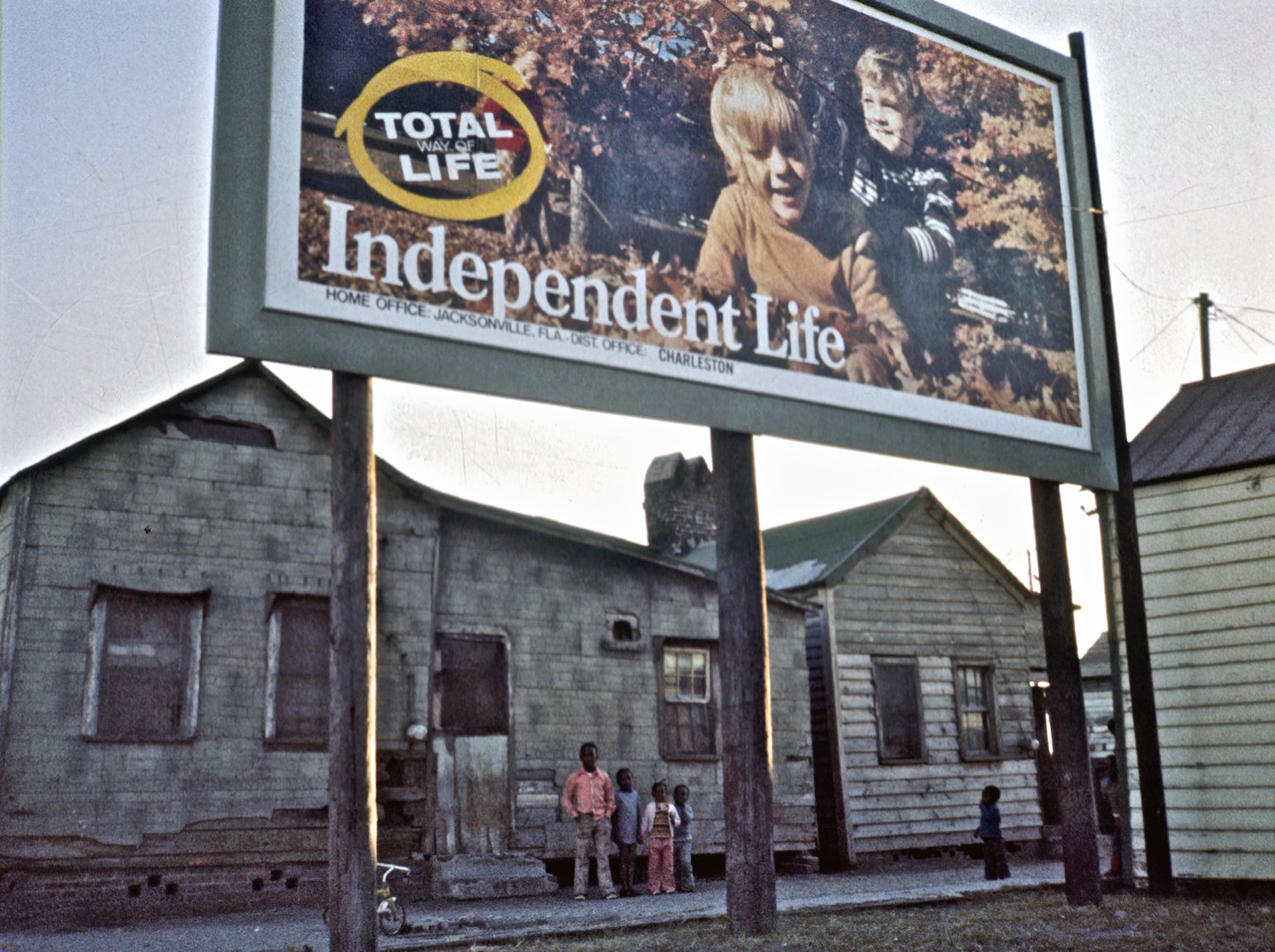
Interviewed on the occasion of the exhibition Faith, Hope and Love, Jacob Holdt’s America in 2009 at Louisiana Museum, still sporting his long, braided beard, and with no plans to retire, he spoke about his extensive travels with his slideshow to schools, trying to educate young adults about the hardships suffered by Black Americans. It took the museum 35 years to exhibit his work, but Holdt had always refused to show his pictures in museums, seeing them not as art but as a fulcrum for workshops on racism, and saying that is was only by accident that he photographed at all. It was his parents who gave him a camera in order to see more from his travels. He had never held one before, and taught himself all the technical aspects. He claims that although he wasn’t a good photographer, he was an excellent vagabond. There’s nothing wrong with the images though; he knows what he’s doing when he frames them, as with the three black kids standing beneath a billboard commercial where two white children are juxtaposed with the text ‘Independent Life’, or the three black women in a beauty pageant smilingly giving the Black Power salute.
I went with Holdt to the small Danish town Ringe, where the lucky recipients at a local high school sat mesmerised for several hours in front of his images of poor black people, very rich white people and poor white members of the Ku Klux Klan. As he told me in the car on our way, he just wants to understand racism, to see the bigger picture of where this hate comes from, and he wants to smother the racists with love and make the hate disappear. Maybe his thinking is propelled by the Scandinavian saying that trolls disappear when they’re exposed to sunlight.
This text is from Perpetual Photographs, Objektiv #21. Find the latest book from Holdt here.
ZINEB SEDIRA
In a year afflicted by the war in Ukraine, and by the remains of the pandemic, the Biennale in Venice did actually open. Cecilia Alemani curated the main exhibition, The Milk of Dreams, which takes its title from a book by Leonora Carrington. Alemani describes the book as a ‘magical world where life is constantly re-envisioned through the prism of the imagination.

Zineb Sedira, Les rêves n’ont pas de titre [Dreams Have No Titles]
Afterimage by Nina Strand:
In a year afflicted by the war in Ukraine, and by the remains of the pandemic, the Biennale in Venice did actually open. Cecilia Alemani curated the main exhibition, The Milk of Dreams, which takes its title from a book by Leonora Carrington. Alemani describes the book as a ‘magical world where life is constantly re-envisioned through the prism of the imagination. It is a world where everyone can change, be transformed, become something or someone else.’ The show included brilliant photographic works by Elle Pèrez, Joanna Piotrowska, Louise Lawler among others. In the latter’s room, the artist Alexandra Pirici performed Encyclopedia of Relations, 2022.
While the Russian Pavilion was closed after curator Raimundas Malašauskas, and artists Alexandra Sukhareva and Kirill Savchenkov pulled out in protest against the invasion of Ukraine, the Ukrainian presence in the Italian city was ensured by curator Maria Lanko. She, together with her team, packed 72 copper funnels – components of the sculpture Fountain of Exhaustion by artist Pavlo Makov – into boxes and loaded them into her car, which she drove out of Kyiv in late February.
War was very much present in this year’s biennale. In Relocating a Structure, Maria Eichhorn dug up the foundations of the German Pavilion and stripped the walls of layers of plaster. In doing so, she revealed the joins between the original Pavilion of 1909 and the extensions made by the Nazis in 1938. The American Museum for Palestine showed work by several Palestinian artists in the Palazzo Mora as a reminder of the constant conflict in that country.
But ‘change’ is a word that often came to mind when looking at other works, such as Francis Alÿs films of children playing, The Nature of the Game, in the Belgian Pavilion, Melanie Bonajo’s film and installation, When the Body Says Yes, at the Chiesetta della Misericordia for the Dutch Pavillion, or The Concert by Latifa Echakhch in the Swiss Pavilion.
The song played at the end of the film Dreams Have No Titles by Zineb Sedira for the French Pavilion is still singing in my head. With the French presidential election just days away on the occasion of the press preview, Sedira, who is the first Algerian artist to represent France at the Biennale, talked about the cinema of the 1960s and 70s, the first co-productions between France, Italy and Algeria. The Pavilion was transformed into a series of sets reconstructed from notable examples of these films, which function as records of cultural and political activism in France, Italy and Algeria. With the film and installation, the artist wished to embrace themes such as the fight against discrimination and racism, decolonisation, freedom, solidarity, identity and family, questioning notions of identity, acceptance of the other, memory, and collective versus individual history.
It was this film that lingered in my mind while taking the ferry back to the airport. In the final credits, one could see Sedira dancing to Express Yourself by Charles Wright, showing – like the oily bodies hugging in Bonajo’s film, Pirici’s performers asking us to close our eyes and hold out our hands to experience touch, or even Eichhorn’s alteration of the Pavilion’s structure – how ‘everyone can change, be transformed, become something or someone else’.
LEE GODIE
I have always found the question, “Who do you think you are?” (used rhetorically, as an accusation) to be an odd one. The implication is that one should know oneself, or know one’s place, as if it were ever a question of knowing, and not just imagining. Nowhere can the gulf between one’s own self image and external appearances be revealed with such brutality as in the self portrait: there is no better stage for one’s self delusions.
Afterimage by Amy Sherlock:
I have always found the question, “Who do you think you are?” (used rhetorically, as an accusation) to be an odd one. The implication is that one should know oneself, or know one’s place, as if it were ever a question of knowing, and not just imagining. Nowhere can the gulf between one’s own self image and external appearances be revealed with such brutality as in the self portrait: there is no better stage for one’s self delusions. Lee Godie had more reason than most to seek the succour of self-delusion. She lived out the majority of her later years homeless on the blustery streets of downtown Chicago. A self- taught artist, she drew and sketched, hawking her wares to passing business people and leaving the proceeds in the care a nearby department store.Her self portraits, many enlivened with paint or pen, some coquettishly flirtatious, others autographed like the calling cards of a budding starlet, were taken in a photobooth in a bus station in the city, which was also the location of the locker that housed most of her worldly possessions. I look at Lee Godie in these images and I think of Vivian Leigh’s Blanche du Bois in her worn-out Mardi Gras outfit – in that scene in A Streetcar Named Desire where she is so wide-eyed and fearful and Marlon Brando’s Stanley so devastatingly handsome – wrapping herself in her airs and her rhinestone tiaras to buttress a fragile sense of self. But I don’t pity Godie. She looks mischievous; she looks happy. She wouldn’t let any Stanley try to tell her that she wasn’t a queen.