FLORENCE BONNEFOUS ON THE ZAPATISTAS
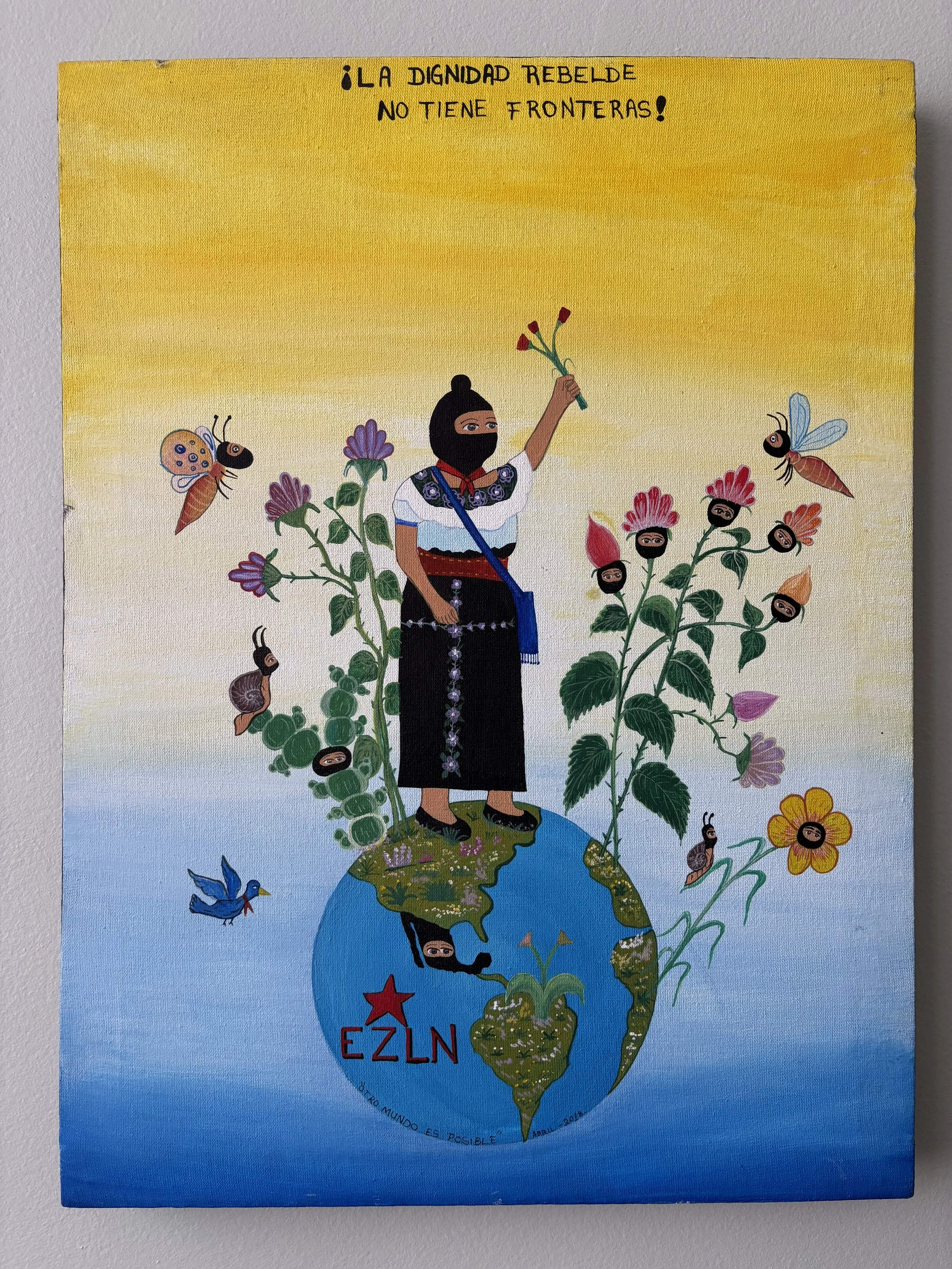
Zapatista Painting. Signed and dated Bruno 04-2018. Gouache and ink on canvas. 40x30 cm. Photo by Florence Bonnefous.
There are so many images that remain, a jumble of loose images, one or another of which sometimes rises to the surface of our memory, until it flickers behind our eyelids.
They keep each other warm they sometimes connect to one another to form an impromptu, a sequence of images, a cinematic collage that comes back when some unexpected trigger calls them up.
No image truly stays. Its persistence is irregular, and its sudden emergence is propelled by the unconscious. Hot sources, healing sources smelling of sulphur, sure sources.
All images flicker.
The frightening ones are sometimes the least explicit, the most abstract, in 2D and in black and white.
A ball drawn in a thin black line moves along a horizontal line against a white background. It rolls quite slowly; it seems very far away. Gradually the perfect circle begins to break down, and the line thickens and warps. Little by little chaos sets in, the simple lines and shapes are destroyed, and blackness takes over, and with it, fear.
And then there are the reassuring, hopeful images that stay with us. We close the shutters, we close our eyes, and they keep watch.
A small Zapatista painting shows a globe floating in the air against a background that shades from blue to yellow, rising from the oceans to the sun. On the globe, North and South America are joined by a small portrait of Subcomandante Marcos smoking his pipe. A Zapatista woman stands proudly on the globe, surrounded by flowers and bees, holding up a bouquet. Every flower and every insect has a human face. Above her, clumsy lettering reads LA DIGNIDAD REBELDA NO TIENE FRONTERAS.
Here is an image that will always remain, an afterimage if the party lasts all day and all night, a cosmos factory, and the few words that describe it may form an ekphrasis of my personal shield.
En français:
Il y a plein d’images qui restent, un fatras d’images en vrac dont l’une ou l’autre remontent parfois à la surface de notre mémoire, jusqu’à nos paupières.
Elles se tiennent chaud elles se connectent parfois l’une à l’autre pour former un impromptu, une séquence d’images, un collage cinématographique qui revient quand un déclencheur inattendu les appelle.
Aucune image ne reste vraiment, elle a une rémanence irrégulière et son surgissement est propulsé par l’inconscient. Sources chaudes, sources guérisseuses à l’odeur de soufre, sources sûres.
Toutes les images vacillent.
Celles qui font peur sont les moins explicites parfois, les plus abstraites, en 2D et en noir et blanc.
Une boule dessinée par un fin trait noir avance sur une ligne horizontale, sur un fond blanc. Elle roule assez lentement, elle semble très lointaine. Peu à peu le cercle parfait s’abîme, la ligne s’épaissit et se déforme. Petit à petit le chaos s’installe, les lignes et les formes simples sont détruites et le noir s’installe, avec lui de la peur.
Et il y a ces images rassurantes et pleines d’espoir qui nous accompagnent. On ferme les volets, on ferme les yeux, elle veillent.
Une petite peinture zapatiste représente un globe qui flotte dans les airs, le fond est un dégradé de bleu au jaune, en remontant des océans au soleil. Sur le globe les continents américains nord et sud sont réunis par un petit portrait du sous-commandant Marcos qui fume la pipe. Sur le globe se tient fièrement une femme Zapatiste entourée de fleurs et d’abeilles et qui brandit un bouquet. Chaque fleur et chaque insecte a un visage humain. Au dessus d’elle une écriture maladroite dit LA DIGNIDAD REBELDA
NO TIENE FRONTERAS.
Voilà une image qui restera toujours, une afterimage si la party dure tout le jour et toute la nuit, une cosmos factory, et les quelques mots qui la décrivent forment peut être une ekphrasis de mon bouclier personnel .
Afterimage is an ekphrastic series exploring that one image you see when you close your eyes—the one that lingers in your mind. We invite different people to reflect on an image they can't shake. This column originated in the inaugural issue of the Objektiv journal and continues today here on our web journal.