NINA STRAND ON LA BIENNALE DE LYON
Passer d'un rêve à l'autre—to pass from one dream to another—the title goes. It feels like there is nothing inside of me holding together, all the organs loose, my friend tells me as we walk into the large MacLyon, heavy techno music coming from outside. Even the train was late coming here. We need to be quick.
The Biennale is spread out over the city, and both of us also want to see the textile museum, where Annette Messager, among others, is shown. We are met with small red images in frames, one depicting bricks or structures falling against each other, and my friend says she feels seen. We pass what looks like a bedsheet with the silhouette of a person imprinted on it, as of an person not really there, or like an Ana Mendieta work, the head a big cloud, or so it seems, it recalls a dream also, but we walk on, there is no time to stop.
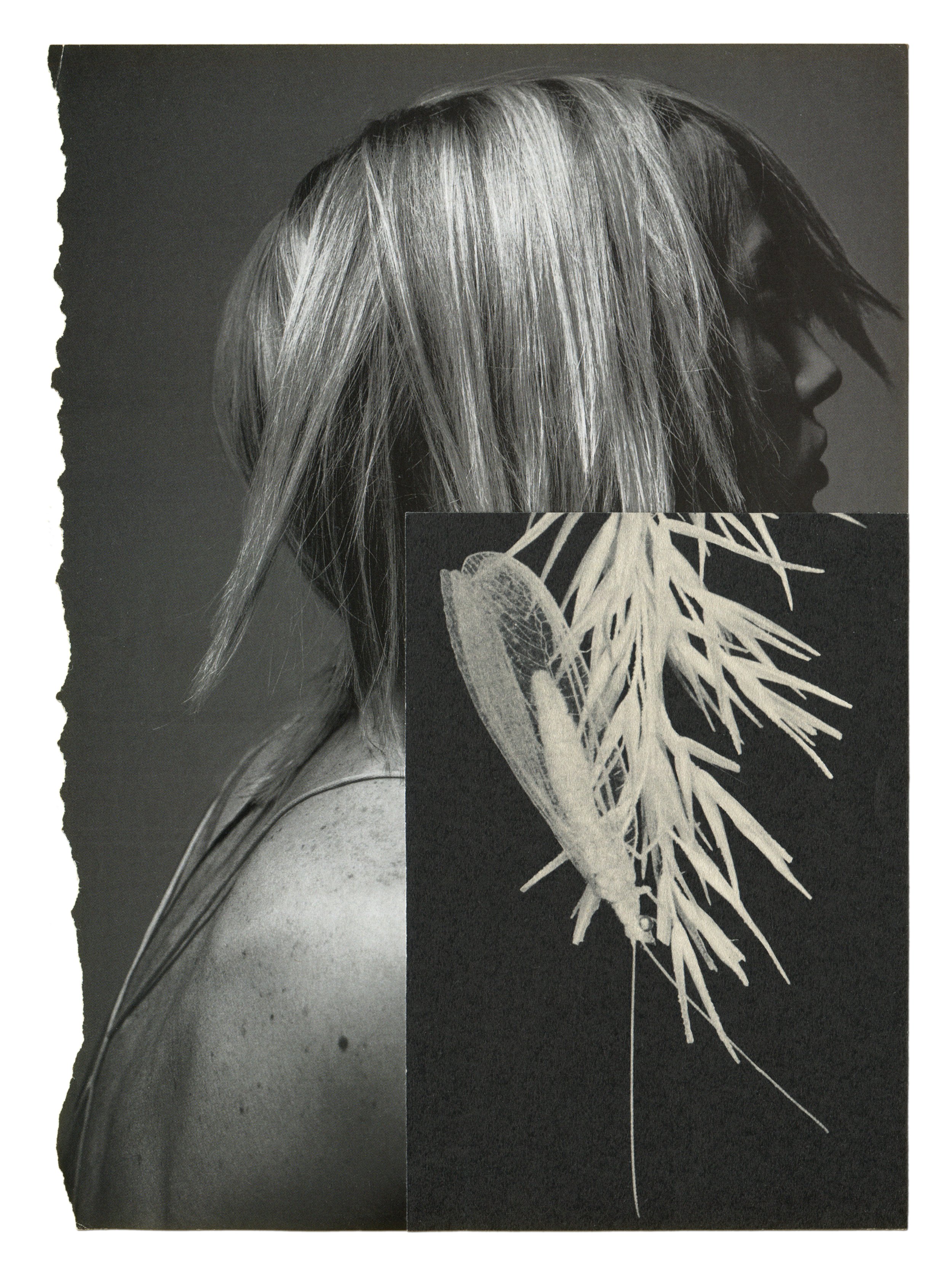
One of the collages by Barbara Breitenfellner catches us: one with a black-and-white image of a bomb over a colour photograph of flowers in a vase, another depicting a woman's head, her blonde hair cut off by another image of straws. The wall text explains that "images, no less than bodies, have an afterlife" for this artist, who thinks of collage as continually reassembling bodies, nature and knowledge. We are as fragmented as these juxtaposed archival images .
There are other fragments we are drawn to: the short film by the French artist Alice Guy, made in 1900, The Cabbage Fairy, a smiling woman surrealistically helping babies being born from cabbages. We see it three times. And we run by the Télégramme by Robert Filliou, this one with the text: La nuit vue de nuit, c'est le jour—The night, seen from night, is day. We discuss another télégramme sentence my friend remembers as: Everything happens and everything happens at the same time. A motto for the day.
We like the gaps and the fragments from this part of the Biennale. MacLyon, smiling politely at the DJ as we leave, there is sadly no one dancing. But it is a Saturday. People will come.
We wait for the bus and read the curators' words on the Biennale: Walk enough through the streets of Lyon and you will find them. Cross the city often enough and you will pass through them: the traboules—a singular system of passages, courtyards and semi-secret stairways; a labyrinthine network of liminal spaces designed to facilitate circulation. And then there is the title, Passer d'un rêve à l'autre, which takes its inspiration from Walter Benjamin's Passagen-Werk (The Arcades Project, 1927–1940). In this vast fragment, Benjamin asks how urban environments—and particularly the Parisian arcades—shape the collective dreams and experiences of society. He approaches the arcades as threshold spaces where the dream-world of modernity becomes legible.
On the metro towards the great train halls, we realise there won't be time for the textile museum after all. We pull out our phones and eagerly scour the images we can find. We really did come so late to town. The old train halls, Les Grandes Locos, had to be prioritised. The curator herself is there, giving a walking tour to a small group, too small for us to ease ourselves into. But we have Laure Prouvost, her large tent, Hovering Caress Amère, heaving and breathing. The debris under the tent functions as a kind of corrective voice, and looking up at the cluster of breasts hanging there, we laugh over the bad-mom joke about women dropping their bras to half-mast the day Dolly Parton died, in her memory.
And like this, with many voices in mind, it seems we pass on to a better dream. That's what we got: taking the metro back to the Bourse and the theatre, and having maybe this year’s last verre piscine in the late September light. We talk about the curators' words on Filliou's La Fête Permanente responding to personal crisis with connection, conviviality and creativity, proposing value as relational rather than financial. And it goes like this, back and forth. We are reminded of another Filliou quote: Art is what makes life more interesting than art.
Barbara Breitenfellner, WVZ 800, collage, 27,4 x 19,8 cm, 2025, © Barbara Breitenfellner. 18th Biennale de Lyon (2026),