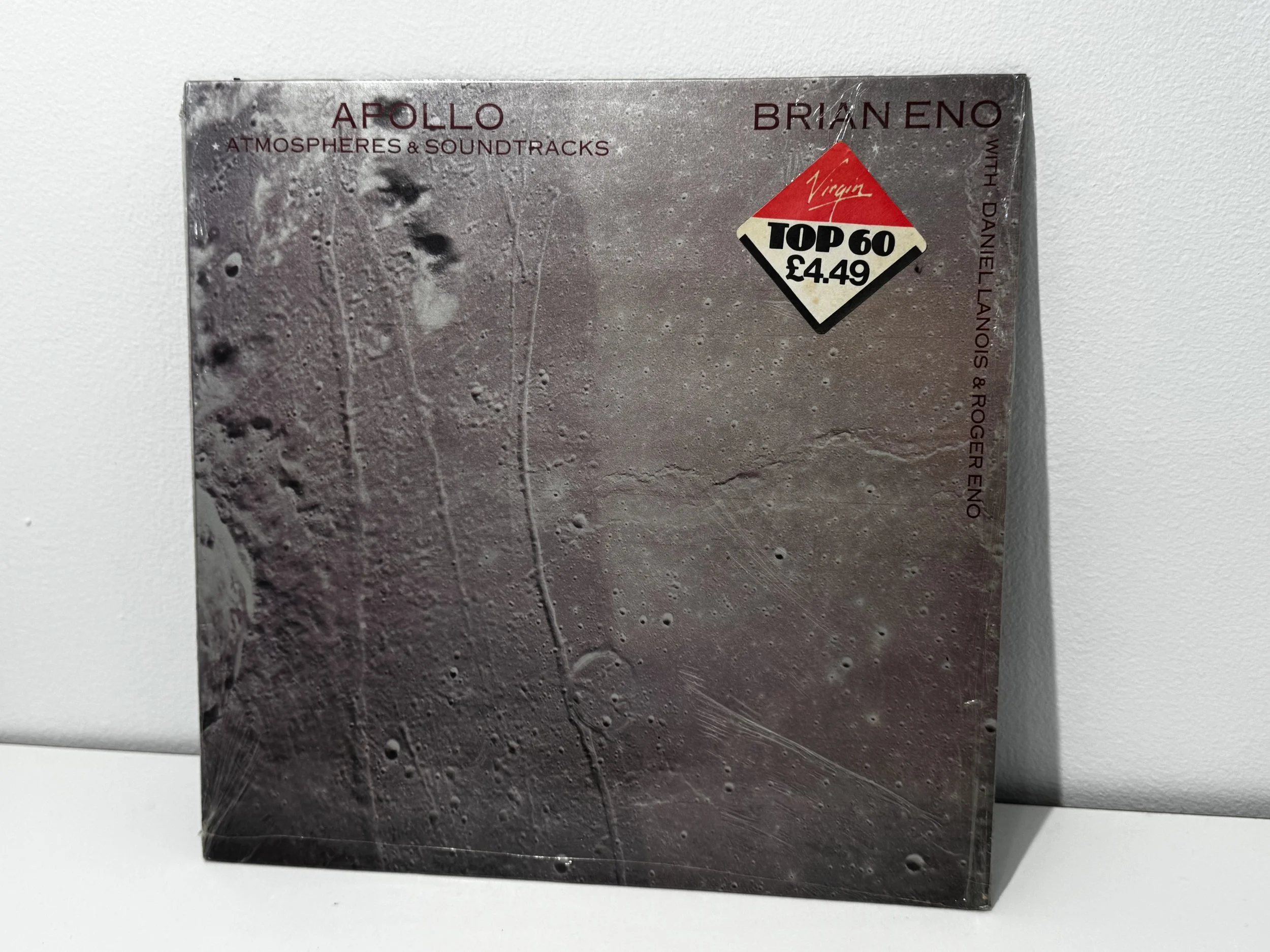
Photo of the album by Arthur Ou.
Afterimage by Arthur Ou:
The cover of Brian Eno's Apollo 1983 album shows the surface of the moon, I believe a detail of the Sea of Tranquility, a large concave area with strange, vein-like formations. The album is composed for a documentary film about the Apollo missions, Apollo 11 being the most famous, the first time that humans stepped on the moon, but there were subsequent trips back, intended to survey and study the lunar surface for future missions. After 17, further missions were planned, but they never took place: there were substantial funding cuts, and many different forces worked against the project.
What I like about the image is the idea of the moon as closely connected to the Earth, essentially a fragment ejected when the Earth was struck by a planet-like object, some 4.5 billion years ago. At least that is the theory.
The album is a soundtrack for a documentary about the missions. We remember the recordings of the astronauts, but the moon itself, lunar space, is silent. I think Eno wanted to use the footage and documentation of the missions to think about what an aural experience of that space might be. Some of the music has a country music vibe, using twangy steel guitar sounds to give the impression of weightlessness. The track Deep Blue Day became quite famous; it was used in the soundtrack for Trainspotting for a dream sequence for the main character Renton.
Even from the perspective of the present, it is still remarkable to imagine unmanned and manned orbiters launching from Earth, approaching the moon, separating from its rockets, entering orbit and taking photographs. These apparatuses traverse long distances and still function well enough to record systematically: the pictures are taken at intervals so that they can be pieced together. And then the whole thing returns to Earth. This was the 1960s and early 1970s, and it still seems wondrous, almost fantastical. How were humans able to do that?
I think of photography as a way of extending sight or vision, and of the orbiter as a vision machine. Because of physics, we have to engineer a way to bring, if not ourselves, then some sort of machinery into close proximity to the object we want to observe. This connects to something I always think about: a vision impulse, the impulse to bring ourselves farther into space, or closer, towards the microscopic. The machine becomes a proxy for the body, an extension that is based on our limitations, on our inability, yet, to travel physically to certain environments or conditions.
This suggests a way of thinking about a longer history of photography, beyond the one we usually date from 1839. The impulse I am describing has probably existed for as long as humans have. It is part of the larger project I am working on now: a longer arc of the history of photography, approached through the natural sciences.
I cannot own the actual photograph, but I can own this album. It is mass-produced, yet it has a similar tactile quality and carries the marks of time, including the price label from when it was new. The whole object is a time capsule, a container for the encounters it has had, encounters that may be invisible but can still be felt. This is the talismanic quality of a physical photograph. Digital pictures are different, because they depend on a machine that is not exactly a black box, but so complex that it is hard to engage with it directly beyond being a user, unless you are a programmer. A physical photograph has to contend with all the forces around it.
That is what I like about album covers. I have been setting aside a small group of records whose covers touch on photographic history: Lee Friedlander, who famously made many jazz covers, an Atget photograph on the first Galaxie 500 album, and a Muybridge cover for an opera by Philip Glass, etc. I like the photograph as an object, but an album is object that is also auditory, engaging both senses. You see the cover, but you have to use a different process to engage with the material inside. I like this contrast in experience, this combination of the visual and the auditory.
Afterimage is an ekphrastic series exploring that one image you see when you close your eyes—the one that lingers in your mind. We invite different people to reflect on an image they can't shake. This column originated in the inaugural issue of the Objektiv journal and continues today here on our web journal.