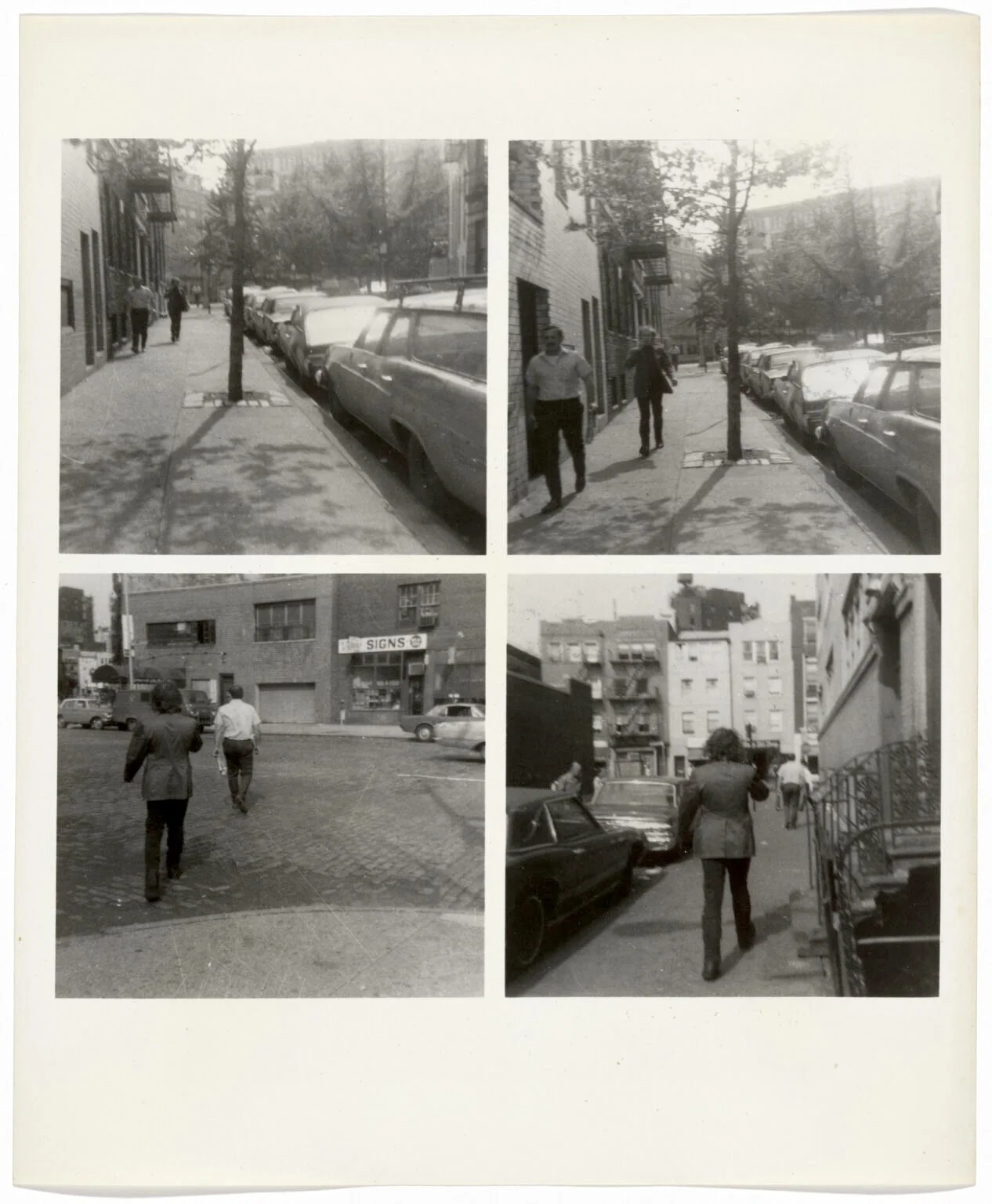
Vito Acconci, Following Piece, between October 3 and 25, 1969, performance, photograph. The Museum of Modern Art, New York. © 2023 Vito Acconci.
Afterimage by Victoria Durnak:
There’s an image I’ve had on my mind for many years, or actually it’s a series of images: Vito Acconci’s Following Piece, in which he followed randomly chosen strangers through the streets of New York and photographed them until they went into a private building.
There are many things I find interesting about the series. For one, it breaks the contract for how we’re expected to behave toward one another, which I find fascinating to think about. I’m especially interested in the intimacy and closeness of an encounter that only one of the parties knows about. That’s something I also explore in my own practice.
It’s intriguing how each image is tied to a specific action, and to see that action in relation to today, when following strangers is a big part of how we interact online. It’s no longer taboo or seen as crazy to do it.
The series also raises questions about what a private space is. Acconci’s pursuit stopped at a door. Today the line between private and public is less clear, especially for children, who can suddenly find themselves on a kind of stage even in their own homes. They can be photographed at any moment, whether in kindergarten or at home. I wonder about the awareness that all our movements can potentially be preserved. What does that do to our self-understanding?
Acconci only photographed their backs, but the people never knew. In a way, it is still a transgression that they became part of an artwork without knowing it. At the same time, we’re always part of other people’s lives when we walk down the street. A relationship arises between him and them that only he knows about.
He has described it as if he almost lost his sense of self while he was following someone, and as putting himself in the service of the scheme. He simply became the action, because he had decided to do it. I find that interesting to think about too. Sometimes it lasted only a few minutes, and other times he kept at it for hours, following someone across the city. The connection to the city is also exciting. Through the movement, and these random pursuits, he drew a map of the city. Doing this, he saw the city from someone else’s perspective, and probably took different routes from those he would have chosen himself.
This is something I’ve been inspired by for many years, both this work and similar ones, such as those by Sophie Calle, who has also made pursuit pieces, because stalking now has become socially acceptable. It’s something we all do.
Afterimage is an ekphrastic series exploring that one image you see when you close your eyes—the one that lingers in your mind. We invite different people to reflect on an image they can't shake. This column originated in the inaugural issue of the Objektiv journal and continues today here on our web journal.