ASPEN MAYS ON CARLETON WATKINS
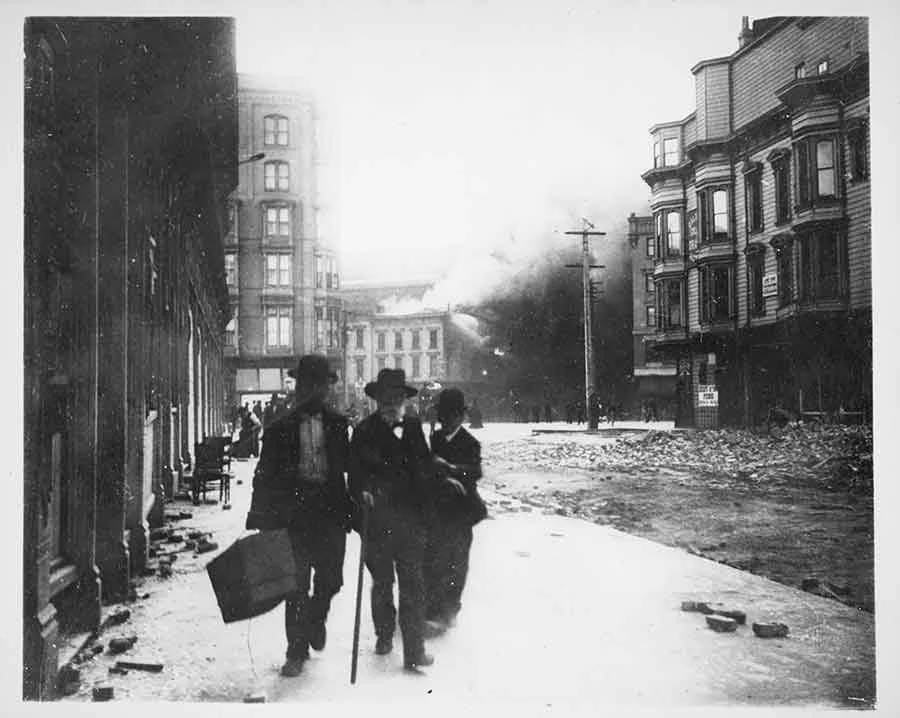
Carleton E. Watkins [with cane, during aftermath of earthquake], April 18, 1906. Unknown photographer. The Huntington Library, Art Collections, and Botanical Gardens.
Afterimage by Aspen Mays:
The image that I'm thinking about right now is a picture of the American photographer Carleton Watkins from 1906. He's being led away by two other people from his studio in San Francisco. At that point, he was an elderly man; in the photograph, he has a big beard and a hat and is holding a cane. There's a man on one side of him who feels like he's moving him forward. And there's a man just behind him. Watkins' shoulder is oriented slightly back—and the man behind him almost feels like he's pulling him back. The obscurity of the other two figures leaves space for you to fill in the story with your own ideas. There's this remarkable tension in the body language of those three people. Behind them, you can see smoke coming out of a building, and there's lots of rubble in the street. There is a sense of disaster, but you don't quite understand what's happening. The picture alone is pretty captivating because of that tension, who is this man? Is he being rushed forward or pulled back?
I teach in California, and as a photographer, Carleton Watkins has had a massive influence on how the American West was pictured. His images in particular were used to help justify and support the establishment of the National Park Service and protection of “wilderness” (in part by not depicting indigenous history and presence). He was also a photographer for hire. His clients included logging companies and mining companies. So he also depicted the extraction and depletion of the West. He has a complicated legacy and occupies a fascinating place in history.
Back to the image. The San Francisco earthquake had just happened, and the fire that followed was just starting in the city. Watkins’ studio was completely destroyed in the 1906 fire. All of his glass plate negatives–all those mammoth plates of the West–all of his correspondence, everything was lost. Just the week before, he had been planning to give his entire archive to Stanford University. He was already sort of destitute at this point in his life, but he had made the deal with Stanford. Then the earthquake happened, and then the fire happened.
When things in the world feel particularly destructive, it's one of those pictures that comes back into my mind. The moment when all is lost: does he know it too? When does he know it? Apparently he was also pretty much blind at this point in his life. Knowing that adds another layer. I didn't know that until years after I first saw the picture. Then thinking about the body language in the photograph changes again.
In better times, I still think about this picture, but it is different. I think more about the mystery of legacy. He remains a remarkably influential photographer, especially in shaping the imagination of the American landscape, as many prints of his work survived. Earlier in his career he had been prosperous and well known, but Watkins ended up dying in poverty in California. Despite how it ended, it wasn't the end of the life of the pictures. It also makes me think about the inherent incompleteness of any archive, what survives and what doesn’t, and the fragility of massive plate glass negatives in a place with huge earthquakes.
I love showing this picture to students because it really moves them. It is tragic to think about a life’s work and how close it was to being saved, just a week away. It touches a core feeling we all have about how precarious everything is, the balance, or imbalance, of the world and now more than ever, the environment that he documented.
Afterimage is an ekphrastic series exploring that one image you see when you close your eyes—the one that lingers in your mind. We invite different people to reflect on an image they can't shake. The column began during our time publishing the journal Objektiv and continues today under Objektiv Press.