YUE CHEN ON GERTRUDE KÄSEBIER
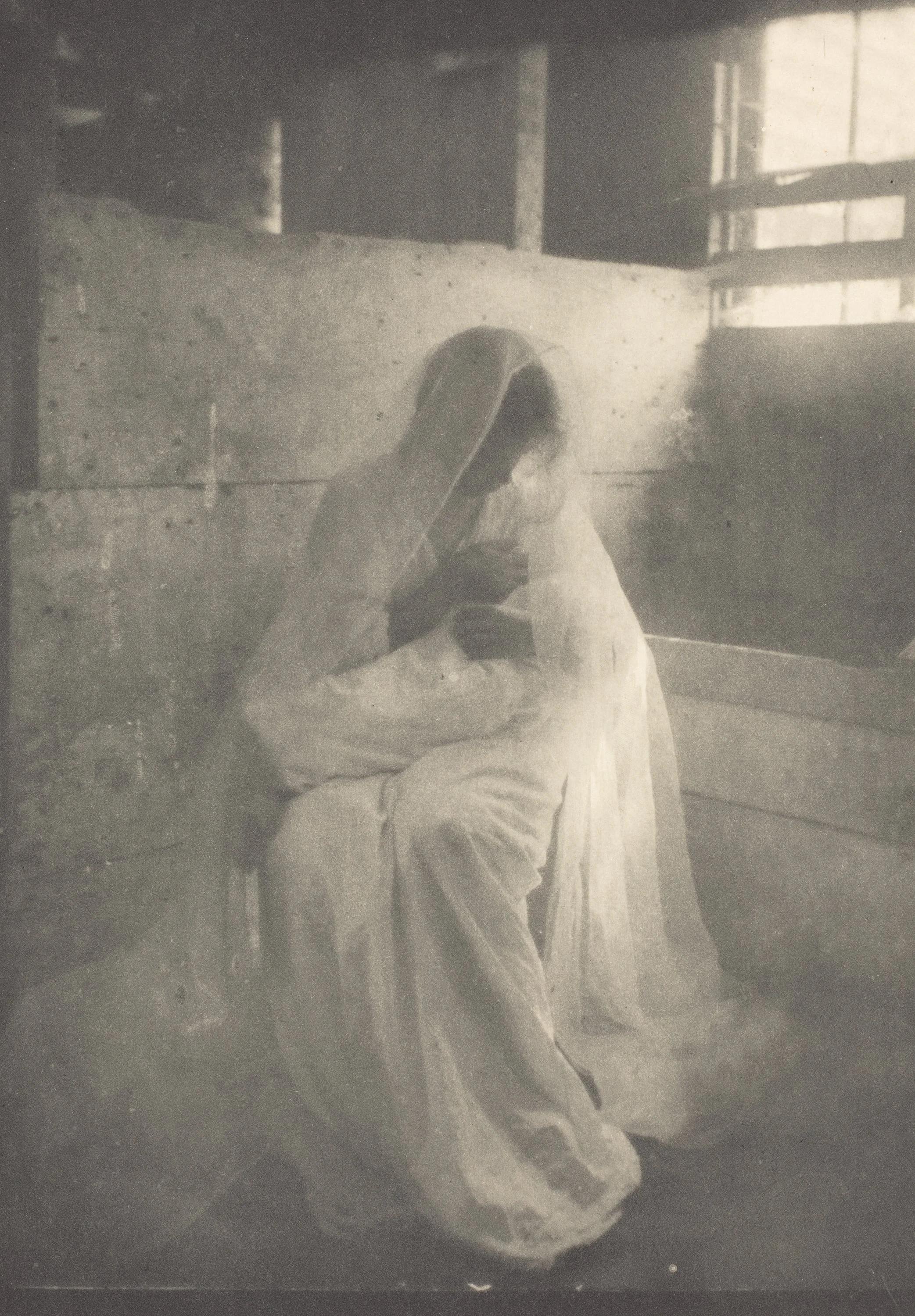
Gertrude Käsebier, The Manger, circa 1900.
Afterimage by Yue Chen:
I have always liked the idea of photography as a way of lending private eyes and feelings to every moment. This because a photographer, guided by a genuine feeling for the moment, can render their subject with a rare dignity and tenderness that would otherwise be unseen, especially across time.
Lately, I am beginning to feel a deep urge to genuinely attend every moment I choose, and to consciously infuse my care into the people and things I hold dear. Attuning oneself to these fleeting instances feels like a deeply photographic act. The moments we live for, or survive on, have a way of staying with us if we just pay closer attention to how they feel in real time. It is a way to hold them close so that they become permanent architecture within us, like rocks standing firm in a river, keeping us from being swept away.
I recently came across this photograph again while looking at Camera Work and felt its grounding power. It is a photograph made by Gertrud Käsebier, a leading Pictorialist and a key figure in the Photo-Secession, a fin-de-siècle movement organized by Alfred Stieglitz to establish photography as an art form on par with painting, with ambitions spanning both Europe and America. Titled The Manger, the photograph references the widely known Nativity scene of Mary wrapping Jesus in swaddling clothes and placing him in a manger. However, the compelling nature of the image lies in its indexicality, a quality unique to photography that distinguishes it from painting. The very fact that real people served as models for these holy figures made the scene take on a palpable, lifelike presence.
To the viewer with no prior knowledge of its art-historical context, the picture strips back to the most fundamental act behind the camera: under the beautiful light, a woman in a white gown holding a baby in a rustic barn-like environment. A sense of mystery pervades the image. One cannot quite discern the features of the woman, whose side profile is softened by a haze-like blur. Yet, one can feel her strong presence in the picture and her attentiveness to the baby, an intimacy that seems to shut out the rest of the world, oblivious to everything around her. And to me, that is the very presentation of maternal love. That is what makes the picture touching. It is not about a relationship re-enacted for the camera, but real relationships as they exist in the world. And you can sense that it is about motherhood without being told. The image hinges on a chain of attentive gazes: from the photographer to her subject, and from the mother to her child. It derives from the knowledge of motherhood that comes from the photographer, being a mother of three.
By 1899, this was the most ever paid for a photograph. It certainly was related to its religious motif and photography being the new art form, but also all of the above. Her promotion of photography as a viable career for women stemmed directly from her dedication to her own values. I looked into her biography and envisioned what it was possibly like for her, how she was standing in a slightly different position from the Photo-Secession movement as it developed and wanted to make different pictures for her family. Sometimes you will encounter this photograph flipped in both directions on the internet, or see it through varied digital scans of prints that have been preserved to different levels. The various states of the photograph make even clearer what makes it truly valuable: it is the touch of love that anchors it against time.
Afterimage is an ekphrastic series exploring that one image you see when you close your eyes—the one that lingers in your mind. We invite different people to reflect on an image they can't shake. The column began during our time publishing the journal Objektiv and continues today under Objektiv Press.