TORBJØRN RØDLAND ON DIM REVELATIONS
Following the recent release of Dim Revelations, The 2013 Journal, we present two interviews in which Rødland speaks about the book and his photographic process.
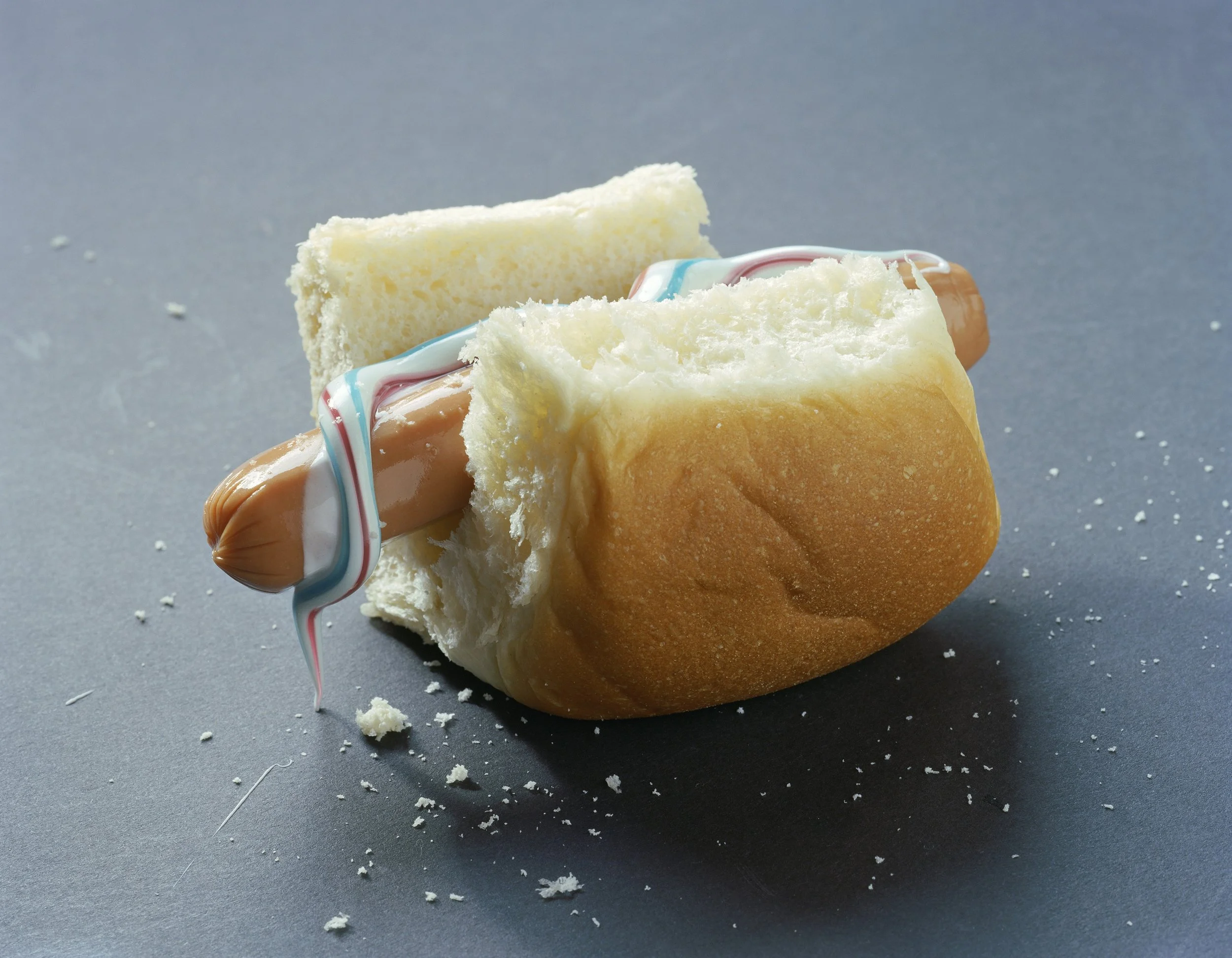
Torbjørn Rødland, Hot Dog, 2013, 28 x 35 cm.
Dark Revelations, D2
By Maja Hattvang
Torbjørn Rødland publishes his diary from 2013 and gives a rare insight into his own photographic process.
In 2013, photographic artist Torbjørn Rødland decided to write. A small piece of text every day, sometimes about photography as an art form, sometimes about his own process ("I got up early and put striped toothpaste on a frankfurter in a wheat bun, right here on the floor"), sometimes about films he watches, Edvard Munch's understanding of hell, or the joy of a fully charged electrical device.
"My best thinking is wordless," he writes, for example, on January 8: "I'm a photography-thinker, which is not quite a thinker." Nevertheless, the entries carry the same shifting between high and low, sincerity and irony that characterizes his photographs.
The idea was always that it would be published, but only now, 13 years later, has Dim Revelations, The 2013 Journal arrived.
"The year 2013 very quickly looked very outdated," says Rødland, who recently moved from Los Angeles to New York. "I had to wait until we could look at the year from a certain distance."
The book is part of Objektiv Press's essay series on camera-based art, and offers a rare glimpse into Rødland's photographic process, which tends to depend on a combination of thorough preparation and intuition.
Halfway through the year, he comes across, by chance, the American author Ken Wilber's so-called integral theory: a kind of synthesis of Eastern and Western, new and old knowledge traditions. It has a tremendously productive effect on his thinking around his own work.
"When I studied photography in Bergen, you were either straight, subjective and poetic, or you were staged, appropriating and critical. Only the latter of these two positions had validity, but it wasn't inclusive enough for me. I needed the poetic and the subjective, but I couldn't ignore the staged and the critical," he says.
"I knew that what I was searching for wasn't a nostalgic image, but I had no suitable concepts. What I wanted to do didn't exist, and therefore had no name."
This was what he found in Wilber's ideas: a concept that encompassed all layers of meaning at once.
Rødland's photographs tend to be perfectly lit, sometimes bordering on softcore or advertisement-like in their choice of subject matter, and haven't always been read in the multi-layered way he himself works from.
"Is it about a need to be understood?"
"Understood. Seen. Mostly on behalf of the images. I'm painfully aware that I fall short as a communicator. But stronger than the need to be understood is my own need to understand."
The 2013 Journal: Torbjørn Rødland, Daily Lazy
By Koshik Zaman
K.Z: This is an honor. I very much enjoyed reading your brand new book Dim Revelations: The 2013 Journal, which is based on diary entries from that year. I chuckled several times, and I loved all the references and insights. According to the preface, you had not kept a diary before 2013, or after, for that matter. What prompted you to start then? Why was that year particularly suited to this?
Torbjørn Rødland: In 2011 I published twenty sentences on photography, and the response I got to that text encouraged me to write more. I was in Scandinavia without my equipment over the 2012 Christmas holidays and decided to start writing on January 1.
K.Z: Out of curiosity, why did you leave out Sundays?
TR: I like the biblical concept of taking Sundays off. It makes a lot of sense to me.
K.Z: Right, you allude to that in one of the entries where you mention Roe Ethridge. What did an ideal Sunday look like then?
TR: Not so different from all the other days. I just didn't have to come up with a paragraph for the journal. A Sunday could be a great day for, say, making a picture.
K.Z: The format is intimate, very reminiscent of a notebook, and fits well within Objektiv Press' essay series. Had you always intended for it to be published, or did that idea come later?
TR: The idea was always to publish it, and the question was always when.
K.Z: So why is now a good time to publish it?
TR: I'm not sure it is. Objektiv Press asked very nicely for a contribution to their book series, and this journal was the best unpublished "essay" I could find on my PowerBook. A lot of people look back at the years leading up to 2016 as a different reality, so maybe 2013 is finally ripe for a revisit. Things and times have definitely changed.
Excerpts from Dim Revelations:
04/26
I think I'm violating the portrait image. They think I'm violating the portrayed person.
06/01
Sexual tension is either projection, telepathy, or a combination of the two.
10/30
A photographer is someone who has grown to love the limitations of her camera.
K.Z: It's evident that you're a talented and very witty writer. Have you not felt compelled to keep writing?
TR: No. Every generation produces a lot of writers who do it better than me, but there is a lack of exciting photographers.
K.Z: Returning to the project more than a decade later, are there any entries that made you think, "I would not write that today"?
TR: Certain artistic approaches that felt tired to me in 2013 are receiving less positive attention today, so I probably wouldn't feel the need to throw shade in those directions. I'm older and would generally throw less shade now, though I repeatedly went there because, as a reader, I'm excited by that type of frankness. I'm drawn to the directness in Edmund Wilson's diaries, perhaps forgetting that they weren't published until after his death.
K.Z: For a contemporary art audience, an introduction is almost redundant. You are one of the leading figures in contemporary photography, and your mise-en-scène approach has clearly
influenced many younger artists. I would still love to ask how you first got started in photography.
TR: I grew up with a father who read amateur photography magazines. He gave me a camera when I was maybe eleven. At that time I was already a dedicated cartoonist, but when that spark expired in my late teens, I transferred my love of image-making to photography. I never seriously considered painting.
K.Z: I read somewhere that you have also worked with video and film, which I was not aware of at all. I believe some of those works were made before you moved to Los Angeles. Has living in the city not inspired you to revisit those mediums? Reading the book, it's evident that you're very interested in film.
TR: Moving to Los Angeles in 2010, I thought the next step would be to make a movie long enough to cross over into the world of cinema, but Hollywood diminished rather than strengthened that appetite. Last year I moved away from California. Let's see if the hunger returns. I won't tell you my genre-bending idea for a feature-length film, as it has still not been attempted by anyone else.
K.Z: Finally, what is left for you to explore? You've exhibited widely, in blue-chip galleries and world-renowned institutions alike. What still excites or challenges you?
TR: Oh, I'm not as impressed by the reception as you seem to be. Have you ever seen one of my exhibitions? Very few have. In my mind, it's just getting started. It will be a long process. What else is exciting? There are still a lot of possible photographic images that just aren't being created. I'll try to make some of them.