AFTERIMAGE SERIES
I've been torn between two images that have been stuck in my head, and I just can’t decide. The first one that came to mind was a photograph by Manuel Álvarez Bravo, a portrait of a woman brushing her hair at the mirror. I was in Toronto over the summer, and there was a show on Latin American photography where this picture was included. It's an image I've known for as long as I've been making photos, about 30 years. Every time I see it in a book or elsewhere, I think it is incredible. About a month before, I made a picture while my husband and I were in Mexico with a similar diagonal light, and I realized this picture has always been in my head. Everything fell into place. I feel like this image is the root of my practice in a way: the way I think about light and shadow, gesture, and photography’s ability to transform a mundane moment into something transcendent.
The films of Nathaniel Dorsky unfold silently through a series of delicate observations. His camera movements are subdued if not completely absent, moving images that are mostly made up of stillness. Instead there’s just a subtle gesture, the play of light and shadow, an image that hovers there for a moment before disappearing—each one like a prayer. I find it difficult to tell his films apart in memory. Those I’ve seen share a similar tone and structure, a succession of images that float by with the same lightness of touch, free from apparent hierarchy or heavy-handed concepts. Still, there are certain images that manage to stand apart from the slow procession. They linger in the mind a little longer or, inexplicably, imprint themselves only to reappear later, in the guise of another image. The finding of an object is always, in fact, a refinding, Freud taught us.
Fotoboken #Ingrid peker på den digitale bevegelsen som videre oppstod blant reaksjonene mot publiseringen av bildene. Fotoboken er uten tekst, og med bilder printet på glossy papir av gjenkjennelige motiver — stock-fotos av blomster, solnedganger, skylines og strender; tilsynelatende lyse bilder, eventuelt også «bilde-spam» — langt fra de eksplisitte bildene som sirkulerte sammen med offerets navn. Ved første øyekast framstår #Ingrid som direkte overfladisk satt i kontekst av et kvinnedrap.
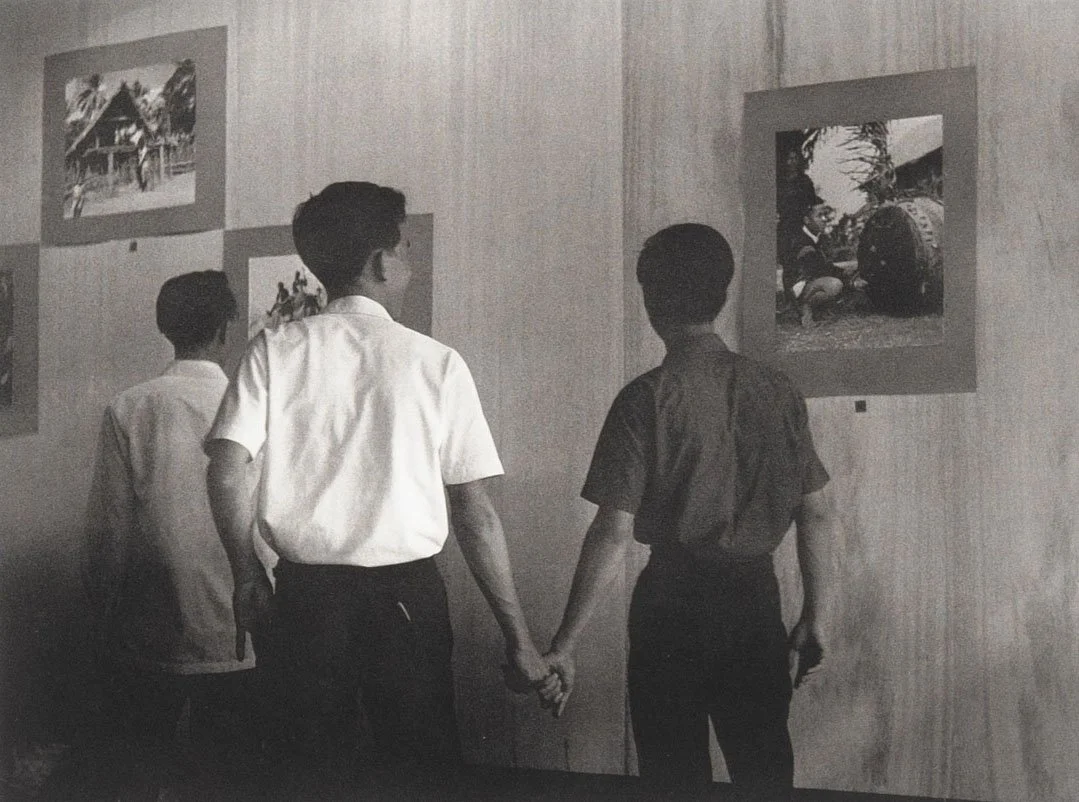
There’s something about this image and my relationship with it, from a photographic and representational point of view, but also in the sense of reproduction, that really fascinates me. It is a photograph of photographs, printed as a photogravure, which has then been digitised, and I view it through my computer screen. Three figures, three photographs on the wall. Multiple picture planes, intentions and techniques, all operating in tandem. I adopt the same position as the young men in the image, almost as if I am standing behind them, facing the same direction, becoming a part of their group. I feel invited into the scene, like a safe and benign presence. On the other hand, I am isolated from them entirely. I feel the weight of cultural difference between Carrier and these young men, the impossibility of touch, as well as the vast gulf of years and geographies.
When I was a little girl, I cut out pictures of the Monaco sisters and Diana and Sarah. I collected old magazines from the neighbors and organized the clippings into folders. The weddings were the highlights; the princesses were so beautiful, I admired them deeply; the royal gowns with their impossibly long trains were really cumbersome to cut out, and I would sit for hours. The men, however, I observed with a sense of wonder. They were utterly uninteresting—so gray and charmless—almost paltry. I genuinely wondered how it could possibly add up. Nine years old, in my childhood bedroom in Sigdal, I knew little about the intricate connections between power, money, and gender.
The image of Andrew Mountbatten-Windsor, after being arrested on suspicion of abuse of office with regard to his involvement in the sordid and depraved world of Epstein, becomes the image he will be remembered for. I have looked at this image over and over. It is a striking shot, but unlike the kind we are used to. It is an image that gives us what we want; it satisfies us.