ELLE PÉREZ ON TORBJØRN RØDLAND
Torbjørn Rødland in conversation with Elle Pérez
Delpire & Co, Paris · Thursday 12 November · 11am
To celebrate Paris Photo, Objektiv Press is returning to the brilliant Delpire & Co for another coffee and croissant event. This time, Torbjørn Rødland will be in conversation with Elle Pérez. Following a successful event in New York during NYABF, we are bringing this conversation to Paris. Dim Revelations by Rødland, the movement of our bodies by Pérez, and other titles will be available in the bookshop.
Coffee & Croissants – Delpire & Co
Torbjørn Rødland in conversation with Elle Pérez
Delpire & Co, Paris · Thursday 12 November · 11am
To celebrate Paris Photo, Objektiv Press is returning to the brilliant Delpire & Co for another coffee and croissant event. This time, Torbjørn Rødland will be in conversation with Elle Pérez. Following a successful event in New York during NYABF, we are bringing this conversation to Paris. Dim Revelations by Rødland, the movement of our bodies by Pérez, and other titles will be available in the bookshop.
Coffee & Croissants – Delpire & Co
Delpire & Co, 13 Rue de l'Abbaye, Paris 6e
www.delpireandco.com
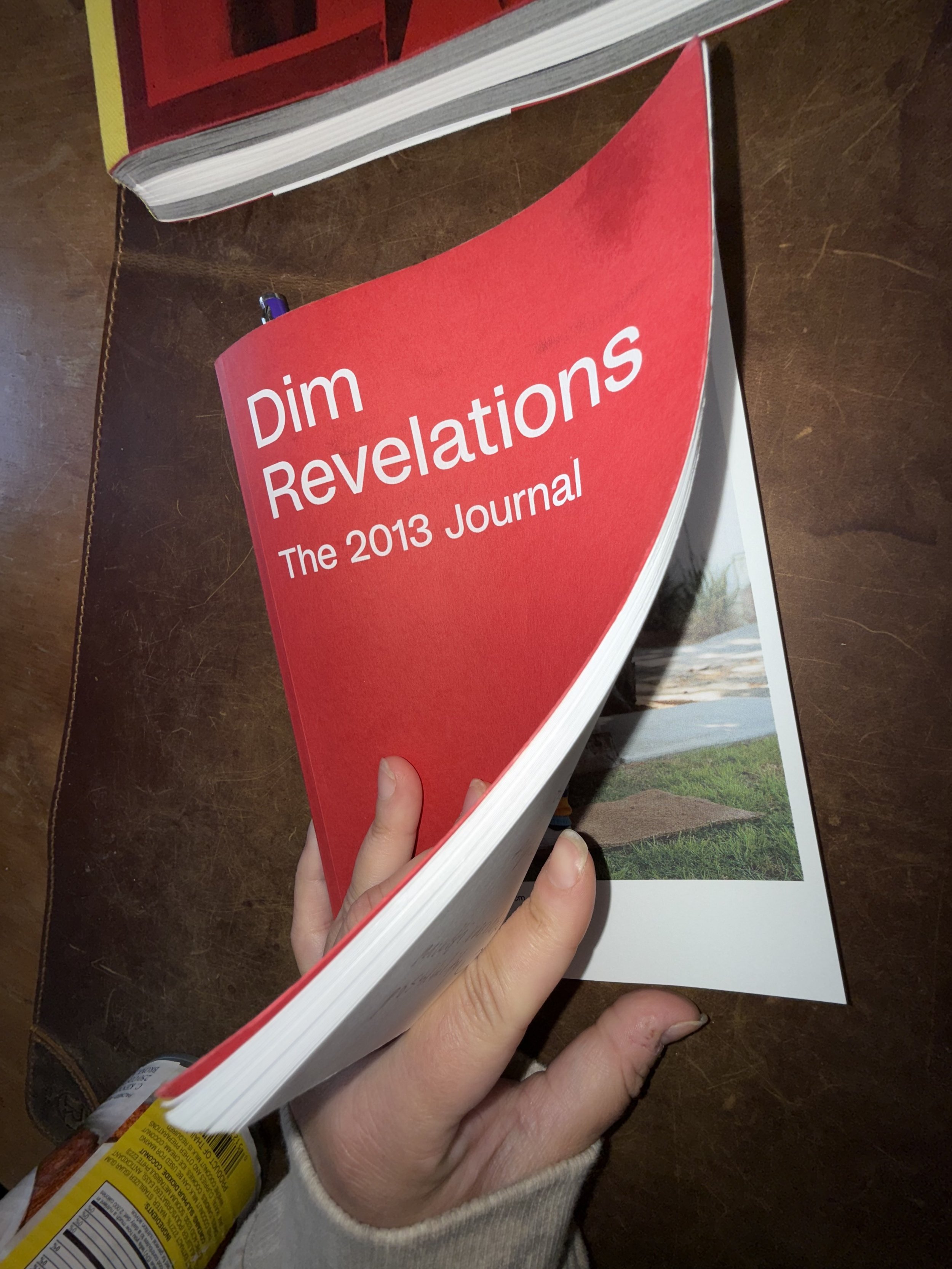
Photo of Dim Revelations by Elle Pérez.
HANS PETTER BLAD ON MRS. NEWTON
The image of Helmut Newton as a convalescent with an umbrella propped beside his bed remains unforgettable in the dark recesses of my hypochondriacal mind. This photograph is taken from the wonderful book Mrs Newton, which pays tribute to June Newton’s work as a photographer and is also a classic Bildungsroman written in the darkroom. The novel's central theme is her all-consuming love for Helmut Newton and, by extension, for all that is illuminated.
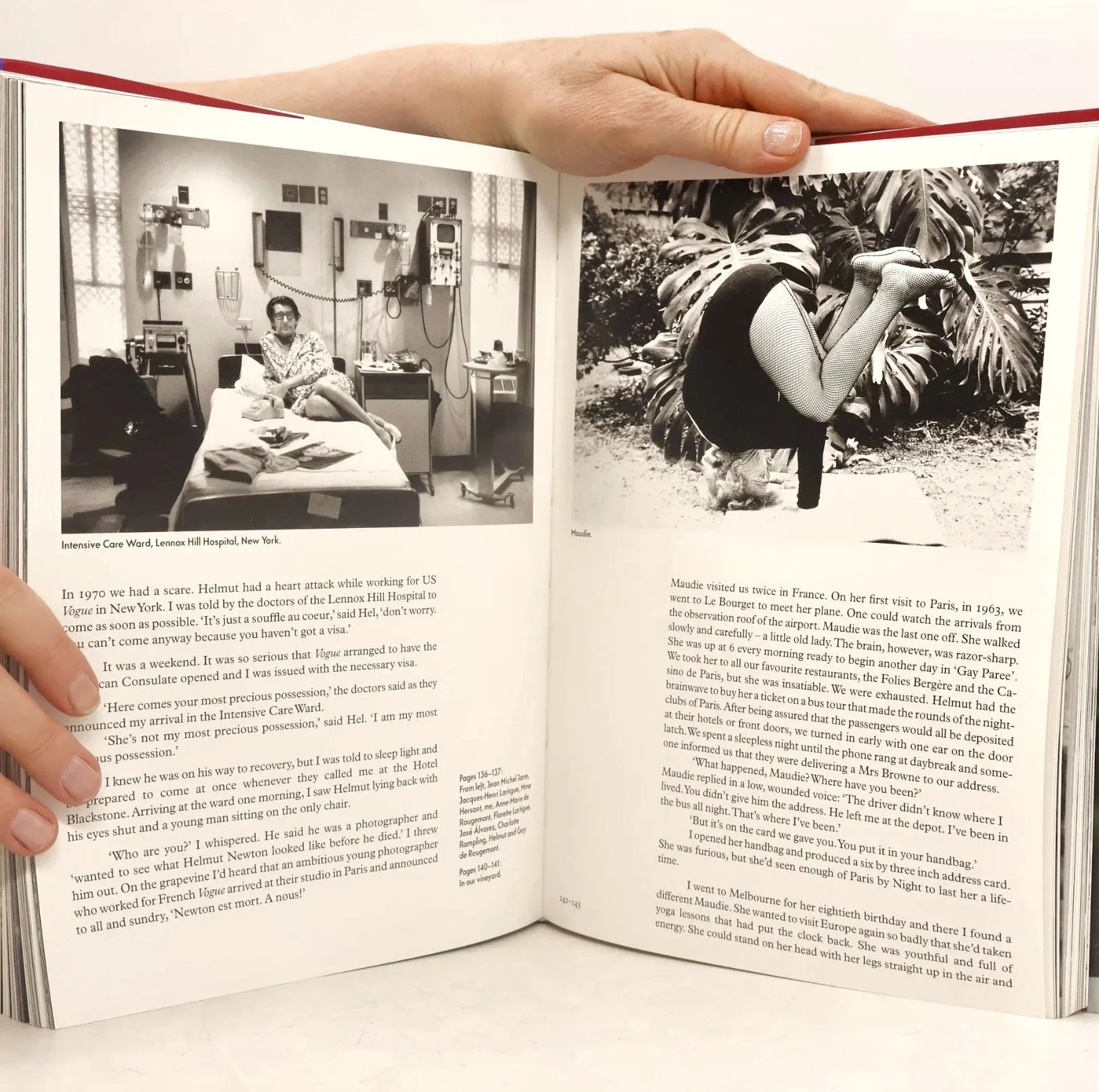
Image found at BookBot. From the 2004 book Mrs Newton by June Newton.
The image of Helmut Newton as a convalescent with an umbrella propped beside his bed remains unforgettable in the dark recesses of my hypochondriacal mind. This photograph is taken from the wonderful book Mrs Newton, which pays tribute to June Newton’s work as a photographer and is also a classic Bildungsroman written in the darkroom. The novel's central theme is her all-consuming love for Helmut Newton and, by extension, for all that is illuminated.
Unlike almost all other literary lovers, who are condemned to wander astray in purgatory, the Newtons find their way to a happiness beyond words. Leafing through the book, one might be tempted to quote Jorge Luis Borges: 'After all these years, I have noticed that beauty, like happiness, appears often. Not a day passes without our finding ourselves, for a moment, in paradise”.
Among the book’s many eloquent images, I have chosen a photograph of Helmut Newton shortly after a heart attack — or juste un souffle au cœur, as he himself dismissively called it — reclining with elegant nonchalance in his hospital bed. Even in the intensive care unit of Lenox Hill Hospital, the celestial is present in the eyes of the man looking through the viewfinder.
Afterimage is an ekphrastic series exploring that one image you see when you close your eyes—the one that lingers in your mind. We invite different people to reflect on an image they can't shake. This column originated in the inaugural issue of the Objektiv journal and continues today here on our web journal. This Afterimage was first published in Objektiv #4.
NANCY WECHTER ON A PICTURE NOT TAKEN
Before I ever had a camera or made much use of one, I experienced the world as a big, insatiable pair of eyes. Taking in everything. I didn’t own a camera until after college, when I could buy myself an Olympus SLR. I bought it with a macro lens; I knew I wanted to get close to things. Seeing is done with more than one’s eyes.
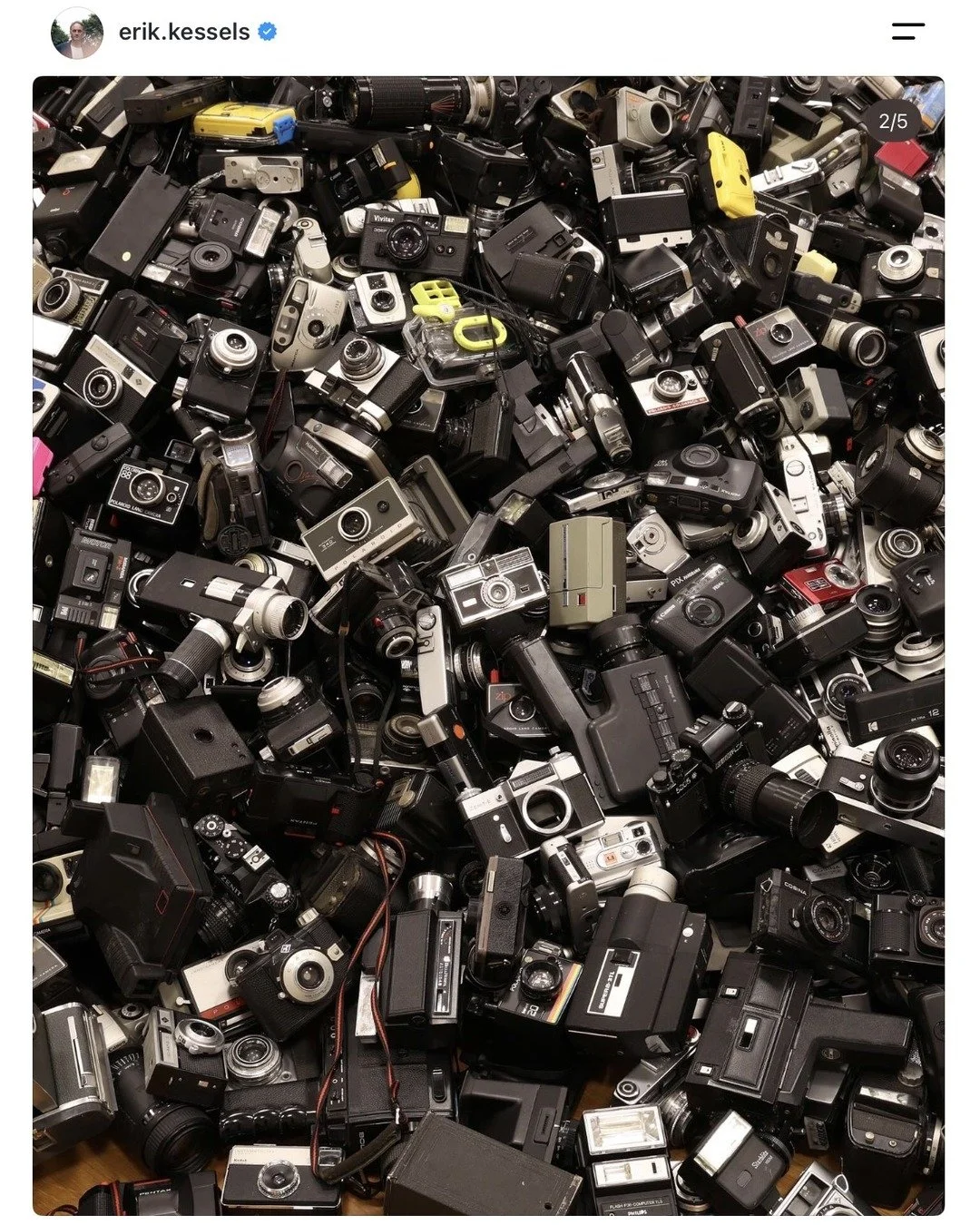
Erik Kessels, The Last of the Lens, 2026. Installation view, Oslo Negativ, Nasjonalgalleriet. Image via Kessels’ Instagram.
Afterimage by Nancy Wechter:
Before I ever had a camera or made much use of one, I experienced the world as a big, insatiable pair of eyes. Taking in everything. I didn’t own a camera until after college, when I could buy myself an Olympus SLR. I bought it with a macro lens; I knew I wanted to get close to things. Seeing is done with more than one’s eyes.
Even though my current home environment is unquestionably rural, I am an urban photographer. Shaped from childhood by New York City, where I grew up and lived until not so long ago. Shooting humans in their environment, being active, quickly perceiving what was fleeting came without thinking. Without thinking is how I like to photograph (and write). Or rather, without thinking beforehand or without overthinking.
My current environment is beautiful. Green from abundant rainfall, resulting in grass-carpeted hills and fields. And then there are the cows. Just yesterday, I walked past the electric-fenced field where my neighbor confines young heifers and where there is an adolescent bull calf with whom I have fallen in love. He stands still while I talk to him, and I take his photo as he is such a willing subject. Am I turning my urban honed gaze onto something quieter? Less clogged with humans? I used to say (and it is still true) that I photograph to find out what I am seeing.
The most vivid story of a picture not taken (an ekphrastic image) that came to mind was the first time I met my rural neighbors. We had just closed on the house and spent our initial night there on a mattress on the floor of the bedroom. That morning, as soon as I woke, I started pulling red contact paper off the lower part of the kitchen walls. Took a break. Took a walk. It was late November, just after Thanksgiving, and there was a light coating of snow on the ground. We saw some activity on the farm next to us and thought it would be nice to go over and say hello and meet our neighbors. As we approached the barnyard, we spotted two men dressed in hunters’ red and black buffalo check jackets and hats. They wore these bright garments to prevent other hunters from mistaking them for deer. The men were one of our neighbor’s grown sons and his grandson.
As we descended into the barnyard, we were greeted by the grisly sight of a deer head, then a ribcage, and finally a bloody red heart lying on the snow. In spite of my distaste for hunting and fear of firearms, all I could think of at that moment was: “Where is my camera?” Of course I hadn’t thought to bring it and I wasn’t yet carrying a cell phone everywhere.
It is this image that remains. Indelible.
P.S. I eventually did get to take pictures of deer carcasses hanging from the beams in their barn during hunting season, like an animal crucifixion. I learned to see this as a local source of good, untainted, even organic meat. Like the smell of manure, it is something you get used to.
Afterimage is an ekphrastic series exploring that one image you see when you close your eyes—the one that lingers in your mind. We invite different people to reflect on an image they can't shake. This column originated in the inaugural issue of the Objektiv journal and continues today here on our web journal.

TOMINGA O’DONNELL ON YVES KLEIN
This photograph is the visual equivalent of an earworm: a catchy tune that you can't get out of your head. Often an annoying one. The fact that this photo emerges when I close my eyes perturbs me. I wish my mind had decided to conjure up something more worthy or urgent. Something that captured the Zeitgeist or made an important political point. Not a manipulated photo of a white male artist seemingly launching himself into the void. The Met Museum in New York called it a seminal gesture. It is – in the sense that the etymology of seminal is semen, and this work bears all the hallmarks of male privilege as Klein made sure that the photograph was widely distributed in a four-page newspaper, Dimanche, that mimicked the Sunday paper Journal du Dimanche, with the headline: A man in space!
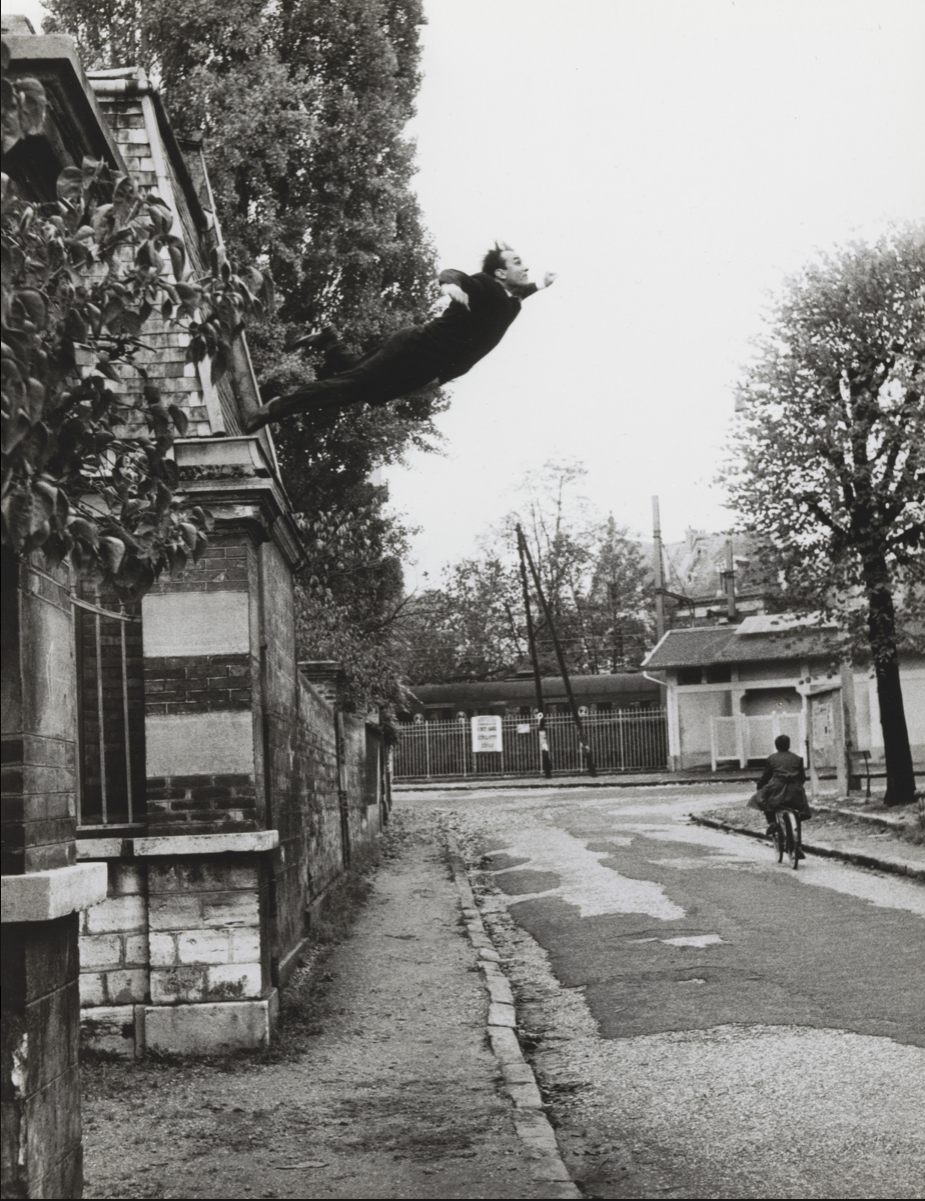
Yves Klein, Leap into the Void, 1960. © 2026 Artists Rights Society (ARS), New York / ADAGP, Paris. Photograph: Shunk-Kender © J. Paul Getty Trust. The Getty Research Institute, Los Angeles
This photograph is the visual equivalent of an earworm: a catchy tune that you can't get out of your head. Often an annoying one. The fact that this photo emerges when I close my eyes perturbs me. I wish my mind had decided to conjure up something more worthy or urgent. Something that captured the Zeitgeist or made an important political point. Not a manipulated photo of a white male artist seemingly launching himself into the void. The Met Museum in New York called it a seminal gesture. It is – in the sense that the etymology of seminal is semen, and this work bears all the hallmarks of male privilege as Klein made sure that the photograph was widely distributed in a four-page newspaper, Dimanche, that mimicked the Sunday paper Journal du Dimanche, with the headline: A man in space!
It is impossible to read the gesture separately from Klein's other well-publicised performative acts: ordering naked women around on canvases as "living brushes", dipped in his characteristic ultramarine International Klein Blue. I adore this colour, but even as I first encountered these works as a teenager at the Museum of Contemporary Art in Oslo in 1997, something felt a bit off. It evoked the misogynist stereotype of using women as objects – tools for the great male artist to show off his genius. Nonetheless, the image of Klein launching himself seemingly into mid-air has stayed with me over the subsequent years, surviving in the private database of my mind, pushing itself to the forefront past worthier, more beautiful, richer, more colourful analogue photographs, not to mention vast swathes of digital, enhanced or AI-generated imagery. Why?
First some contextual information: Leap into the Void was staged in October 1960 on a street in the Parisian suburb of Fontenay-aux-Roses. Klein was 32 years old at the time and would die just two years later. The artist had hired photographers Harry Shunk and János (Jean) Kender to take a series of pictures of him launching himself from the rooftop of a building onto a tarpaulin that his friends held up beneath. By printing two negatives of him falling and one of the street scene together (sans friends and tarpaulin), he was able to create an image that looked like he had launched himself into the void. He claimed this was a restaging of an actual leap from a second-storey building earlier that year. Klein's helpers were sworn to secrecy, and it was several years before images of how the process was staged emerged.*
In today's media landscape of image manipulation, deepfakes and swift, AI-generated pictures, the status of the photograph as a truthful witness has all but evaporated. In the aftermath of Klein's trick in 1960, however, the veracity of photography was relatively undisputed. That made the image all the more intriguing. The tongue-in-cheek references to space travel Klein made in his newspaper insert, along with an established history of "trickery" including showing "invisible paintings" at Galerie Colette Allendy and an empty display case in an empty space in the exhibition The Void at Galerie Iris Clert in 1958, all added to the intrigue. For the opening of the latter, Klein famously posted Republican Guards at the entrance to the gallery, which was painted IKB on the outside, and served blue cocktails to his many visitors (some 2000–3000), which resulted in their urine turning blue for several days. Like Leap into the Void, these works thematise absence but are ultimately about performance, which is why Klein holds such influence both within the histories of Conceptual Art and Performance Art.
Both the "leap" and the "void" had long interested Klein, the former from his experience of judo and falling techniques, and the latter as a form of dematerialised art practice. On 27 October, just over a week after the staging of Leap into the Void, the manifesto of the New Realists was signed in Klein's apartment. It was drafted by the critic and curator Pierre Restany and signed by several artists, including Arman, Raysse, Spoerri, Tinguely and Klein.* In Restany's obituary in Artforum in 2003, curator and proponent of relational aesthetics Nicolas Bourriaud wrote, "To Restany, art represented a 'cleansing of vision'—that is, not a set of more or less well-made objects but an optical device that allowed us to look at the new world surrounding us, whether that meant supermarkets or streets."* Klein's rather polished and crafted works are not immediately resonant with the other New Realists' emphasis on readymades and the manipulation or collaging of everyday objects, but his Leap into the Void instead fits into this notion of "the streets" that Bourriaud mentions.* Another famous image by Klein "from the streets" captures the dematerialised essence of the work and shows him throwing gold leaf into the Seine – having just received it as payment for one of his invisible paintings.
Leap into the Void can also be connected to the notion of a leap of faith. Klein had a complex form of spirituality, derived from different religious sources: his judo and long stays in Japan had familiarised him with Japanese Zen Buddhist traditions, whereas he was also a member of the Catholic confraternity The Order of the Archers of St. Sebastian, and the Rosicrucian Order, which was based on Christian mysticism. Combined with the widely publicised space exploration of the time, which challenged many people's conception of a "heaven above", and which Klein played with in his publication of Leap into the Void, this makes the philosophical backdrop of the work both metaphysical and highly topical.
My father was an art student in the early 1970s and stresses the impact of Klein's work, citing its novelty and originality. Ten years after his death in 1962, seemingly no other artist had done what Klein had done. My father describes his initial memories of Leap into the Void as "uplifting". I think this is the source of my inability to shake this doctored photograph from my mind's eye. The analogue doctoring of the image has long since been made redundant. Rather, it is about what it represents both performatively in the physical leap, which was captured by the cameras, and conceptually as the potential for human flight or levitation. It invites the imagination to soar like the artist in the photograph.
* According to Thomas McEvilley, the first time these images came into public view was in the exhibition Yves Klein (1928–1962): A Retrospective at the Institute for the Arts, Rice University, in February 1982. Thomas McEvilley, “Yves Klein: Messenger of the Age of Space”, Artforum, January 1982.
** Despite the movement initially being rather male-heavy, Restany spent his career championing a number of female artists, as this 2018 article by Hélène Gheysens notes: “Pierre Restany et les artistes femmes”, AWARE: Archives of Women Artists, Research and Exhibitions, 2018.
*** Nicolas Bourriaud, “Pierre Restany”, Artforum, 2003.
**** In Norwegian exhibition history, New Realist artists can be seen in the exhibition Our World of Things – Objects, which Harald Szeemann co-curated at Henie Onstad Art Centre in 1970. This exhibition was one of my case studies for my PhD thesis, Space as Curatorial Practice: the exhibition as a spatial construct (AHO: Oslo School of Architecture and Design, 2016).
Afterimage is an ekphrastic series exploring that one image you see when you close your eyes—the one that lingers in your mind. We invite different people to reflect on an image they can't shake. This column originated in the inaugural issue of the Objektiv journal and continues today here on our web journal.
FLORENCE BONNEFOUS ON THE ZAPATISTAS
There are so many images that remain, a jumble of loose images, one or another of which sometimes rises to the surface of our memory, until it flickers behind our eyelids.
They keep each other warm they sometimes connect to one another to form an impromptu, a sequence of images, a cinematic collage that comes back when some unexpected trigger calls them up.
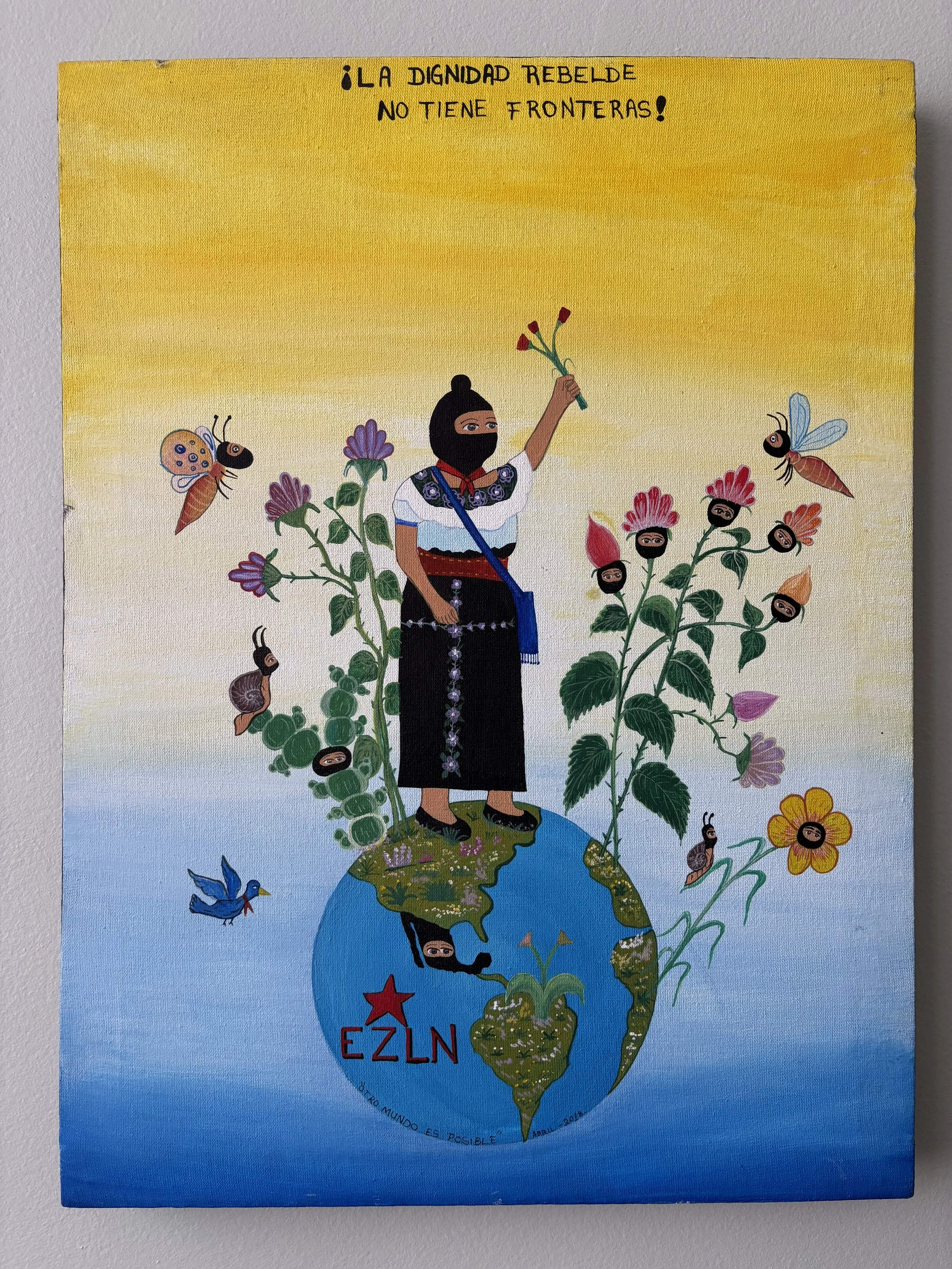
Zapatista Painting. Signed and dated Bruno 04-2018. Gouache and ink on canvas. 40x30 cm. Photo by Florence Bonnefous.
There are so many images that remain, a jumble of loose images, one or another of which sometimes rises to the surface of our memory, until it flickers behind our eyelids.
They keep each other warm they sometimes connect to one another to form an impromptu, a sequence of images, a cinematic collage that comes back when some unexpected trigger calls them up.
No image truly stays. Its persistence is irregular, and its sudden emergence is propelled by the unconscious. Hot sources, healing sources smelling of sulphur, sure sources.
All images flicker.
The frightening ones are sometimes the least explicit, the most abstract, in 2D and in black and white.
A ball drawn in a thin black line moves along a horizontal line against a white background. It rolls quite slowly; it seems very far away. Gradually the perfect circle begins to break down, and the line thickens and warps. Little by little chaos sets in, the simple lines and shapes are destroyed, and blackness takes over, and with it, fear.
And then there are the reassuring, hopeful images that stay with us. We close the shutters, we close our eyes, and they keep watch.
A small Zapatista painting shows a globe floating in the air against a background that shades from blue to yellow, rising from the oceans to the sun. On the globe, North and South America are joined by a small portrait of Subcomandante Marcos smoking his pipe. A Zapatista woman stands proudly on the globe, surrounded by flowers and bees, holding up a bouquet. Every flower and every insect has a human face. Above her, clumsy lettering reads LA DIGNIDAD REBELDA NO TIENE FRONTERAS.
Here is an image that will always remain, an afterimage if the party lasts all day and all night, a cosmos factory, and the few words that describe it may form an ekphrasis of my personal shield.
En français:
Il y a plein d’images qui restent, un fatras d’images en vrac dont l’une ou l’autre remontent parfois à la surface de notre mémoire, jusqu’à nos paupières.
Elles se tiennent chaud elles se connectent parfois l’une à l’autre pour former un impromptu, une séquence d’images, un collage cinématographique qui revient quand un déclencheur inattendu les appelle.
Aucune image ne reste vraiment, elle a une rémanence irrégulière et son surgissement est propulsé par l’inconscient. Sources chaudes, sources guérisseuses à l’odeur de soufre, sources sûres.
Toutes les images vacillent.
Celles qui font peur sont les moins explicites parfois, les plus abstraites, en 2D et en noir et blanc.
Une boule dessinée par un fin trait noir avance sur une ligne horizontale, sur un fond blanc. Elle roule assez lentement, elle semble très lointaine. Peu à peu le cercle parfait s’abîme, la ligne s’épaissit et se déforme. Petit à petit le chaos s’installe, les lignes et les formes simples sont détruites et le noir s’installe, avec lui de la peur.
Et il y a ces images rassurantes et pleines d’espoir qui nous accompagnent. On ferme les volets, on ferme les yeux, elle veillent.
Une petite peinture zapatiste représente un globe qui flotte dans les airs, le fond est un dégradé de bleu au jaune, en remontant des océans au soleil. Sur le globe les continents américains nord et sud sont réunis par un petit portrait du sous-commandant Marcos qui fume la pipe. Sur le globe se tient fièrement une femme Zapatiste entourée de fleurs et d’abeilles et qui brandit un bouquet. Chaque fleur et chaque insecte a un visage humain. Au dessus d’elle une écriture maladroite dit LA DIGNIDAD REBELDA
NO TIENE FRONTERAS.
Voilà une image qui restera toujours, une afterimage si la party dure tout le jour et toute la nuit, une cosmos factory, et les quelques mots qui la décrivent forment peut être une ekphrasis de mon bouclier personnel .
Afterimage is an ekphrastic series exploring that one image you see when you close your eyes—the one that lingers in your mind. We invite different people to reflect on an image they can't shake. This column originated in the inaugural issue of the Objektiv journal and continues today here on our web journal.
NINA STRAND ON LA BIENNALE DE LYON
Passer d'un rêve à l'autre—to pass from one dream to another—the title goes. It feels like there is nothing inside of me holding together, all the organs loose, my friend tells me as we walk into the large MacLyon, heavy techno music coming from outside. Even the train was late coming here. We need to be quick.
The Biennale is spread out over the city, and both of us also want to see the textile museum, where Annette Messager, among others, is shown. We are met with small red images in frames, one depicting bricks or structures falling against each other, and my friend says she feels seen. We pass what looks like a bedsheet with the silhouette of a person imprinted on it, as of an person not really there, or like an Ana Mendieta work, the head a big cloud, or so it seems, it recalls a dream also, but we walk on, there is no time to stop.
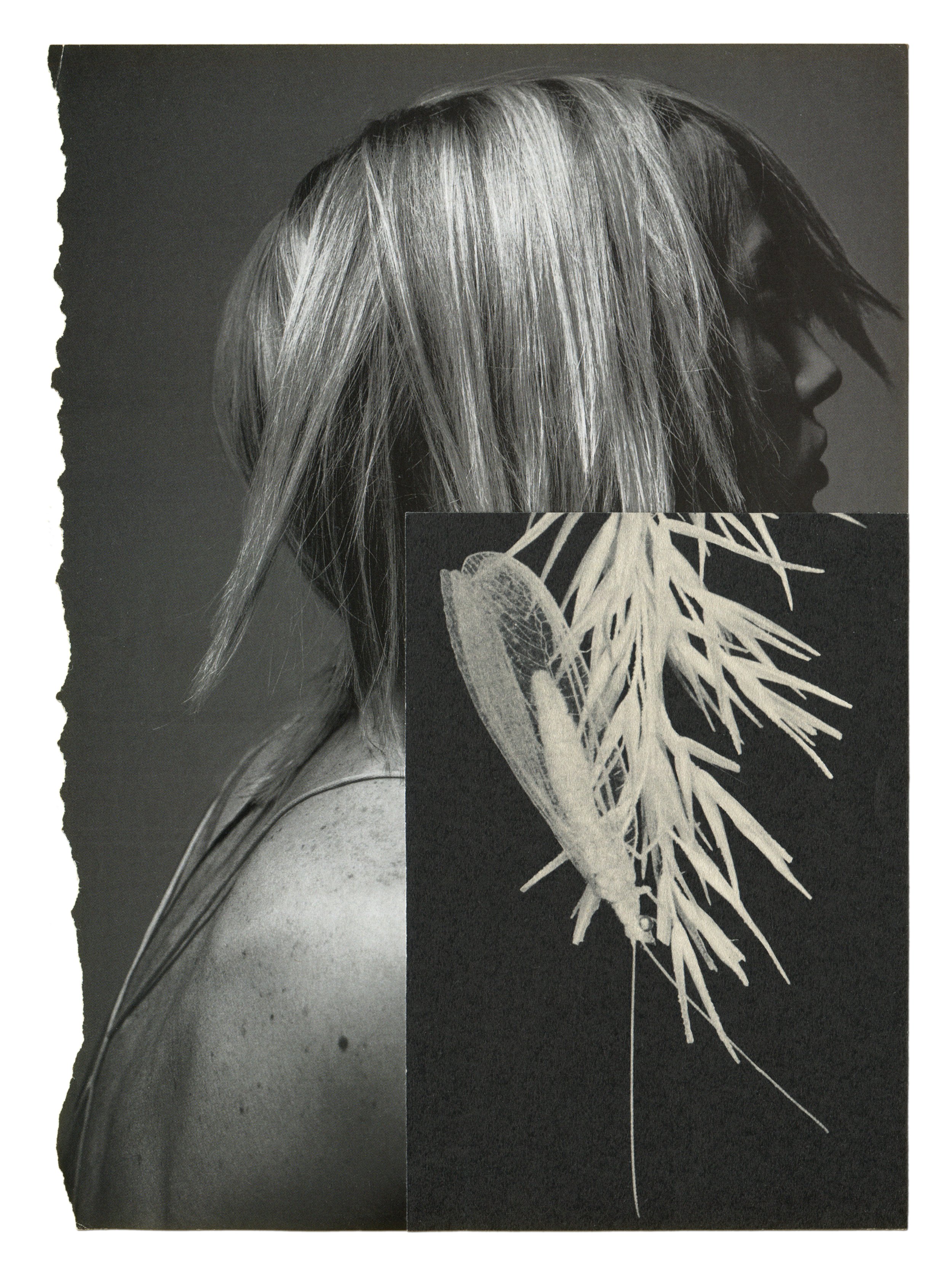
Barbara Breitenfellner, WVZ 800, 2025, © Barbara Breitenfellner. 18th Biennale de Lyon, 2026.
Passer d'un rêve à l'autre—to pass from one dream to another—the title goes. It feels like there is nothing inside of me holding together, all the organs loose, my friend tells me as we walk into the large MacLyon, heavy techno music coming from outside. Even the train was late coming here. We need to be quick.
The Biennale is spread out over the city, and both of us also want to see the textile museum, where Annette Messager, among others, is shown. We are met with small red images in frames, one depicting bricks or structures falling against each other, and my friend says she feels seen. We pass what looks like a bedsheet with the silhouette of a person imprinted on it, as of an person not really there, or like an Ana Mendieta work, the head a big cloud, or so it seems, it recalls a dream also, but we walk on, there is no time to stop.
One of the collages by Barbara Breitenfellner catches us: one with a black-and-white image of a bomb over a colour photograph of flowers in a vase, another depicting a woman's head, her blonde hair cut off by another image of straws. The wall text explains that "images, no less than bodies, have an afterlife" for this artist, who thinks of collage as continually reassembling bodies, nature and knowledge. We are as fragmented as these juxtaposed archival images .
There are other fragments we are drawn to: the short film by the French artist Alice Guy, made in 1900, The Cabbage Fairy, a smiling woman surrealistically helping babies being born from cabbages. We see it three times. And we run by the Télégramme by Robert Filliou, this one with the text: La nuit vue de nuit, c'est le jour—The night, seen from night, is day. We discuss another télégramme sentence my friend remembers as: Everything happens and everything happens at the same time. A motto for the day.
We like the gaps and the fragments from this part of the Biennale. MacLyon, smiling politely at the DJ as we leave, there is sadly no one dancing. But it is a Saturday. People will come.
We wait for the bus and read the curators' words on the Biennale: Walk enough through the streets of Lyon and you will find them. Cross the city often enough and you will pass through them: the traboules—a singular system of passages, courtyards and semi-secret stairways; a labyrinthine network of liminal spaces designed to facilitate circulation. And then there is the title, Passer d'un rêve à l'autre, which takes its inspiration from Walter Benjamin's Passagen-Werk (The Arcades Project, 1927–1940). In this vast fragment, Benjamin asks how urban environments—and particularly the Parisian arcades—shape the collective dreams and experiences of society. He approaches the arcades as threshold spaces where the dream-world of modernity becomes legible.
On the metro towards the great train halls, we realise there won't be time for the textile museum after all. We pull out our phones and eagerly scour the images we can find. We really did come so late to town. The old train halls, Les Grandes Locos, had to be prioritised. The curator herself is there, giving a walking tour to a small group, too small for us to ease ourselves into. But we have Laure Prouvost, her large tent, Hovering Caress Amère, heaving and breathing. The debris under the tent functions as a kind of corrective voice, and looking up at the cluster of breasts hanging there, we laugh over the bad-mom joke about women dropping their bras to half-mast the day Dolly Parton died, in her memory.
And like this, with many voices in mind, it seems we pass on to a better dream. That's what we got: taking the metro back to the Bourse and the theatre, and having maybe this year’s last verre piscine in the late September light. We talk about the curators' words on Filliou's La Fête Permanente responding to personal crisis with connection, conviviality and creativity, proposing value as relational rather than financial. And it goes like this, back and forth. We are reminded of another Filliou quote: Art is what makes life more interesting than art.
Afterimage is an ekphrastic series exploring that one image you see when you close your eyes—the one that lingers in your mind. We invite different people to reflect on an image they can't shake. This column originated in the inaugural issue of the Objektiv journal and continues today here on our web journal.
GEIR MOSEID ON SARAH DOBAI
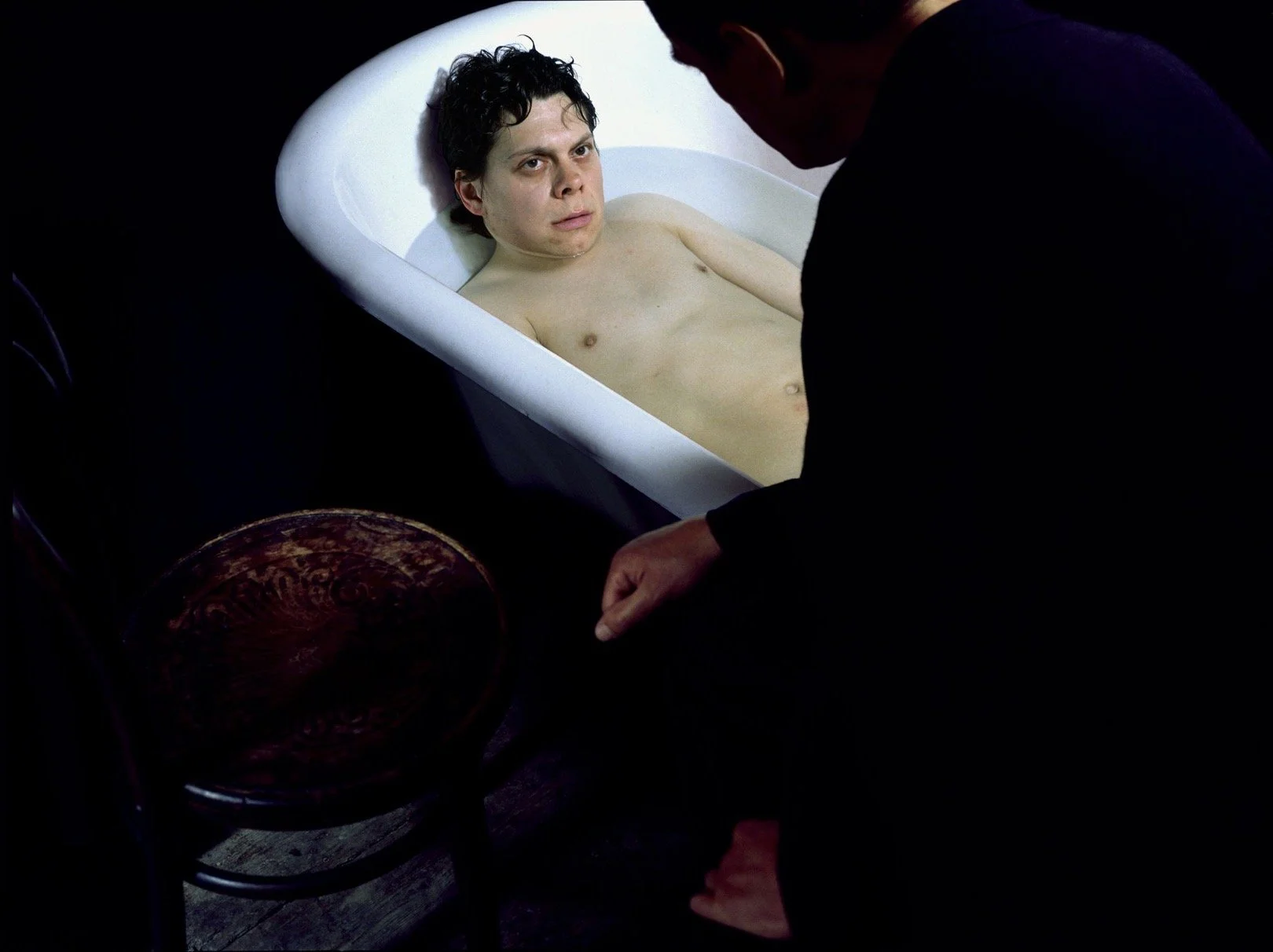
"Mike" has a childlike body, but an adults face. And immediately when I looked at him, I saw him as a victim. But the longer I sit and look at the image, the less certain I become about whether he's in fact the one in control of the whole situation. And then the hierarchical relationship between the two shifts. I looked at it earlier today and still, twenty years on, I can't settle on it. I think of it as that certain itch on your back you can't reach, an image you want to return to. An image that can never quite be completed. And that's what I strive for myself in my own work.
Afterimage by Geir Moseid:
The image on my mind is one made by Sarah Dobai, whom I assisted when I was a student and for a few years afterwards. The image shows a person lying in a bathtub with another person sitting above them looking down towards the person in the tub. You can see the upper body and face of the one in the bathtub, and then you can see the other person's back. The person in the water must be called Mike, I think, as that is the title of the work.
"Mike" has a childlike body, but an adults face. And immediately when I looked at him, I saw him as a victim. But the longer I sit and look at the image, the less certain I become about whether he's in fact the one in control of the whole situation. And then the hierarchical relationship between the two shifts. I looked at it earlier today and still, twenty years on, I can't settle on it. I think of it as that certain itch on your back you can't reach, an image you want to return to. An image that can never quite be completed. And that's what I strive for myself in my own work.
Sarah was very meticulous about how she wanted things. Whereas when I work, I'm looser about it. I let chance happen. But the casting here, because it is a staged image, is perfect. I first developed my interest in visual communication through film clubs and going to the cinema, and have always really appreciated good casting — it can truly make or break a work. And Mike is so generic and so cinematic too, so there are also lots of such connotations. In all its simplicity it still becomes very complex. It's an image I love.
Often when you assist people you don't quite understand the importance of the work at the time. But then, several years later you realise that the methodology you observed, you've taken on and made yours somehow. Those years with Sarah were very formative for how I work myself, with micro-expressions and gestures. How the mouth moves, hands. Finding those in-between positions where you get what you might call ambivalence. The thing you can't quite figure out. I keep returning to that, I can't seem to finish with that kind of uncanniness.
There's often one specific thing that triggers why I need to make a certain type of image. And with Mike, it's that indeterminate gaze towards the other character. Which I'm not finished with. It's wonderfully satisfying that he owns the image. That he's perhaps not the victim. And then suddenly he's owned by the image too. That's what keeps shifting.
Of course, for me as a man, manoeuvring around other men has changed a great deal over the years. I'm not some macho type of guy. But you do mirror yourself in other men, and especially in different types of masculinity. And Mike has an undetermined masculinity I would say. A feminine childlike body, but a masculine face, almost menacing. And it's quite simple too. It's just a bathtub, two men and a chair. Surrounded by black. Many people think staged photography is so advanced and meticulous, and of course it can be, but it can be incredibly simple too. A few people or objects and some light he he. That's something I always kept coming back to when teaching. You don't need to search for the perfect location or the most attractive friend. That's not what makes an interesting image. It's like the social anthropologist who goes to the highest mountain to find the tribe not yet photographed. Maybe you should just knock on your neighbour's door instead. You might get so much more.
Afterimage is an ekphrastic series exploring that one image you see when you close your eyes—the one that lingers in your mind. We invite different people to reflect on an image they can't shake. This column originated in the inaugural issue of the Objektiv journal and continues today here on our web journal.
RACHAEL WOODSON ON RICHARD AVEDON
In her essay Touching Photographs: Roland Barthes’s “Mistaken” Identification (2002), researcher and photographer Margaret Olin describes an index as a representation created by direct contact with its referent: A thumbprint is an index. Because the item had to be there for an indexical representation of it to exist, it is often thought that an index is inherently more persuasive than an icon. A photograph is both an icon and an index; it is like an icon with a seal of approval, or, as Barthes calls it, a ‘certificate of presence.’
Though years had passed since I’d last seen the postcard, I recognized it instantly. That day, it appeared to me as a talisman. Moved by my discovery and the years of handling that had worn away its surface, I examined it more closely. Among the marks, I could make out several barely visible fingerprints. An atlas of touch, a certificate of presence.
Afterimage by Rachael Woodson:
Portrait of a Postcard
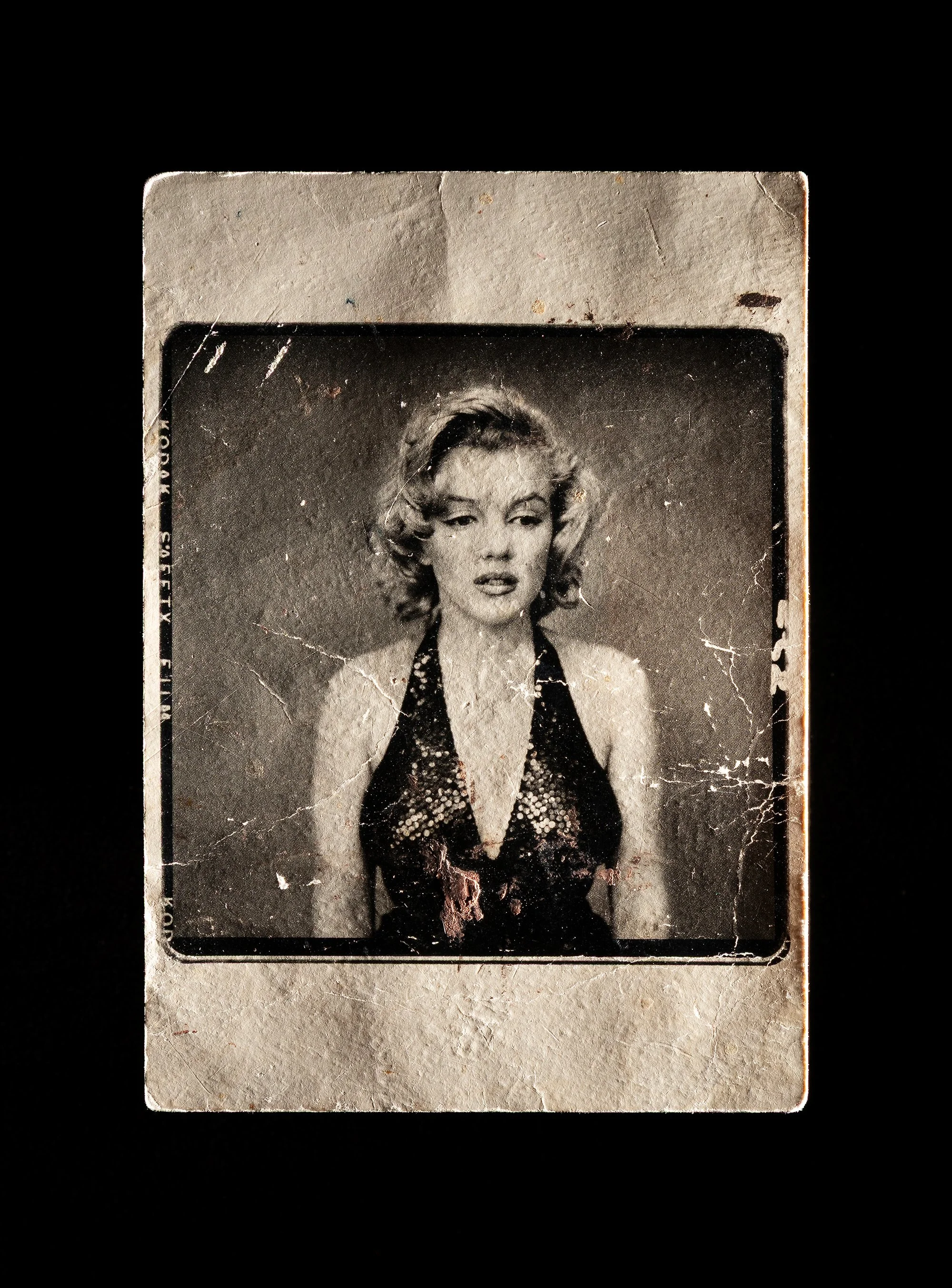
The Marilyn postcard (front), 2025. Rachael Woodson.
Yellowed with age
A weathered skin
Scuffs and stains
Fine lines like wrinkles around the eyes.
The crackling of its gelatin finish
Forms a network of small fractures.
Brownish red spots resemble dried blood
Smudges of blue, specks of beige
Dusty lipstick caked around her waistline.
Other marks reveal themselves only fleetingly -
Held at a certain angle
The light picks up traces
Of ricocheted liquids
Invisible ink.
When flipped over
The back is blank
Aside from an impressive topography
Of waves, ripples
And a corroded barcode
In a corner, the credit line reads:
MARILYN MONROE, ACTOR
NEW YORK, MAY 6, 1957
PHOTOGRAPH BY RICHARD AVEDON
©2007 THE RICHARD AVEDON FOUNDATION
Despite its condition, this postcard is hardly innocuous.
Its surface reads like a polyphonic blueprint.
The sister
In 2019, my sister Alice was killed in a bus accident. In the days that followed, I flew back to the United States to join my family. I remember how it felt to enter her apartment. Light streamed from open windows, refracting through a glass vase shaped like a skull that sat on a coffee table. Particles of fine dust drifted through fields of light and shadow. I took a few photographs that day.
We sorted through Alice’s belongings: drawers, closets, piles of clothes, photographs, and artwork. In the wake of immense loss, what is kept and what is discarded? The depth of remembrance, as expressed through objects, resonated differently for each of us as we combed over the most intimate corners of her home. It was in this archaeology of everyday life that I found the Marilyn postcard tucked inside a drawer.
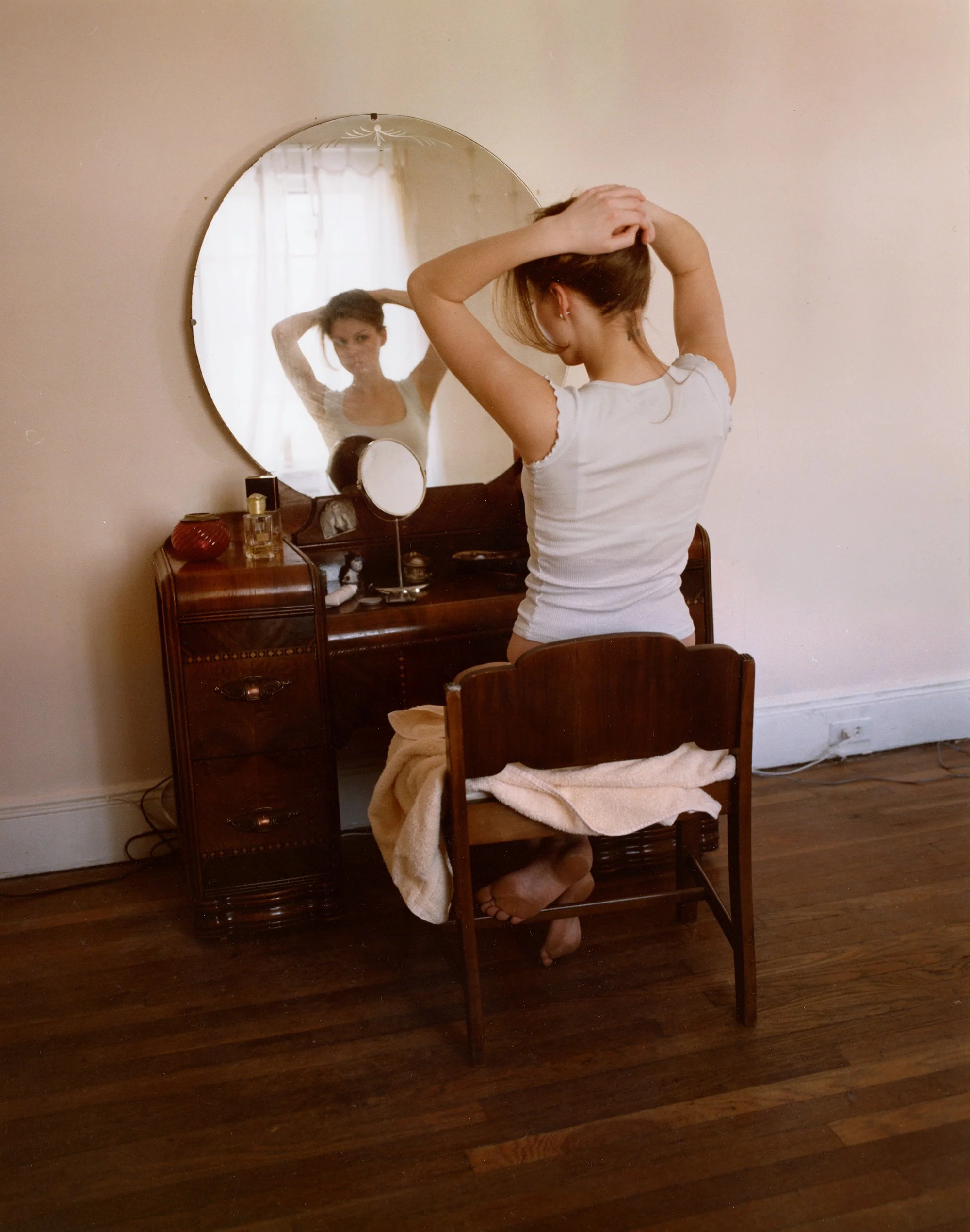
Alice, 2003. Rachael Woodson.
In her essay Touching Photographs: Roland Barthes’s “Mistaken” Identification (2002), researcher and photographer Margaret Olin describes an index as a representation created by direct contact with its referent:
A thumbprint is an index. Because the item had to be there for an indexical representation of it to exist, it is often thought that an index is inherently more persuasive than an icon. A photograph is both an icon and an index; it is like an icon with a seal of approval, or, as Barthes calls it, a ‘certificate of presence.’Though years had passed since I’d last seen the postcard, I recognized it instantly. That day, it appeared to me as a talisman. Moved by my discovery and the years of handling that had worn away its surface, I examined it more closely. Among the marks, I could make out several barely visible fingerprints. An atlas of touch, a certificate of presence.
The photographer
Richard Avedon believed in surfaces. Through his lens, they became an elastic material, full of contradictions to explore. His intention was to make photographs that mapped out a person’s “emotional geography” (“Avedon,” interview for Le Monde, July 1993). Translating such clues into image form required a total visual sensitivity; think of Andy Warhol’s belly full of scars, the textures of Isak Dinesen’s face, Sandra Bennett’s freckled skin and steady gaze.
Avedon’s technical choices reflect this. Both the medium format Rolleiflex, positioned at waist level, and the large format camera he would later use allowed for the line of vision between photographer and subject to remain unobstructed. By the late 1950s, he was established in the fashion world, creating editorials for Harper’s Bazaar and Life. In parallel, his portrait work was taking an experimental turn. Isolating backdrops and raw directional strobe light brought surface details and emotional nuance to the forefront.
Underlying Avedon’s versatility between the fashion and art worlds was a conception of beauty that drew from personal experience. He grew up in Depression-era New York, and some of his first photographs were portraits of his younger sister Louise. She was known for her enigmatic looks and would become the archetype for the models Avedon worked with early on in his fashion career. He later described the isolating effects of such objectification as having weighed heavily on Louise (“Un Portrait est une Opinion,” Égoïste, September 1984).
Avedon spoke of the theatrical lengths his family would go to when taking snapshots — posing in front of a stranger’s luxury home or an expensive car, borrowing a dog to complete their picture-perfect fantasy narrative. “All of the photographs in our family album were built on some kind of lie about who we were, and revealed a truth about who we wanted to be.” (“Borrowed Dogs,” Richard Avedon: Portraits, 2002). A photograph’s surface is understood as a porous site where reality and fiction overlap.
Readings of a star
On May 6, 1957, Marilyn Monroe arrived at Richard Avedon’s Madison Avenue studio to shoot publicity for her upcoming film The Prince and the Showgirl. This was the first and only film she would produce independent of the Hollywood studios. She was thirty years old and at the height of stardom. Avedon later recalled:
There was no such person as Marilyn Monroe… Marilyn Monroe was someone Marilyn Monroe invented, like an author creates a character… For hours she danced and sang and flirted… And then there was the inevitable drop. And when the night was over… she sat in the corner like a child, with everything gone… And as I came with the camera, I saw that she was not saying no.
(“Avedon’s Endgame,” Maria Morris Hambourg and Mia Fineman, Richard Avedon: Portraits, 2002)
The most enduring of the photographs made that day, featured on the postcard pictured here, is occasionally referred to as Sad Marilyn. This strikes me as a reductive label, conflating Avedon’s image with Charcot’s photographic experiments at the Salpêtrière. To move beyond the surface of this particular portrait, one must keep in mind Avedon’s penchant for paradox and the layers of Monroe’s performative skill, exercised both for the public and for the camera. As Sharon Marcus states in her book The Drama of Celebrity (2019):
Like any celebrity, Monroe became a distinctive star not simply by standing out from the crowd but also by multiplying herself. To read a single article about Marilyn Monroe was often to encounter many Marilyns, since editors and page compositors rarely limited themselves to one picture of the star.
The public’s fascination with Monroe’s plurality lies within the fluctuating ideologies of post-war America. In Stars (1976), Richard Dyer points out that the diffusion of Freudian thought in popular culture, the publication of the Kinsey reports and Betty Friedan’s The Feminine Mystique as well as shifts in film censorship amid competition from television all contributed to making her image so successful. In La Rabbia (1963), Pier Paolo Pasolini portrays Monroe as the perfect host for an image-hungry culture, her death a symbol for the transition into a post-atomic era.
The most photographed girl in the world
I have yet to encounter Marilyn Monroe’s account of being photographed by Richard Avedon, which leads me to reflect on her relationship to photography in general. In the first pages of her unfinished autobiography, she recalls an early experience with a photograph:
There was one object in my mother’s rooms that always fascinated me. It was a photograph on the wall. There were no other pictures on the walls, just this one framed photograph. Whenever I visited my mother I would stand looking at this photograph and hold my breath for fear she would order me to stop looking. (My Story, 1974)
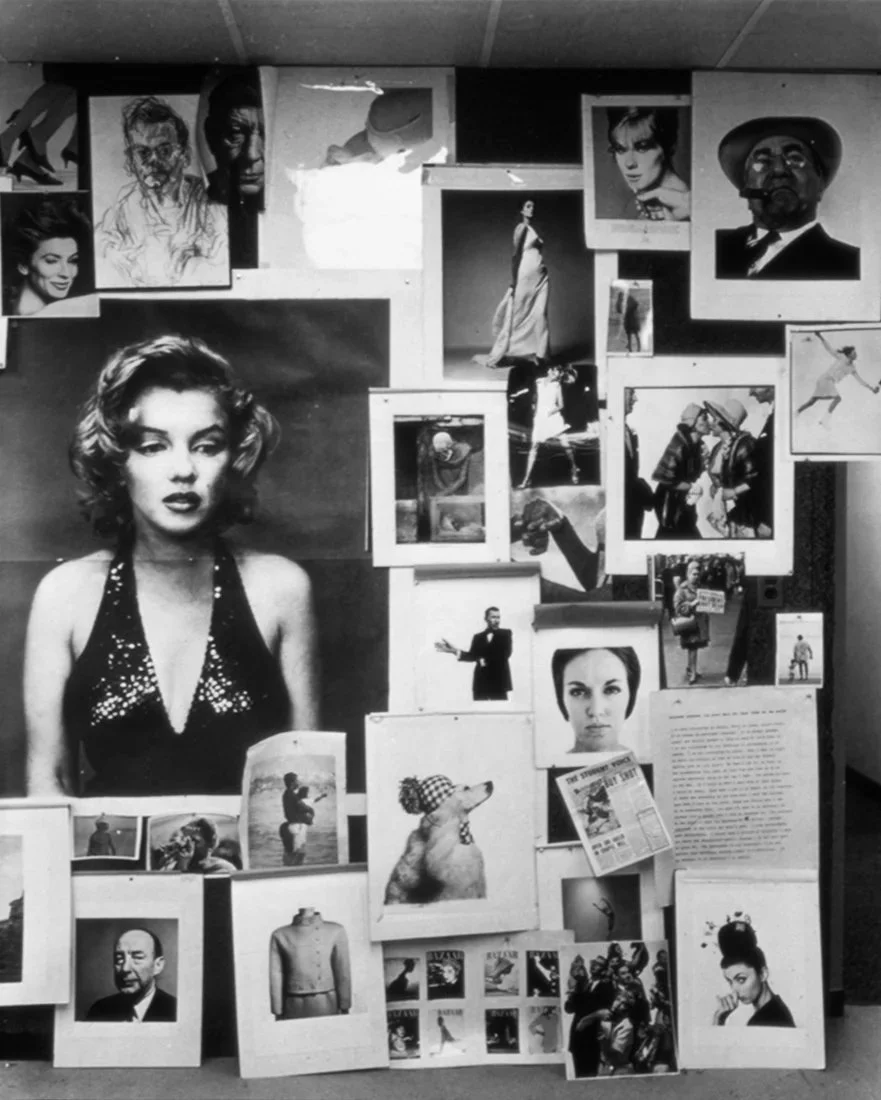
Installation view of the exhibition A Collage, McCann, Erickson, New York, 1964. Photographer : Richard Avedon. © The Richard Avedon Foundation
Marilyn was told that the man in the photograph was her father, a revelation that set off an intense emotional reaction. The portrait took on a symbolic presence, becoming a proxy for an absent man. “The night I met his picture I dreamed of it when I fell asleep. And I dreamed of it a thousand times afterward.” This suggests that photography functioned for Monroe not merely as representation but as a space of projection and fantasy, prefiguring the mirror of selves she would later construct for the camera.
Portraits
When I left Alice’s empty apartment, I carried a small selection of her things that followed me back to Paris — a moth-eaten silk handkerchief, a copy of The Autobiography of Malcolm X and the postcard. Like the framed father for Marilyn, Alice’s postcard has become a host of ideas and images that extend far beyond its material circumstances. I see it as a contemporary relic, a palimpsest of histories opening onto countless memories.
In the fall of 2002, the Metropolitan Museum of Art opened Richard Avedon: Portraits, a major exhibition spanning his sixty-year career and the last held during his lifetime. Having just moved to New York to study photography, I went to see the exhibition and spent a long time taking in room after room of people who had agreed to perform some part of themselves for Avedon’s ritual.
Alice and I must have talked about it not long after. By then, I was making a series of portraits of her and our two brothers, and would often spend weekends at our mother’s house in New Jersey photographing them. On one such occasion, I noticed the Marilyn portrait taped to the side of the round mirror in her bedroom, no doubt cut out from a review of the exhibition she’d read in one of her fashion magazines. This was later replaced by a more durable postcard version, which remained there for many years. The day Alice left our mother’s house, the portrait went with her and it never left her.
First published in French in Entre-Temps (Collège de France), February 11, 2026
Afterimage is an ekphrastic series exploring that one image you see when you close your eyes—the one that lingers in your mind. We invite different people to reflect on an image they can't shake. This column originated in the inaugural issue of the Objektiv journal and continues today here on our web journal.
SVERRE STRANDBERG ON JEFF WALL
There is something about the modernist house, the architecture, the building filling most of the picture frame. And then this figure outside. There is some realism in the photograph, and yet it is a constructed scenography. I like this dualism between realism and the constructed, where you intervene in something which is realistic.
One can choose many different details in this one. The milk being in a paper bag, for one, hidden from view, and the one holding it looking in the other direction. Turning away from the explosion. One can see the veins in his arm. It makes me think that he is holding something back, something that is about to burst out, much like the splash of milk.
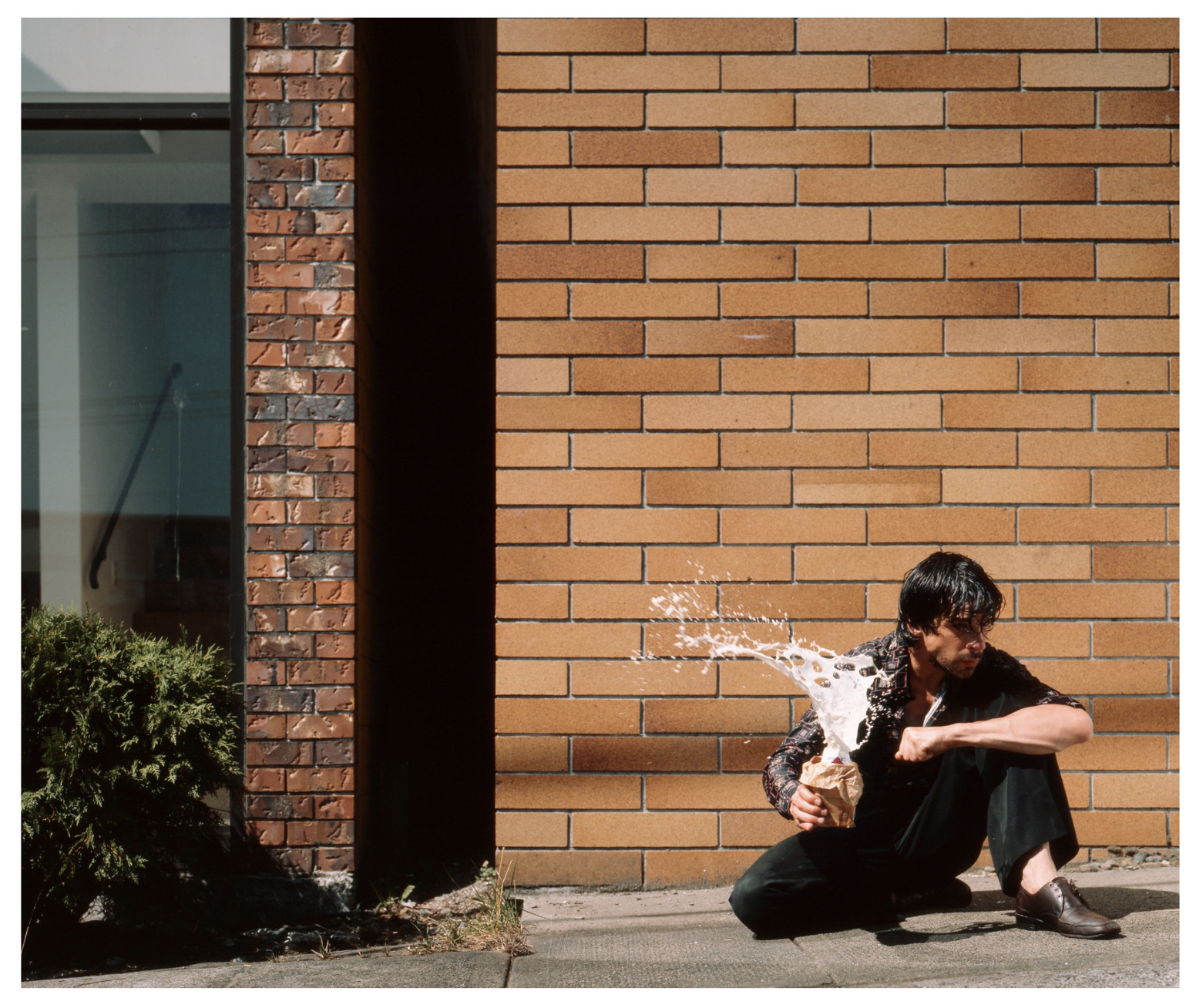
Jeff Wall, Milk, 1984.
Afterimage by Sverre Strandberg:
It is in a way a hard task to think about just one image as how I relate to photography has changed. The idea of the singular image is not on my mind these days. I think of images in a series, in a context of more images. I am no longer seeking the one glorious photograph as I used to do.
There is one very well-known work on my mind though, Milk by Jeff Wall. It is a bit scary to talk about such a known image, from a time when the formats were huge, in the 80s, with him and Gursky, Ruff, and the others.
This one stuck with me. I had started art academy working with film, and then, in my final year, I flipped through different photobooks and there it was. It sort of beat everything else in a way. Looking at it again for this, it has this composition where everything goes together, and the frozen moment of the liquid, something only photography can do. And the fundamental symbolism of milk for all humans. Milk emerged as a recurring theme in contemporary photography from the early 1960s through the 1980s.
There is something about the modernist house, the architecture, the building filling most of the picture frame. And then this figure outside. There is some realism in the photograph, and yet it is a constructed scenography. I like this dualism between realism and the constructed, where you intervene in something which is realistic.
One can choose many different details in this one. The milk being in a paper bag, for one, hidden from view, and the one holding it looking in the other direction. Turning away from the explosion. One can see the veins in his arm. It makes me think that he is holding something back, something that is about to burst out, much like the splash of milk.
Afterimage is an ekphrastic series exploring that one image you see when you close your eyes—the one that lingers in your mind. We invite different people to reflect on an image they can't shake. This column originated in the inaugural issue of the Objektiv journal and continues today here on our web journal.
BRIAN PAUL LAMOTTE ON Sonderkommando No. 283
Perhaps the political power of an image isn't simply its ability to show us something.
It is its ability to make it impossible for us to say that we did not know.
For as long as I can remember, I’ve been surrounded by photographs and steeped in image culture. An early university professor keenly observed that I had seen more images in my short lifetime than all of my classmates combined. Growing up in my father’s photo studio, I had access not only to the means of production but also to endless slides, negatives, and prints.
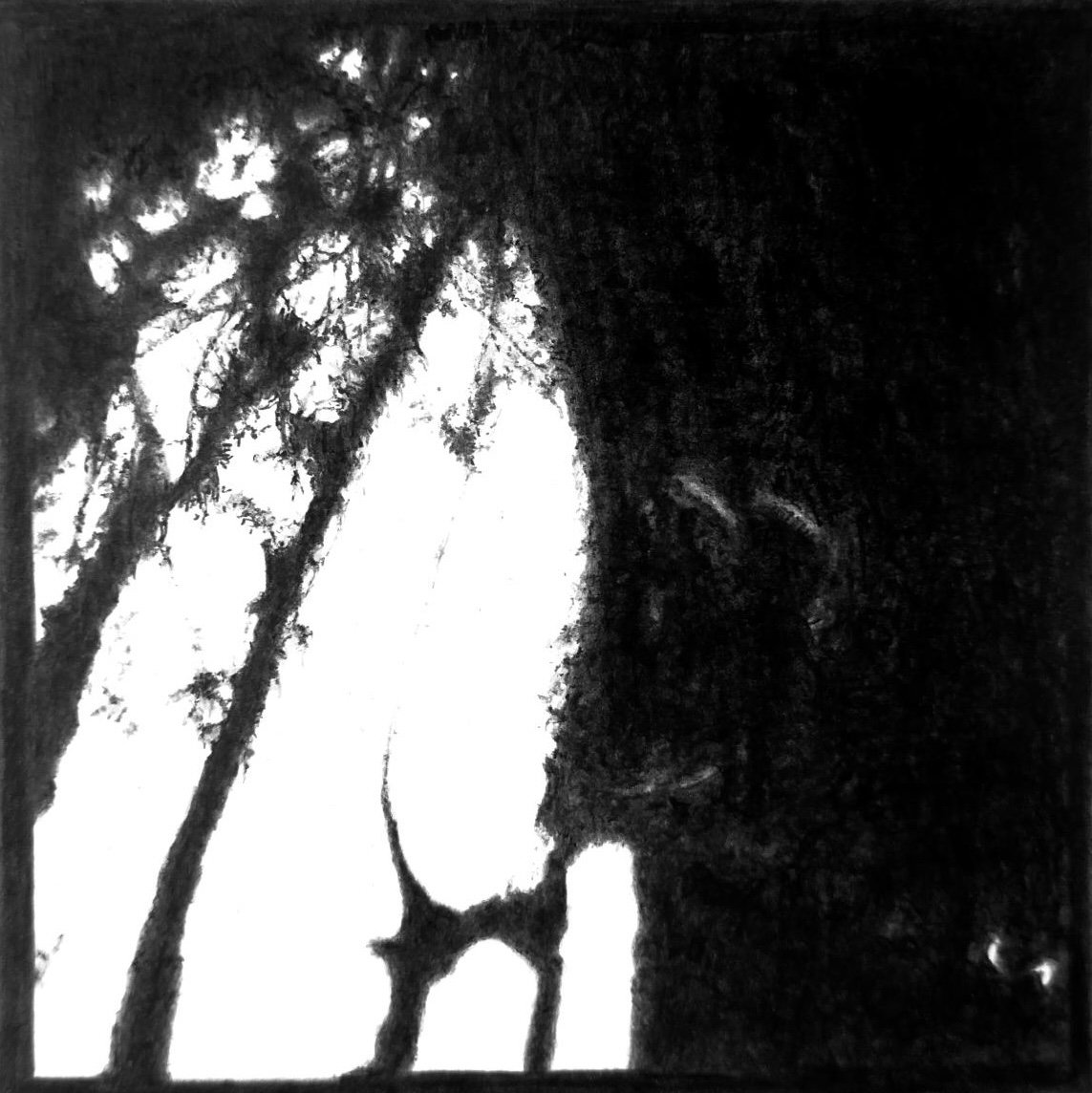
Gerhard Richter, Birkenau no. 283, Postscript.
Afterimage by Brian Paul Lamotte:
Perhaps the political power of an image isn't simply its ability to show us something.
It is its ability to make it impossible for us to say that we did not know.
For as long as I can remember, I’ve been surrounded by photographs and steeped in image culture. An early university professor keenly observed that I had seen more images in my short lifetime than all of my classmates combined. Growing up in my father’s photo studio, I had access not only to the means of production but also to endless slides, negatives, and prints. I took this for granted before that comment. I now have the privilege and pleasure of working with images daily, designing art and photography books for nearly twenty years, drawn not only to their material aspects but also to working with sequences and multiple images. It’s perhaps not a coincidence that the photograph that has stayed with me since last November cannot be separated from its place at the end of a sequence documenting one of the most horrific moments in human history.
On a brisk and grey Sunday at the tail end of Paris Photo last November, I made the journey to Fondation Louis Vuitton to see the Gerhard Richter retrospective. I went expecting blurry paintings and gestural movements to soothe my eyes and mind after a long week of photographs and books. Instead, when I reached the end of the exhibition, I was confronted with something so urgent and haunting that I couldn’t look away, and seemingly everything I had seen previously vanished. It wasn’t a painting or a book but a series of small black-and-white photographs tucked into the back left corner of a cavernous room, with four overwhelming canvases hanging adjacent and smoky mirrors on the opposite wall. The canvases were Richter’s monumental Birkenau paintings. The small photographs in the corner, framed and placed in sequence, were his source material: the clandestine Sonderkommando photographs taken inside Auschwitz-Birkenau and smuggled out through the Polish Resistance. What struck me, and what has stayed with me, is not simply the photographs themselves but the feeling of urgency and necessity when you observe them. The first two frames, No. 280 and No. 281, depict the atrocities we have come to understand and collectively reckon with. But it was the final two, and particularly No. 283 (shown above), that affected me most—not for what they depict, but for what is missing or lies outside the frame. The danger and fear we feel in the tilted frame of No. 282 become more palpable in No. 283 as form and figure fall away and we’re left with abstraction and uncertainty. Its power comes as much from what is outside the photograph as from what is inside it.
As I left the exhibition, shaken and moved in a way I hadn’t experienced before, I began an internal dialogue about political images and our contemporary image culture. We consume photographs through various feeds and endless social-media scrolls, where images of suffering become part of the same visual stream as everything else. What the Sonderkommando photographs unearthed was a more profound question for me: What has happened to our capacity to sustain attention to an image? The first two frames are figurative and frankly unimaginable, while No. 282 and, more so, No. 283 have a pastoral and abstract quality that becomes deeply unsettling once we understand their context and the frames that preceded them. One could argue they hold more resonance because of the unspectacular nature of what they don’t depict. The trees and skyline bear witness to what is outside the frame and force us to ask: What can an image make visible without showing the thing we expect it to show?
I’m writing this ten months later, sitting in a friend’s Berlin apartment I’m calling home for the next week and a half. An enormous black-and-white print sits behind me depicting a Palestinian olive tree in the occupied territories. Its monumentality and fragility, and the history carried by the tree itself, are not lost on me. Yesterday I biked past the Memorial to the Murdered Jews of Europe on my way to see a Brâncuși retrospective. Abstraction keeps reappearing. History and current politics are intertwined and colliding in this country’s collective memory as it struggles to negotiate the complexities of “never again.” What is the responsibility of memory if it does not alter how we encounter suffering in the present? No. 283 gives us trees and sky; the Palestinian olive tree carries land, continuity, displacement, inheritance, and survival; Brâncuși reduces bodies and objects towards elemental form; and the Holocaust Memorial refuses figurative representation, giving us repeated concrete forms. All, in different ways, make visible something that cannot simply be depicted.
The photographer of the Sonderkommando photographs, long identified only as “Alex” and now widely believed to have been Alberto Errera, a Greek Jewish naval officer, made these images as an act of resistance and testimony. He and the fellow prisoners who acted as lookouts risked their lives to document what was being deliberately kept unseen. The photographs survived through a chain of people who understood that this evidence had to reach the outside world. The Nazis understood that images of this nature could not be allowed to exist, that visual evidence threatened the machinery of extermination. What stays with me, and what I continue to ponder, is this contradiction: the necessity of making photographic evidence and the necessity, for those committing the atrocities, of destroying it. The image itself became an act of resistance, evidence that had to survive and reach the outside world.
We’re left with trees. Sky. Almost nothing.
Support for Palestinian Students to Study Abroad (SPSSA) is currently raising funds to help Palestinian photography students evacuate Gaza and continue their studies in the UK, covering tuition, living, evacuation, and contingency costs. Donate via Chuffed
Afterimage is an ekphrastic series exploring that one image you see when you close your eyes—the one that lingers in your mind. We invite different people to reflect on an image they can't shake. This column originated in the inaugural issue of the Objektiv journal and continues today here on our web journal.
WHITNEY HUBBS
In February 2025, one week before David Lynch died, and six months before my thirty-year high school reunion, I watched my high school in west L.A. burn down on Instagram live, in my home, in an upstate New York town, during a snowstorm. It didn't feel real, and that makes sense to me. I didn't feel sad, and I'm embarrassed that this also makes sense to me. It felt more real and more sad that David Lynch died. And then I feel sad because I felt closer to David Lynch than I did to my life during high school, or maybe that's normal?
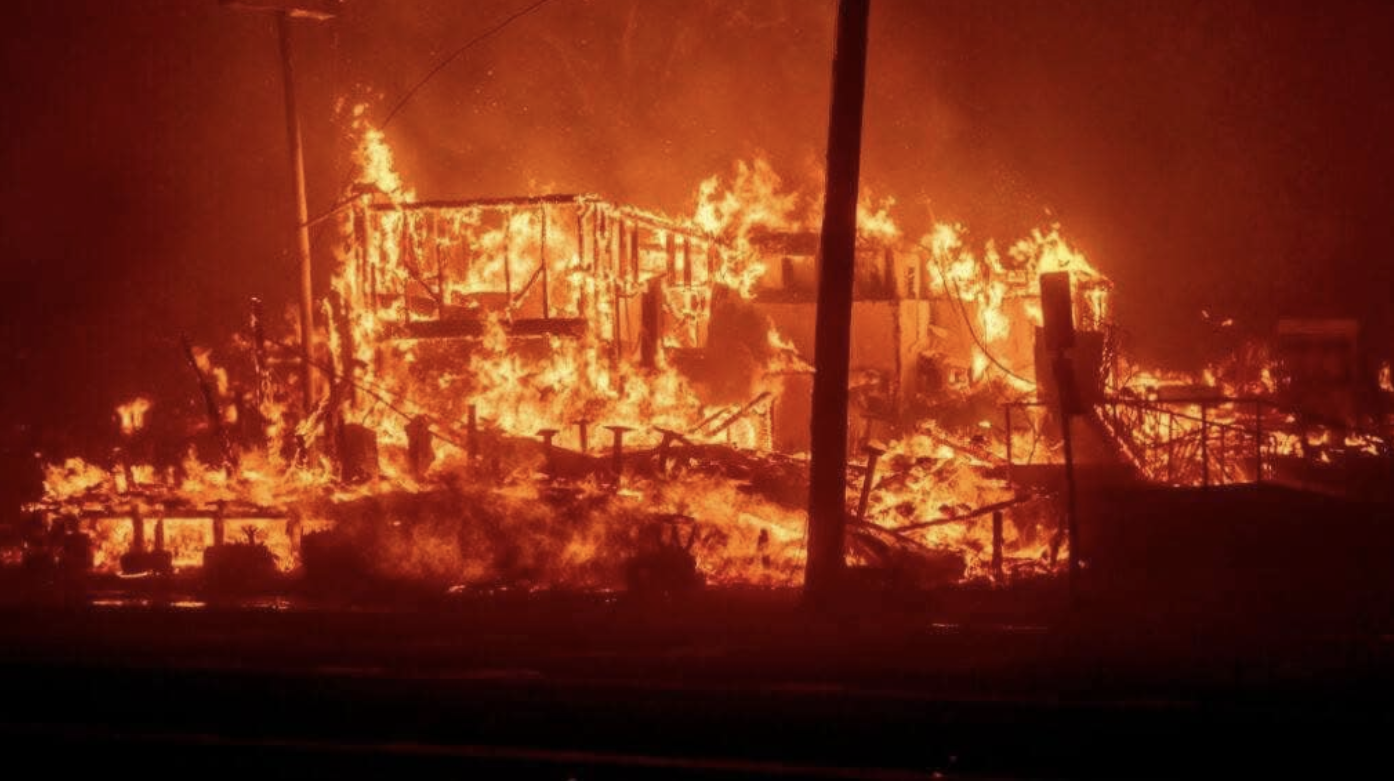
Screenshot of the fire.
Afterimage by Whitney Hubbs:
In my second round of puberty (aka perimenopause) my high school burned down. In February 2025, one week before David Lynch died, and six months before my thirty-year high school reunion, I watched my high school in west L.A. burn down on Instagram live, in my home, in an upstate New York town, during a snowstorm. It didn't feel real, and that makes sense to me. I didn't feel sad, and I'm embarrassed that this also makes sense to me. It felt more real and more sad that David Lynch died. And then I feel sad because I felt closer to David Lynch than I did to my life during high school, or maybe that's normal?
Carrie and Teen Wolf were shot at my high school that burned down. I also found out that the second house I lived in—that a reality tv star lived in with his wife—burned down.. In 2018 I watched the first house I lived in burn down on a livestream YouTube channel, shot from a helicopter. M*A*S*H and Twin Peaks were filmed around that house. I watched that house burn down in a different, but smaller, upstate New York town, and also during a snowstorm.
Back to my high school. I don't see why my locker wouldn't have burned down with the entire school, but that would mean that the photo classroom across from my locker also burned down where the only good memories are from my puberty. I took my first photo class when I was a freshman in 1991. That year I wanted to be a war photographer because my teacher showed us James Nachtwey's War Photographer. But then when I was a sophomore, he showed us Annie Leibovitz's pictures of famous people, like that Keith Haring portrait. I didn't really want to be her, because being Keith Haringg seemed cooler. And when I pretended to be him and made a self-portrait, I got photo of the week.
I am writing this in 2026, and I hear that my high school is holding classes at the empty Sears building in the next town over—a place I shoplifted knock off Doc Marten's from. By the time this second round of puberty hit, both houses from my first eighteen years were incinerated. Both times, I decided not to go back and photograph these places that aren't even places anymore, and instead I had a fun (in a macabre way) writing about it.
Afterimage is an ekphrastic series exploring that one image you see when you close your eyes—the one that lingers in your mind. We invite different people to reflect on an image they can't shake. This column originated in the inaugural issue of the Objektiv journal and continues today here on our web journal.
SERAFIN GERBER ON RYAN MCGINLEY & FERDINAND HODLER
I am on a journey to find the image in my head. I haven't reached the bottom, but I'm on it. I took the assignment literally: what's the image you see when you close your eyes? So I lay down, closed my eyes, and looked. Not one image came, but many.
I'm a melancholic person, especially in summer (I’m writing this in July); every new one makes me feel time passing, and I think of past summers, miss what has been. The older I get, the more I think: I used to be so young, so free, everything felt light, endless, limitless. Now it all feels heavier, more serious. This feeling hits me every summer.
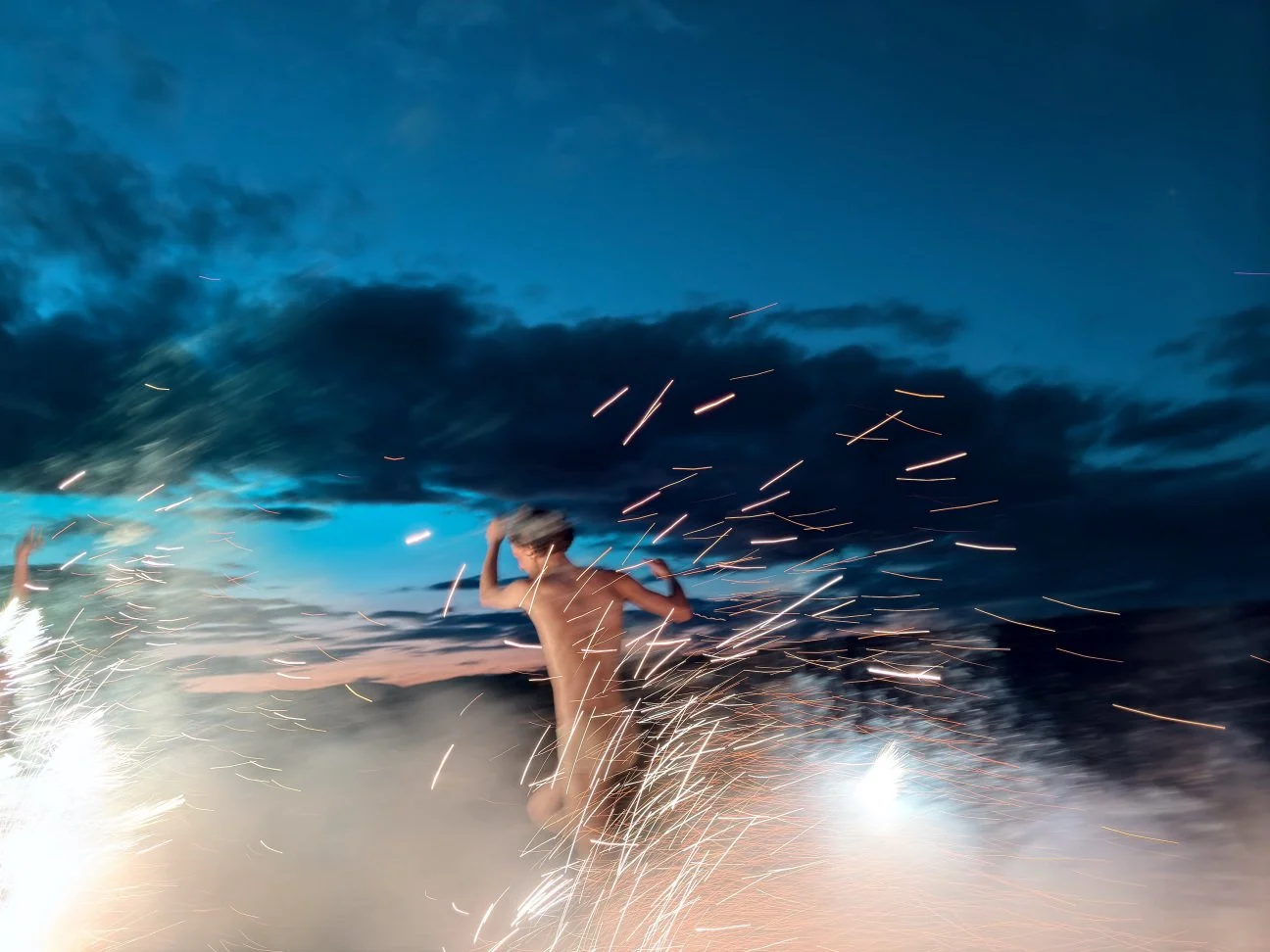
Ryan McGinley, Sparky.
Afterimage by Serafin Gerber:
I am on a journey to find the image in my head. I haven't reached the bottom, but I'm on it. I took the assignment literally: what's the image you see when you close your eyes? So I lay down, closed my eyes, and looked. Not one image came, but many.
I'm a melancholic person, especially in summer (I’m writing this in July); every new one makes me feel time passing, and I think of past summers, miss what has been. The older I get, the more I think: I used to be so young, so free, everything felt light, endless, limitless. Now it all feels heavier, more serious. This feeling hits me every summer.
There's a contrast in it. On one side I'm fully present, swimming in a river under this exact sun, hyper-real, right here, right now. But then it layers with every summer before it. It results in this sort of mental time travel, this longing for what has been, this slight fear of what's coming. The very moment becomes a timeline. Saturated, both ways at once.
I grew up in the countryside, so visually summer to me means saturated colour, late evening light lying horizontal and warm, fields, meadows, the wind in them, rivers, hills, mountains.
I have this ritual I do every time I swim: I dive, open my eyes underwater, and swim toward the sun looking straight at it, watching the light break. Full steam summer evening light, running super fast, close friends, warm beer—this is where freedom lives, where everything feels possible. Wide space, the sky, closeness, intimacy, melancholy.
Three images came out of it, layered.
The most photographic one is Ryan McGinley's early work—fireworks, figures shot against the sun. It's the same gesture: looking into the sun through water, that closeness, that youth. His images breathe. Everything is here at once. I found his work years ago, forgot about it, and it came back to me while I was trying to name this feeling—the wide lens, people close together, fireworks or sun, small flares of light. Not many photographs move me the way his do.
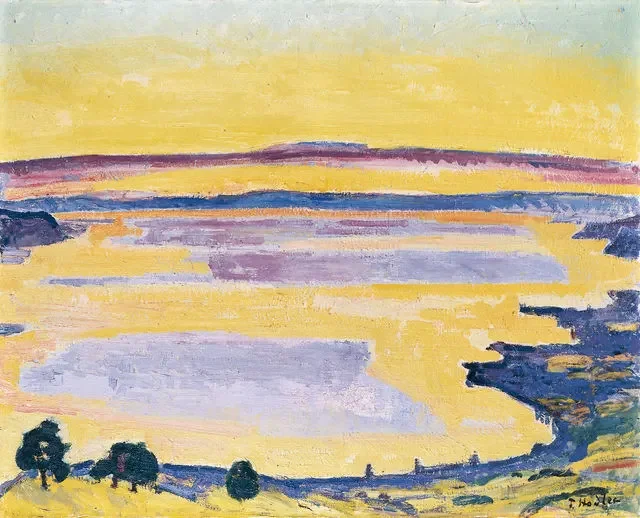
Ferdinand Hodler, Sonnenuntergang auf dem Genfer See, 1915.
The second is Ferdinand Hodler, a Swiss painter—lakes, forests, streams, rocks, his light. Figures holding each other by the hand. I can't name one painting; it's the colour and the light matching what I feel, not any single image.
The third is the sunrise emoji. I use it constantly. A small square that is also an image.
These three layer into what I see right now when I close my eyes. Together, they are my inner world right now. Not a concise answer to a simple question. The word for it might be saudade—the presence of an absence. Longing for something that isn't here now.
Afterimage is an ekphrastic series exploring that one image you see when you close your eyes—the one that lingers in your mind. We invite different people to reflect on an image they can't shake. The column began during our time publishing the journal Objektiv and continues today under Objektiv Press.
TORBJØRN RØDLAND ON DIM REVELATIONS
Following the recent release of Dim Revelations, The 2013 Journal, we present two interviews in which Rødland speaks about the book and his photographic process:
In 2013, photographic artist Torbjørn Rødland decided to write. A small piece of text every day, sometimes about photography as an art form, sometimes about his own process ("I got up early and put striped toothpaste on a frankfurter in a wheat bun, right here on the floor"), sometimes about films he watches, Edvard Munch's understanding of hell, or the joy of a fully charged electrical device.
Following the recent release of Dim Revelations, The 2013 Journal, we present two interviews in which Rødland speaks about the book and his photographic process.
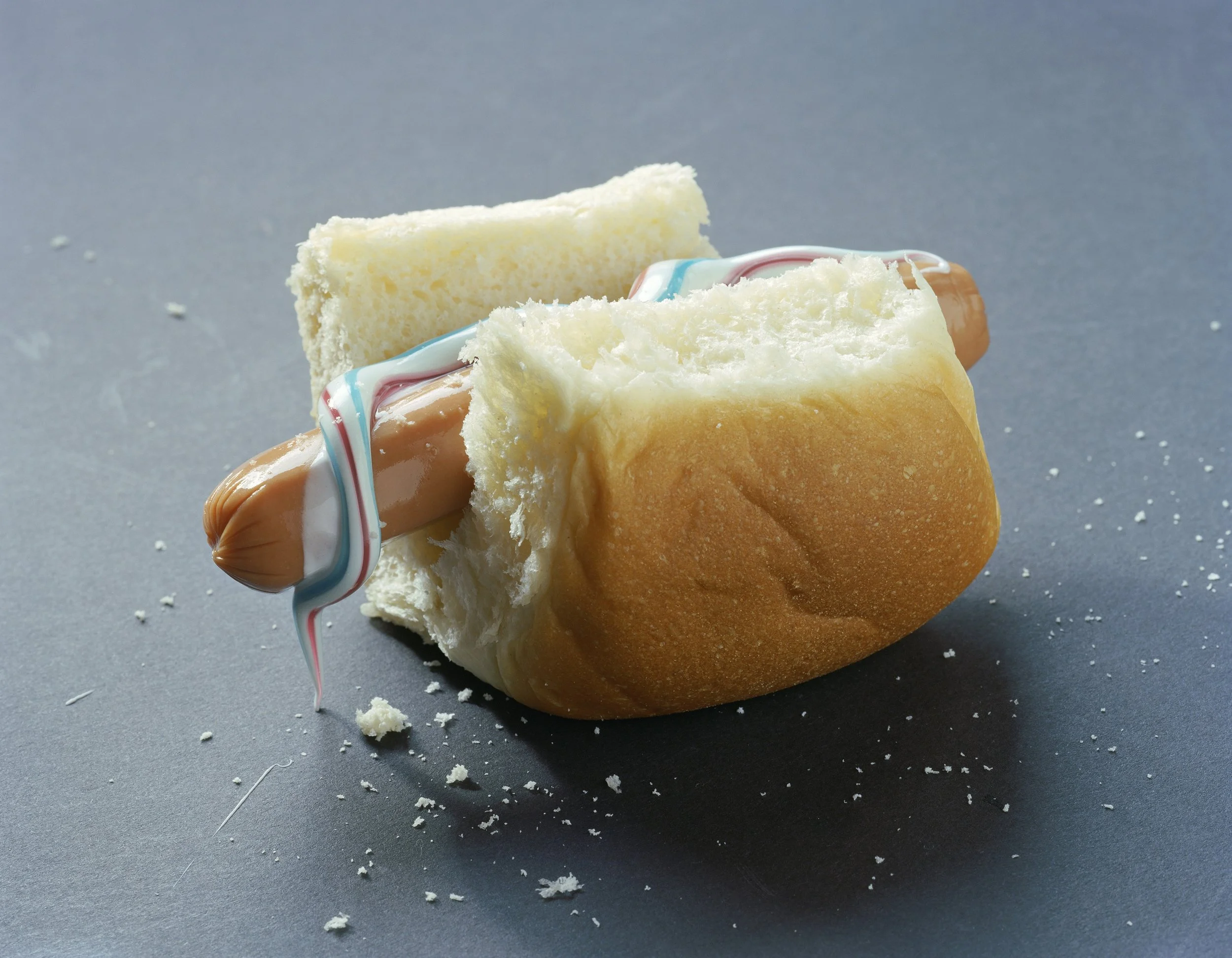
Torbjørn Rødland, Hot Dog, 2013, 28 x 35 cm.
Dark Revelations, D2
By Maja Hattvang
Torbjørn Rødland publishes his diary from 2013 and gives a rare insight into his own photographic process.
In 2013, photographic artist Torbjørn Rødland decided to write. A small piece of text every day, sometimes about photography as an art form, sometimes about his own process ("I got up early and put striped toothpaste on a frankfurter in a wheat bun, right here on the floor"), sometimes about films he watches, Edvard Munch's understanding of hell, or the joy of a fully charged electrical device.
"My best thinking is wordless," he writes, for example, on January 8: "I'm a photography-thinker, which is not quite a thinker." Nevertheless, the entries carry the same shifting between high and low, sincerity and irony that characterizes his photographs.
The idea was always that it would be published, but only now, 13 years later, has Dim Revelations, The 2013 Journal arrived.
"The year 2013 very quickly looked very outdated," says Rødland, who recently moved from Los Angeles to New York. "I had to wait until we could look at the year from a certain distance."
The book is part of Objektiv Press's essay series on camera-based art, and offers a rare glimpse into Rødland's photographic process, which tends to depend on a combination of thorough preparation and intuition.
Halfway through the year, he comes across, by chance, the American author Ken Wilber's so-called integral theory: a kind of synthesis of Eastern and Western, new and old knowledge traditions. It has a tremendously productive effect on his thinking around his own work.
"When I studied photography in Bergen, you were either straight, subjective and poetic, or you were staged, appropriating and critical. Only the latter of these two positions had validity, but it wasn't inclusive enough for me. I needed the poetic and the subjective, but I couldn't ignore the staged and the critical," he says.
"I knew that what I was searching for wasn't a nostalgic image, but I had no suitable concepts. What I wanted to do didn't exist, and therefore had no name."
This was what he found in Wilber's ideas: a concept that encompassed all layers of meaning at once.
Rødland's photographs tend to be perfectly lit, sometimes bordering on softcore or advertisement-like in their choice of subject matter, and haven't always been read in the multi-layered way he himself works from.
"Is it about a need to be understood?"
"Understood. Seen. Mostly on behalf of the images. I'm painfully aware that I fall short as a communicator. But stronger than the need to be understood is my own need to understand."
The 2013 Journal: Torbjørn Rødland, Daily Lazy
By Koshik Zaman
K.Z: This is an honor. I very much enjoyed reading your brand new book Dim Revelations: The 2013 Journal, which is based on diary entries from that year. I chuckled several times, and I loved all the references and insights. According to the preface, you had not kept a diary before 2013, or after, for that matter. What prompted you to start then? Why was that year particularly suited to this?
Torbjørn Rødland: In 2011 I published twenty sentences on photography, and the response I got to that text encouraged me to write more. I was in Scandinavia without my equipment over the 2012 Christmas holidays and decided to start writing on January 1.
K.Z: Out of curiosity, why did you leave out Sundays?
TR: I like the biblical concept of taking Sundays off. It makes a lot of sense to me.
K.Z: Right, you allude to that in one of the entries where you mention Roe Ethridge. What did an ideal Sunday look like then?
TR: Not so different from all the other days. I just didn't have to come up with a paragraph for the journal. A Sunday could be a great day for, say, making a picture.
K.Z: The format is intimate, very reminiscent of a notebook, and fits well within Objektiv Press' essay series. Had you always intended for it to be published, or did that idea come later?
TR: The idea was always to publish it, and the question was always when.
K.Z: So why is now a good time to publish it?
TR: I'm not sure it is. Objektiv Press asked very nicely for a contribution to their book series, and this journal was the best unpublished "essay" I could find on my PowerBook. A lot of people look back at the years leading up to 2016 as a different reality, so maybe 2013 is finally ripe for a revisit. Things and times have definitely changed.
Excerpts from Dim Revelations:
04/26
I think I'm violating the portrait image. They think I'm violating the portrayed person.
06/01
Sexual tension is either projection, telepathy, or a combination of the two.
10/30
A photographer is someone who has grown to love the limitations of her camera.
K.Z: It's evident that you're a talented and very witty writer. Have you not felt compelled to keep writing?
TR: No. Every generation produces a lot of writers who do it better than me, but there is a lack of exciting photographers.
K.Z: Returning to the project more than a decade later, are there any entries that made you think, "I would not write that today"?
TR: Certain artistic approaches that felt tired to me in 2013 are receiving less positive attention today, so I probably wouldn't feel the need to throw shade in those directions. I'm older and would generally throw less shade now, though I repeatedly went there because, as a reader, I'm excited by that type of frankness. I'm drawn to the directness in Edmund Wilson's diaries, perhaps forgetting that they weren't published until after his death.
K.Z: For a contemporary art audience, an introduction is almost redundant. You are one of the leading figures in contemporary photography, and your mise-en-scène approach has clearly
influenced many younger artists. I would still love to ask how you first got started in photography.
TR: I grew up with a father who read amateur photography magazines. He gave me a camera when I was maybe eleven. At that time I was already a dedicated cartoonist, but when that spark expired in my late teens, I transferred my love of image-making to photography. I never seriously considered painting.
K.Z: I read somewhere that you have also worked with video and film, which I was not aware of at all. I believe some of those works were made before you moved to Los Angeles. Has living in the city not inspired you to revisit those mediums? Reading the book, it's evident that you're very interested in film.
TR: Moving to Los Angeles in 2010, I thought the next step would be to make a movie long enough to cross over into the world of cinema, but Hollywood diminished rather than strengthened that appetite. Last year I moved away from California. Let's see if the hunger returns. I won't tell you my genre-bending idea for a feature-length film, as it has still not been attempted by anyone else.
K.Z: Finally, what is left for you to explore? You've exhibited widely, in blue-chip galleries and world-renowned institutions alike. What still excites or challenges you?
TR: Oh, I'm not as impressed by the reception as you seem to be. Have you ever seen one of my exhibitions? Very few have. In my mind, it's just getting started. It will be a long process. What else is exciting? There are still a lot of possible photographic images that just aren't being created. I'll try to make some of them.
NINA STRAND ON MATIAS FALDBAKKEN
And then, there it is. Fifteen years after the terrorist attacks in Oslo and on Utøya: Upholding, the national memorial for July 22. A towering steel structure as a protest against forgetting.
Those who live in Oslo will likely remember the large steel rig built to preserve Pablo Picasso's artwork The Fishermenfrom the demolished Y-block. This inspired the artist, who filled this new structure with a mosaic work whose motif is from the island of Utøya. We see a wading bird, a common redshank, and some reeds and twigs reflected in the water. The bird is typical of the area around the island. The names and ages of the 77 people who lost their lives on July 22nd are engraved on the base beam of the rig. The back, painted in the same red as Utøya's speaker's platform, is meant to function as an open wound.
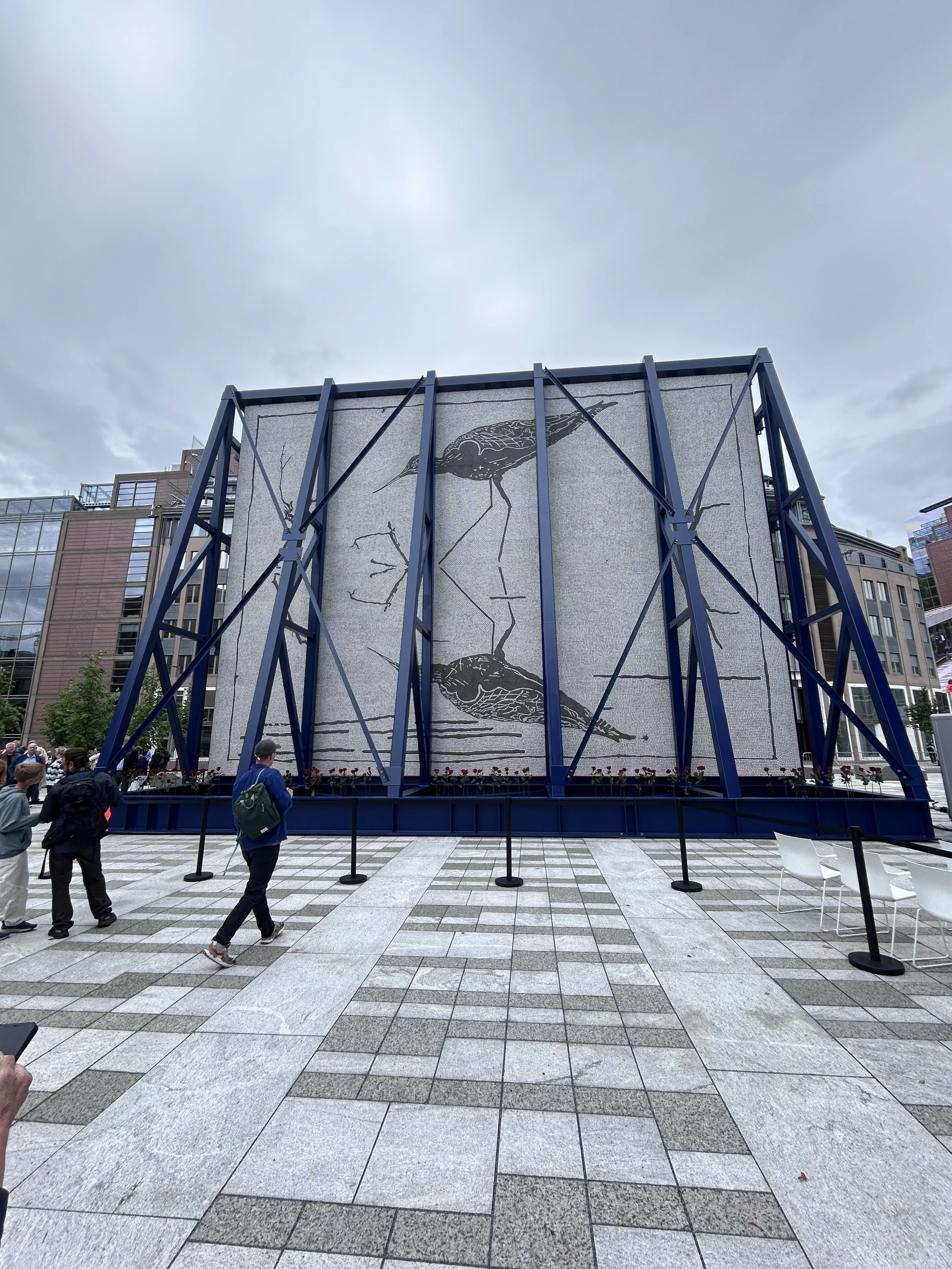
En opprettholdelse / Upholdong (2026), Matias Faldbakken. Photo by Niklas Hart / KORO.
Afterimage by Nina Strand:
And then, there it is. Fifteen years after the terrorist attacks in Oslo and on Utøya: Upholding, the national memorial for July 22. A towering steel structure as a protest against forgetting.
Those who live in Oslo will likely remember the large steel rig built to preserve Pablo Picasso's The Fishermen from the demolished Y-block. This inspired the artist, who filled this new structure with a mosaic work whose motif is from the island of Utøya. We see a wading bird, a common redshank typical of the area around the island, and some reeds and twigs reflected in the water. The other side of the sculpture is painted in the same red as Utøya's speakers' platform, can function as an open wound
The rig itself refers to what happened in the government quarter, and the motif to what happened on Utøya; the work thus becomes a bridge between the two horrific events. In the description of the work, the artist states that the rig that protected Picasso's work ‘appeared as an essential object from the transitional phase between the old and new government quarter, and further, a Norway before and after the attack.’
The placement is also significant: when standing in front of the mosaic, one looks towards Utøya, with only a couple of degrees' deviation. According to the artist, the mosaic functions in this way both as a window and as a screen, echoing Vilém Flusser: ‘The image is a screen which hides what it means.’
Co-creating the work with survivors and the bereaved underscored its inclusive dimension. Many were invited to place the mosaic together with the artist, among them teenagers who were not yet born when the terrorist acts took place. As one of them put it, we are the future, and it is important that we know what we want to do with it.
Afterimage is an ekphrastic series exploring that one image you see when you close your eyes—the one that lingers in your mind. We invite different people to reflect on an image they can't shake. The column began during our time publishing the journal Objektiv and continues today under Objektiv Press.
RUTH ANDERWALD ON ALEC SOTH
There are several elements that I connect to this image. One is that with all the problems that we have in the world right now, constantly in our minds when opening (or not opening) the newspapers, we are perpetually aware of a certain pressure level that exists. And the way I think about it, and the way I connect this image to it, is that we only have each other as humanity. This is it. We have only us, and we need to connect with each other. That's our only way of managing, of moving on, of creating. Connected to that is a kind of wonderment: how have we survived as humanity for so long without having created a sustainable way of coexistence? I mean, how did we even manage to end up here? It's crazy. I see a lot of these things in that couple on the ice sheet, also connected to climate change.
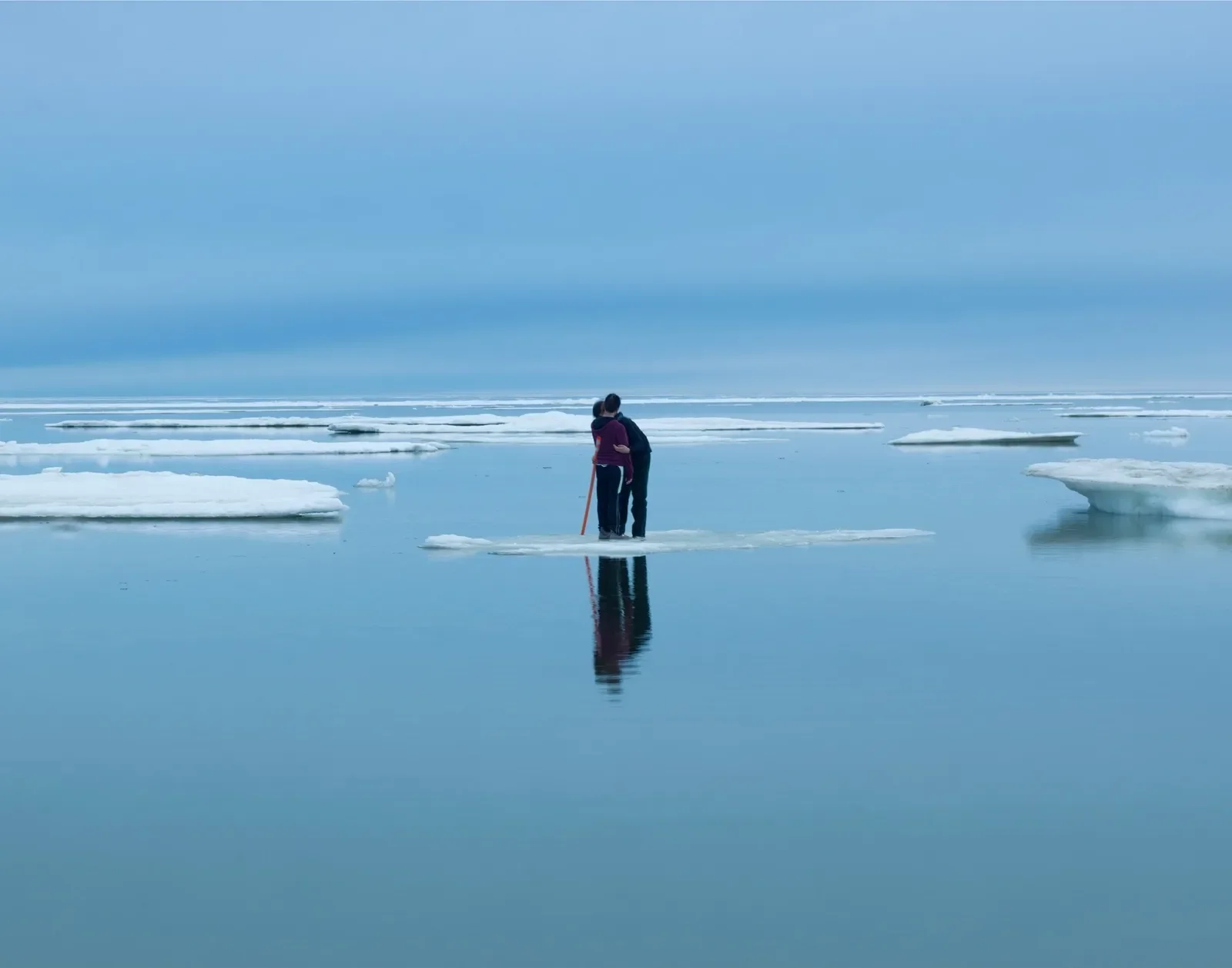
Alec Soth, A couple off of Nome's beachfront, Alaska, 2015.
Afterimage by Ruth Anderwald:
What is the image that is always at the back of my mind, on the inside of my eyelids? When thinking about this, I realised that my thinking in images puts them in relation to each other, and that my afterimage is somehow overlaid imagery. When I tried digging deeper, I realized the image that I'm yearning for is one that I have to make — my next project. It's been a really interesting self-discovery journey, this task of thinking about an afterimage.
Nevertheless, I will propose an image that exists, made by a really well-known photographer. It is Alec Soth's A Couple off Nome's Beachfront, Alaska, from 2015. You see a couple standing on a small piece of ice; one of them has crutches, and they hug each other. There is only this — the ice, the couple, and the blue sea.
There are several elements that I connect to in this image. One is that, with all the problems that we have in the world right now, constantly on our minds whenever we open (or don't open) the newspapers, we are perpetually aware of a certain level of pressure that exists. And the way I think about it, and the way I connect this image to it, is that we only have each other as humanity. This is it. We have only us, and we need to connect with each other. That's our only way of managing, of moving on, of creating. Connected to that is a kind of wonderment: how have we survived as humanity for so long without creating a sustainable way of coexisting? I mean, how did we even manage to end up here? It's crazy. I see a lot of these things in that couple on the ice sheet, also in connection with climate change.
And then I think what stands out is that this is a part of Alaska that was part of the gold rush of the early 20th century, taken away from Indigenous people — erasing their culture and values, or at least trying to. So, a lot of things come together in this image.
My thinking has revolved a lot around coexistence lately, and what art and artistic thinking can teach us — also artistic practice and photographic practice. There are performative aspects to photography. One is the bodily presence of the photographer and the subjects: how their presence is impressed upon the photographer and vice versa. The presence of a camera changes the setting and allows for different things to emerge. And then, of course, photography makes things visible and is therefore used a lot in activism, making visible things that would otherwise remain hidden. I think there is a lot in the medium of photography, but also in the way that we as artists manage to survive — building relationships, grasping opportunities, and trying to build up not only careers for ourselves, because this wouldn't work alone; we also create networks to sustain each other and deal with things together.
This is the performativity that art has. It can nudge you to think differently, to engage, to act. In Austria, the climate of discussion is so heated right now that even people who agree on a lot of things don't talk to each other anymore. I think we should have more burning questions to raise and more pressing challenges to address than to stop speaking to a person because they might see certain things differently. It's so strange. Each other is all we have.
Afterimage is an ekphrastic series exploring that one image you see when you close your eyes—the one that lingers in your mind. We invite different people to reflect on an image they can't shake. The column began during our time publishing the journal Objektiv and continues today under Objektiv Press.
YUE CHEN ON GERTRUDE KÄSEBIER
I have always liked the idea of photography as a way of lending private eyes and feelings to every moment. This is not because the content or subject being photographed is hard to access, but because a photographer, guided by a genuine feeling for the moment, can render their subject with a rare dignity and tenderness that would otherwise be unseen—especially across time.
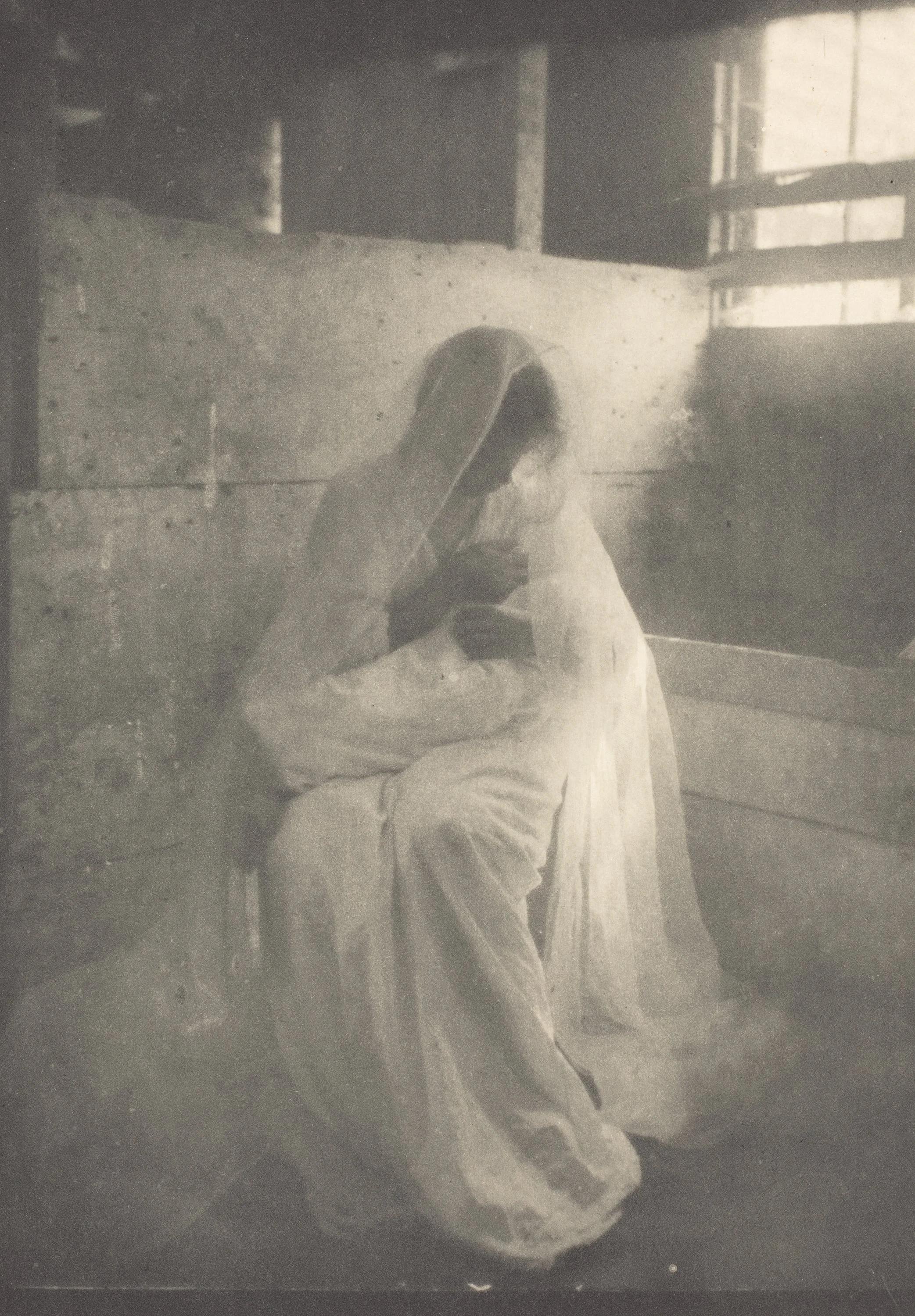
Gertrude Käsebier, The Manger, circa 1900.
Afterimage by Yue Chen:
I have always liked the idea of photography as a way of lending private eyes and feelings to every moment. This because a photographer, guided by a genuine feeling for the moment, can render their subject with a rare dignity and tenderness that would otherwise be unseen, especially across time.
Lately, I am beginning to feel a deep urge to genuinely attend every moment I choose, and to consciously infuse my care into the people and things I hold dear. Attuning oneself to these fleeting instances feels like a deeply photographic act. The moments we live for, or survive on, have a way of staying with us if we just pay closer attention to how they feel in real time. It is a way to hold them close so that they become permanent architecture within us, like rocks standing firm in a river, keeping us from being swept away.
I recently came across this photograph again while looking at Camera Work and felt its grounding power. It is a photograph made by Gertrud Käsebier, a leading Pictorialist and a key figure in the Photo-Secession, a fin-de-siècle movement organized by Alfred Stieglitz to establish photography as an art form on par with painting, with ambitions spanning both Europe and America. Titled The Manger, the photograph references the widely known Nativity scene of Mary wrapping Jesus in swaddling clothes and placing him in a manger. However, the compelling nature of the image lies in its indexicality, a quality unique to photography that distinguishes it from painting. The very fact that real people served as models for these holy figures made the scene take on a palpable, lifelike presence.
To the viewer with no prior knowledge of its art-historical context, the picture strips back to the most fundamental act behind the camera: under the beautiful light, a woman in a white gown holding a baby in a rustic barn-like environment. A sense of mystery pervades the image. One cannot quite discern the features of the woman, whose side profile is softened by a haze-like blur. Yet, one can feel her strong presence in the picture and her attentiveness to the baby, an intimacy that seems to shut out the rest of the world, oblivious to everything around her. And to me, that is the very presentation of maternal love. That is what makes the picture touching. It is not about a relationship re-enacted for the camera, but real relationships as they exist in the world. And you can sense that it is about motherhood without being told. The image hinges on a chain of attentive gazes: from the photographer to her subject, and from the mother to her child. It derives from the knowledge of motherhood that comes from the photographer, being a mother of three.
By 1899, this was the most ever paid for a photograph. It certainly was related to its religious motif and photography being the new art form, but also all of the above. Her promotion of photography as a viable career for women stemmed directly from her dedication to her own values. I looked into her biography and envisioned what it was possibly like for her, how she was standing in a slightly different position from the Photo-Secession movement as it developed and wanted to make different pictures for her family. Sometimes you will encounter this photograph flipped in both directions on the internet, or see it through varied digital scans of prints that have been preserved to different levels. The various states of the photograph make even clearer what makes it truly valuable: it is the touch of love that anchors it against time.
Afterimage is an ekphrastic series exploring that one image you see when you close your eyes—the one that lingers in your mind. We invite different people to reflect on an image they can't shake. The column began during our time publishing the journal Objektiv and continues today under Objektiv Press.
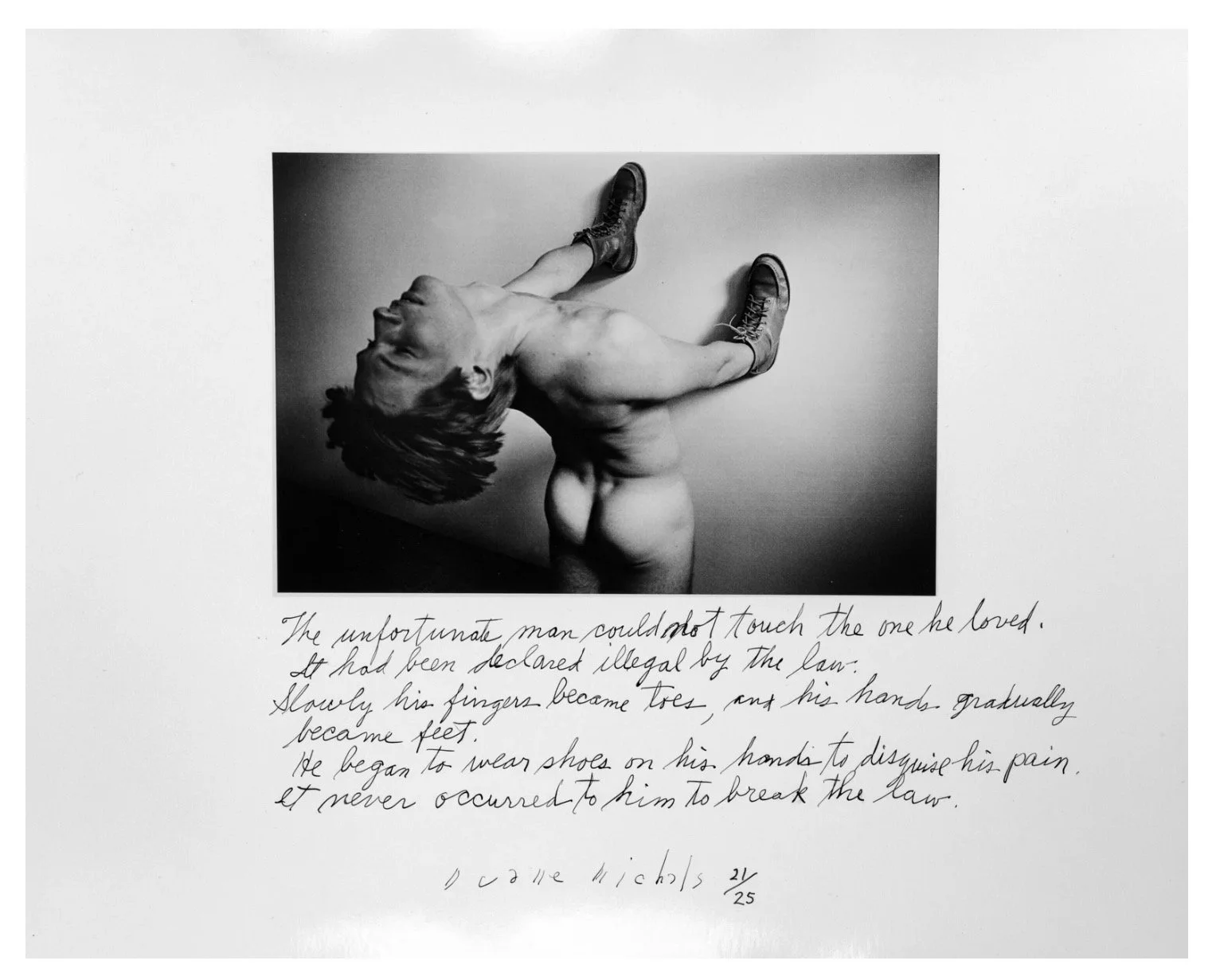
DUANE MICHALS
Michals said he didn’t pay much attention to photography as a field, feeling peripheral to PHOTOGRAPHY. However, because he loves the medium, he remains thoughtful and critical about its possibilities and limitations. He has always enjoyed literature and poetry, in some ways more than photography, because writing conjures up an imaginary universe that you share with the writer and help create. Photography is defined by the facts it represents. ‘It doesn’t float in the air the way poetry does.’ De Chirico and Magritte are both poetic painters who play with facts, yet contradict them with mystery, in his opinion.
Afterimage-interview by Nina Strand:
It was inspiring to learn, when interviewing Michals in 2016, that he, at the age of 83, had made his first films. These were created for his exhibition Sequences & Talking Pictures at DC Moore Gallery in New York, which featured a number of his short films, or ‘mini-movies’ as Michals called them. The show also included posters for the films and several of his earlier picture sequences from the 1960s and 1970s.
‘A new illiteracy of images is being born,’ he said, ‘and this is the result of the illiteracy of a culture with pretend language and pretend emotions. The images people are being presented with don’t demand much.´ Donald Trump is the reductio ad absurdum of one-line-insult intellectual discourse. Trump is the ultimate destination of the trivialisation of language and meaning.
He said he didn’t pay much attention to photography as a field, feeling peripheral to PHOTOGRAPHY. However, because he loves the medium, he remains thoughtful and critical about its possibilities and limitations. He has always enjoyed literature and poetry, in some ways more than photography, because writing conjures up an imaginary universe that you share with the writer and help create. Photography is defined by the facts it represents. ‘It doesn’t float in the air the way poetry does.’ De Chirico and Magritte are both poetic painters who play with facts, yet contradict them with mystery, in his opinion.
Years ago, he saw a photograph of a young man on crutches. His leg was in a cast, he had no shirt on, and he was standing at home, leaning in a doorway. Michals was deeply moved by his vulnerability, his future possibilities as a man, and his fragility. Although he has never specifically copied this image, it has crept into his work as part of how he perceives life.
Perhaps some of this can be seen in his work The Unfortunate Man, which is currently included in the exhibition Fragile beauté. Photographies de la collection de Sir Elton John et David Furnish, at Jeu de Paume, along with other works by Michals.
Interview with Duane Michals published in the essaybook Perpetual Photographs, 2020.
DIM REVELATIONS BY TORBJØRN RØDLAND
03/04
Blanket pins might offer a temporary fix for a torn sun lounger. I drive down to Koontz Hardware in West Hollywood to find some. Passing the store’s kitchen department on my way out, an oversized avocado in glazed ceramics makes me stop and stare. That … guacamole bowl is too interesting to leave behind. Don’t ask me why. This is not a time for reflection.
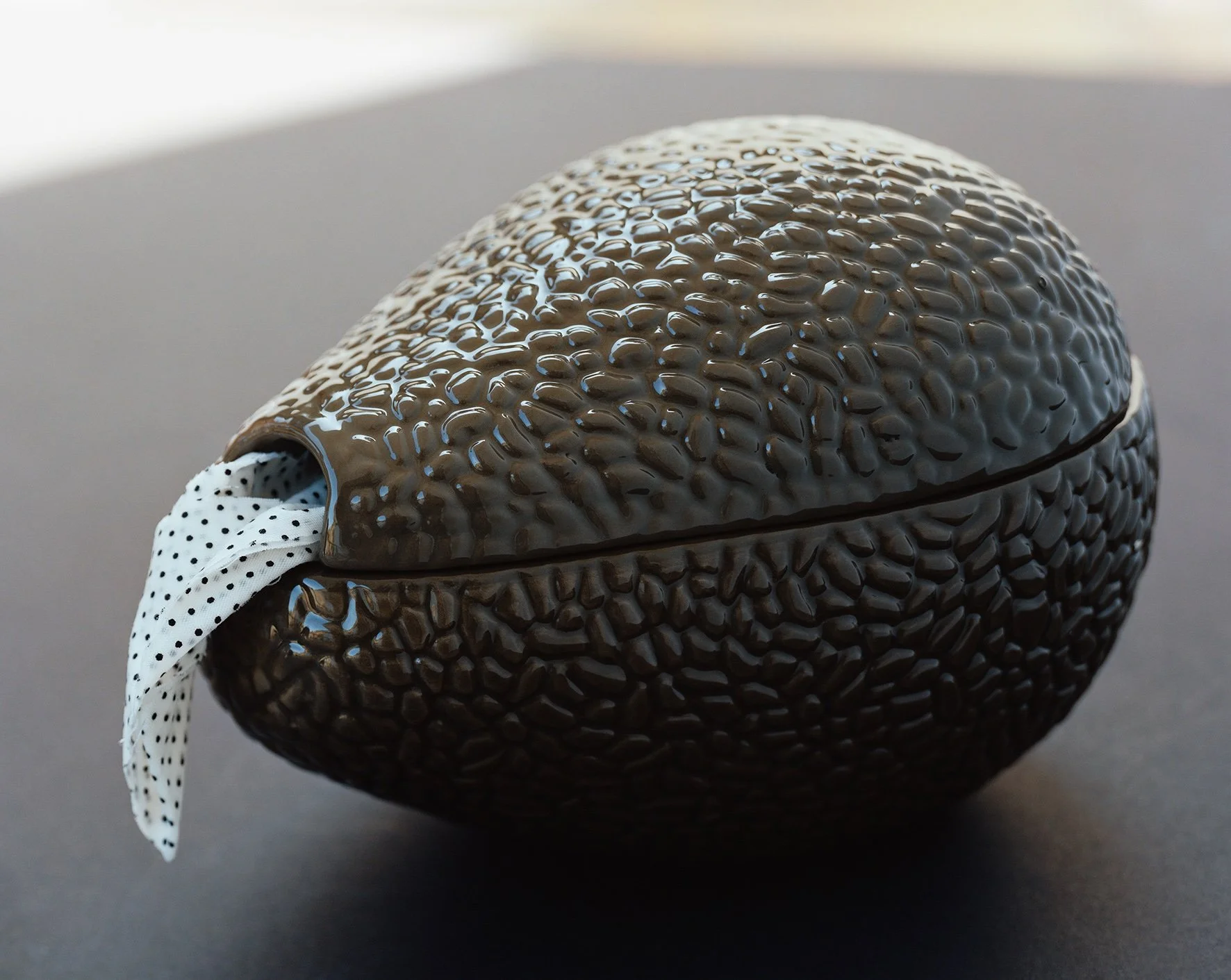
Torbjørn Rødland, Avocado, 2013.
03/04
Blanket pins might offer a temporary fix for a torn sun lounger. I drive down to Koontz Hardware in West Hollywood to find some. Passing the store’s kitchen department on my way out, an oversized avocado in glazed ceramics makes me stop and stare. That … guacamole bowl is too interesting to leave behind. Don’t ask me why. This is not a time for reflection.
There’s still a bit of direct light on the terrace when I get home. The sun lounger can wait. I chase the light calmly, exposing three color negatives while 1987 Sodom plays from iTunes inside the house. I photograph the dark avocado discharging a dotted, white fabric through its spoon hole. Then I unload the film holders, get back into the car, and drive to the Icon lab.
We are delighted to announce the launch of our new title with Torbjørn Rødland with this excerpt. Dim Revelations offers a rare and generous insight into the work of one of today's most renowned lens-based artists. Like his photographic practice, this illustrated diary operates on multiple levels — internalizing a variety of genres and voices, including theory, aphorism, criticism, poetry, and the occasional spilling of tea. Rødland has not kept a journal before or since 2013. Order your copy here.
DIM REVELATIONS BY TORBJØRN RØDLAND
Dim Revelations by Torbjørn Rødland offers a rare and generous insight into the work of one of today's most renowned lens-based artists. Like his photographic practice, this illustrated diary operates on multiple levels — internalizing a variety of genres and voices, including theory, aphorism, criticism, poetry, and the occasional spilling of tea. Rødland has not kept a journal before or since 2013. Rødland will be signing at Librairie Yvon Lambert on June 10th, from 5 to 7 pm.
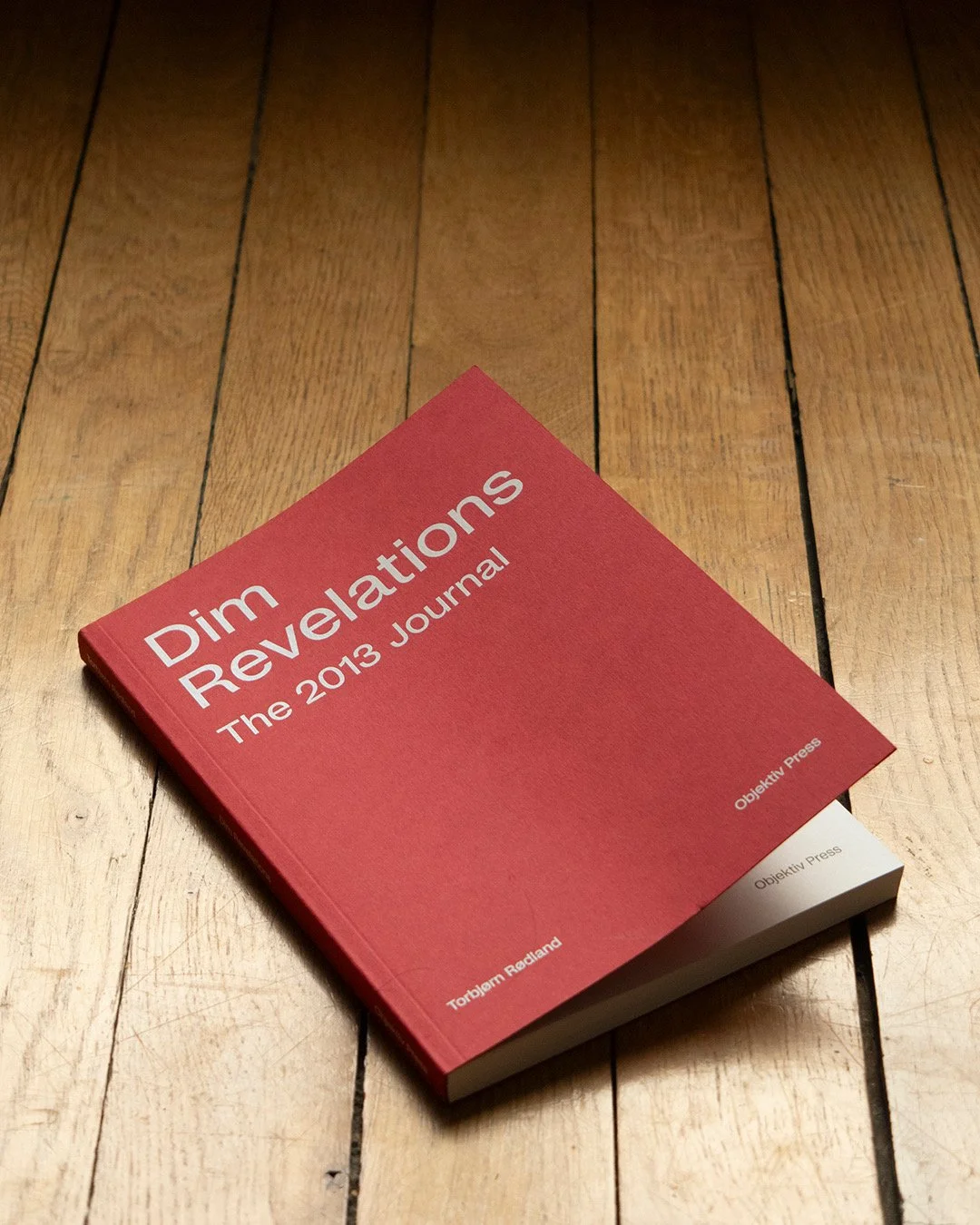
Photo of the book by Rødland.
04/23
The temperamental relationships between successful gallerists and their artists seem to have undergone a reversal. The erratic painter is now an anomaly. Young artists everywhere are patiently waiting for their dealers to straighten up, calm down, write back and keep their promises.
04/24
Any concern too small to be turned into a photograph is too small to be made into a burden.
04/26
I think I’m violating the portrait image. They think I’m violating the portrayed person.
04/27
Words, words, words. The unconscious cannot speak and is therefore more comfortable with photography.
We are delighted to announce the launch of our new title with Torbjørn Rødland with this excerpt. Dim Revelations offers a rare and generous insight into the work of one of today's most renowned lens-based artists. Like his photographic practice, this illustrated diary operates on multiple levels — internalizing a variety of genres and voices, including theory, aphorism, criticism, poetry, and the occasional spilling of tea. Rødland has not kept a journal before or since 2013. Order your copy here.
VALIE EXPORT
The body as a sign was for me a tool of negation and affirmation at the same time. In the Body Configurations series for example, I was interested in placing the body in relation to power, to architecture, to the monument. Architecture is a language of power: it speaks through urban space, it shapes us, it conditions us. These works were born precisely from this relationship between body, space, ideology and language.
Nature too is culture. Architecture often comes from natural materials: stone, earth. Where does nature end and civilization begin? The body configurations show how these spaces — urban or natural — shape us, even when we believe we are free. The restrictions we often carry within ourselves.
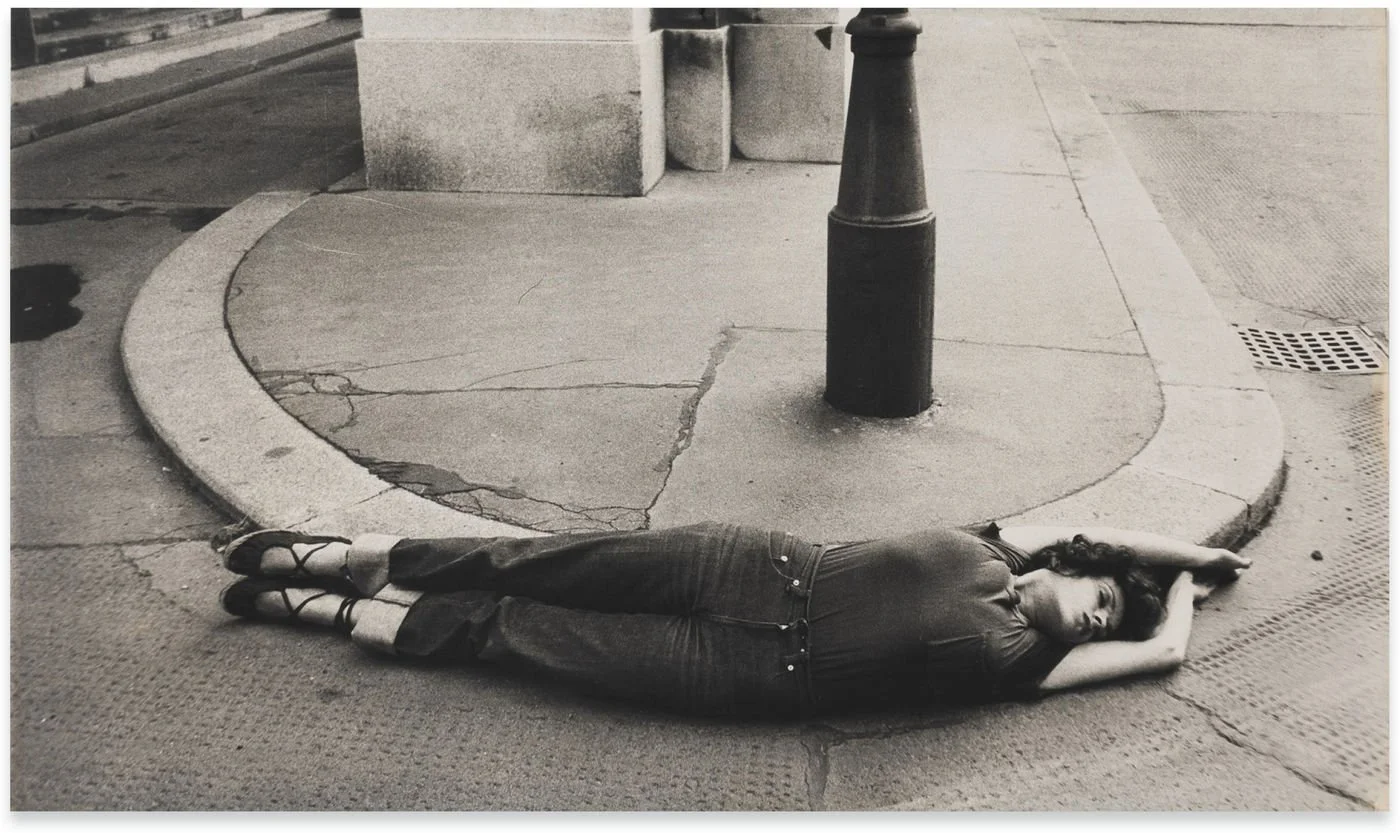
VALIE EXPORT, Einkreisung, 1976/1980. Courtesy the artist/Thaddaeus Ropac.
An Afterimage homage to VALIE EXPORT:
The body as a sign was for me a tool of negation and affirmation at the same time. In the Body Configurations series for example, I was interested in placing the body in relation to power, to architecture, to the monument. Architecture is a language of power: it speaks through urban space, it shapes us, it conditions us. These works were born precisely from this relationship between body, space, ideology and language.
Nature too is culture. Architecture often comes from natural materials: stone, earth. Where does nature end and civilization begin? The body configurations show how these spaces — urban or natural — shape us, even when we believe we are free. The restrictions we often carry within ourselves.
The relationship with media has always been central to my work. From the very beginning it was clear to me that the subject would become increasingly mediated, technologically extended. Body, politics, technology are inseparable. What we now call biopolitics was already present. My work tries to make this condition visible, to think it critically, to inhabit it without being subjected to it.
- Taken from an interview with EXPORT by Bartolomeo Pietromarchi, featured in Il Giornale dell’Arte, 2026